On the surface, agrivoltaics sounds almost too good to be true: solar panels and farming sharing the same land, with crops thriving in partial shade while clean electricity hums overhead. But the simple image belies a more complex reality—one where the specifics of climate, crop choice, and design configuration determine whether this dual-use approach actually works or becomes mere greenwashing.
The concept itself is gaining real traction. In hot, dry conditions especially, field trials have shown that shade from elevated solar panels can reduce water stress, lower evaporation, and cool the surrounding microclimate enough to boost both crop yields and solar panel efficiency. This is not theoretical. Yet agrivoltaics encompasses a sprawling family of distinct land-use systems—vegetables grown under elevated panels, sheep grazing beneath utility-scale arrays, pollinator habitats sown around solar rows, panels hovering over fish ponds, semi-transparent photovoltaic glass on greenhouses, and orchards sheltered under solar canopies. Each has different economics, different agricultural outcomes, and different ecological trade-offs. Comparing them as interchangeable obscures rather than clarifies what works where.
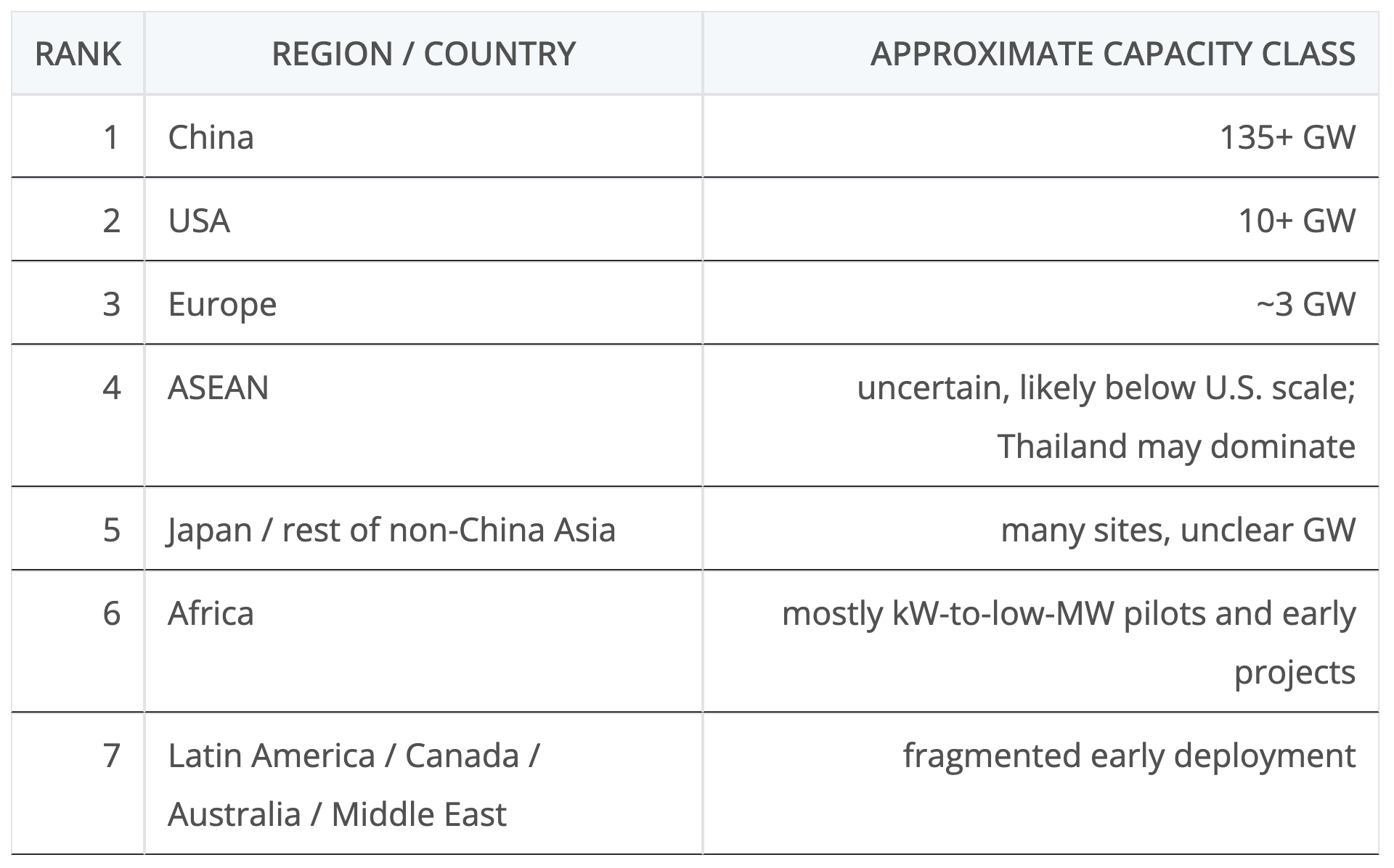
The global deployment picture reveals sharp regional differences. China leads by a commanding margin. A 2026 study in Scientific Data identified 1,678 agrivoltaic projects across China totaling 134.55 gigawatts of capacity by the end of 2022. That figure draws from a broad definition spanning crop-based, fishery-based, greenhouse, and livestock co-use systems. The United States, by contrast, had accumulated roughly 10 gigawatts of agrivoltaic capacity by November 2024 according to the National Renewable Energy Laboratory's tracking—nearly 600 sites covering about 60,000 acres. While meaningful, this is less than one-tenth of China's reported capacity from two years prior, and the American portfolio leans heavily toward sheep grazing, pollinator management, and vegetation control rather than purpose-built elevated structures for crop production.
Europe occupies middle ground both in scale and approach. More than 200 projects across France, Germany, Italy, Spain, and the Netherlands had exceeded 2.8 gigawatts as of 2024, according to SolarPower Europe's agrisolar map. But European countries are grappling with a harder question than simply how much capacity to build: what counts as legitimate agrivoltaics? Permitting rules, agricultural definitions, subsidy eligibility, and performance standards remain inconsistent across borders.
Japan offers a cautionary note. With thousands of solar-sharing installations and decades of experience farming under panels, the country discovered that agrivoltaics could devolve into "paper agriculture"—projects that look compliant on paper but fail to produce meaningful crops or are poorly managed. This realization led to stricter requirements around cultivation plans, monitoring, and actual agricultural output. If the farming becomes ornamental, the public interest argument collapses.
The lesson emerging from these varied experiences is that agrivoltaics can work, but only when the system matches the place. Climate matters. Crop choice matters. Design details matter. The promise is real—especially in water-stressed regions where shade offers genuine agronomic benefit—but it requires moving beyond social media simplicity toward the careful, location-specific engineering that characterizes successful dual-use land systems.