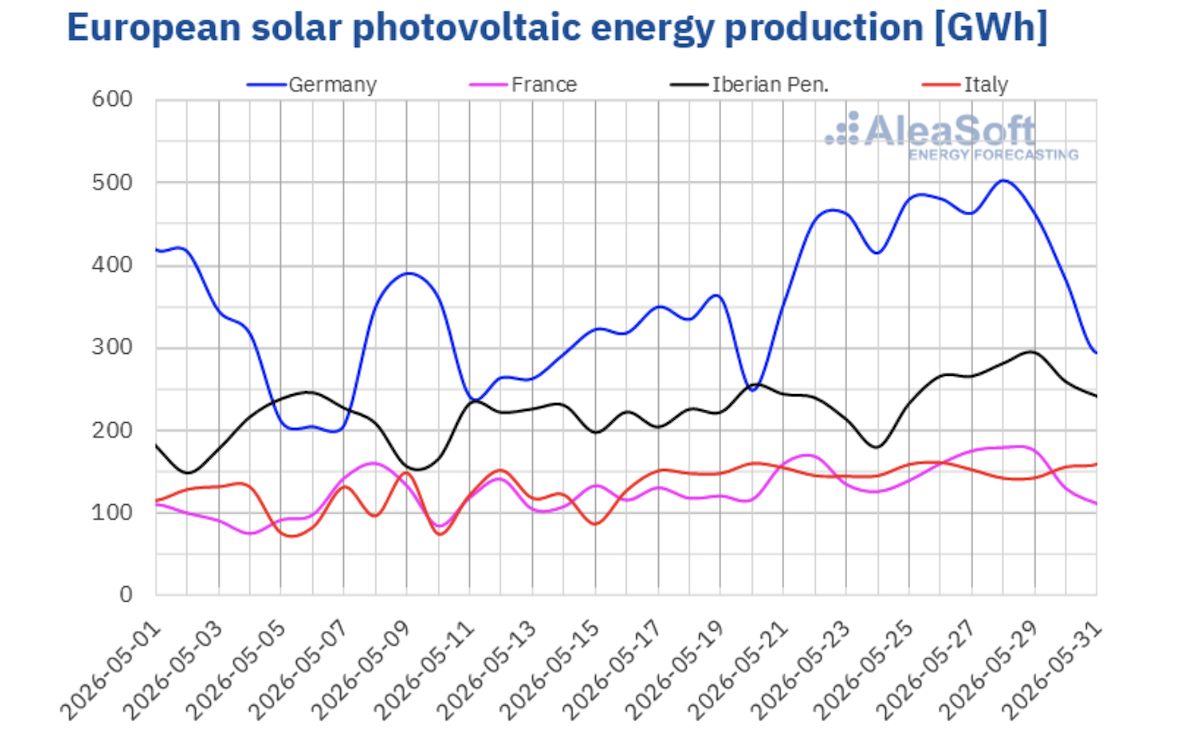
On May 28, Germany's solar panels soaked up the lengthening spring sun and delivered 503 gigawatt-hours of electricity in a single day—the country's new record. Within days, Spain, France, Italy, and Portugal joined in the milestone spree, each breaking their own daily solar generation records as the Northern Hemisphere tilted toward summer and the days grew longer. These five nations didn't just inch past their previous benchmarks; they shattered them in what energy analysts are calling another record-breaking week for European solar power.
The scale of this renewable surge matters because it reveals how quickly solar energy is transforming Europe's electricity grid. When five major industrial nations simultaneously hit new production peaks, it's no longer a novelty—it's the new normal. According to AleaSoft Energy Forecasting, Spain generated 265 GWh on May 29, France produced 179 GWh on May 28, Italy hit 161 GWh on May 26, and Portugal reached 32 GWh on May 29. These weren't isolated achievements. PV Magazine noted that France, Germany, Italy, and Portugal had already set new solar records just the week prior, suggesting this surge represents a genuine shift in Europe's renewable capacity rather than a one-off spike.
The economic ripple effects were immediate and telling. Across Belgium, Britain, the Netherlands, Germany, and Nordic markets, wholesale electricity prices dropped in the week following this solar surge. The reason is straightforward: when massive amounts of free solar energy flood the grid, the marginal cost of electricity plummets. This is precisely the kind of price-suppressing effect that renewable energy advocates have long promised—and it's now playing out in real markets with real numbers.
The picture wasn't uniformly rosy everywhere, though. Despite their record solar production, France, Portugal, Spain, and Italy all saw their average weekly electricity prices actually increase. The culprit? A simultaneous drop in wind energy production, combined with higher electricity demand. This constraint reveals an important truth about Europe's renewable transition: solar and wind are complementary but unpredictable partners. When both are generating at high volumes simultaneously, the grid gets the best of both worlds and prices fall sharply. But when one resource drops, it can erase the gains from the other.
This interplay highlights why Europe's energy future likely depends less on betting everything on a single renewable source and more on building resilient systems that can harness multiple clean sources simultaneously. The continent is clearly making progress on that front. That Germany alone can now generate over half a terawatt-hour of solar electricity in a day—something unimaginable just a decade ago—demonstrates how far solar technology has advanced in both efficiency and deployment.
As summer approaches and days continue to lengthen, these records may well fall again. The trend is unmistakable: solar generation in Europe isn't just growing; it's accelerating. For anyone watching the global energy transition, these quiet records being broken across five nations in a single week offer a glimpse of where the future is heading—toward cleaner, cheaper electricity powered by the sun.