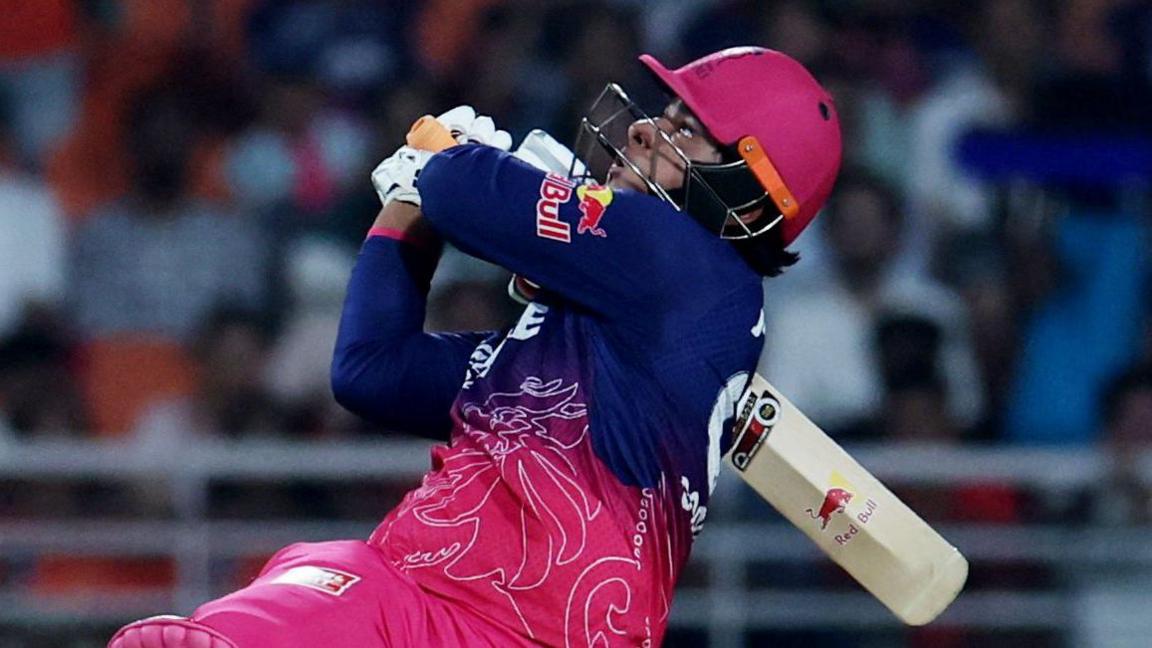
In the eighth over of an Indian Premier League eliminator in Hyderabad, 15-year-old Vaibhav Sooryavanshi was caught at deep third attempting an upper cut—and in that single moment, a record slipped away. He had just struck 97 runs from 29 balls, a cascade of 12 sixes that had left Sunrisers Hyderabad reeling and the crowd on their feet. One more delivery, and he would have broken Chris Gayle's record for the fastest IPL century. Instead, he became something else entirely: a reminder that cricket's future is arriving faster than anyone expected.
Sooryavanshi's innings matters because it rewrites how we understand what's possible at the sport's highest professional level. The Indian Premier League, the world's premier Twenty20 cricket tournament, attracts the game's most explosive hitters and sharpest bowlers. It's where careers are made and reputations tested. For a teenager still in school to walk onto that stage and produce numbers that rank among the tournament's most dominant performances is not merely noteworthy—it signals a generational shift.
The specifics of his batting are staggering. He reached 50 runs in just 16 balls, then continued his onslaught without mercy. Three consecutive sixes came off Pat Cummins, the Australian captain and one of world cricket's most respected fast bowlers. His seventh six, hit in only the fourth over, shattered the IPL's single-season sixes record, eclipsing the 59 hit by Chris Gayle, the legendary West Indian whose power batting defined modern cricket. Sooryavanshi's 12 sixes on this one afternoon alone speak to a player operating at an extraordinary tempo—not just scoring runs, but dismantling the conventional limits of what bowlers can defend.
What makes this performance even more striking is its context. Sooryavanshi was batting alongside Yashasvi Jaiswal, already an India international across all formats, who was himself playing well on 25 from 20 balls. Yet Sooryavanshi's innings outshone his senior partner so completely that Jaiswal became almost a footnote. Rajasthan Royals had raced to 125 for one loss after eight overs, a launch pad that seemed destined to produce a towering total. Even India legend Sunil Gavaskar, commentating on the match, could only express wonder: "What an innings. What a player. That is an innings to remember. An innings to savour."
The dismissal itself carried a touch of poignancy. Sooryavanshi looked crestfallen in the middle, aware that one more boundary would have etched his name into the record books in an entirely different way. But Sunrisers Hyderabad's fielding unit—and Cummins's captaincy—had kept just enough discipline to claim his wicket. Even then, his opponents and the crowd acknowledged what they had witnessed. He received congratulations from opposing players and a standing ovation from the stands.
The broader impact extended beyond the individual innings. Sooryavanshi's performance lifted him to the top of this year's IPL run-scorers' list, a position typically held by seasoned professionals with years of tournament experience. It confirmed what his previous performances had hinted at: this is not a flash in the pan, but a player whose growth trajectory is genuinely exceptional. Rajasthan Royals ultimately finished with 243 for eight, a competitive total that proved the foundation he laid remained valuable even after his departure. For young cricketers watching from across India and beyond, Sooryavanshi's evening in Hyderabad offers something priceless: proof that excellence at the highest level is not reserved for the fully grown.