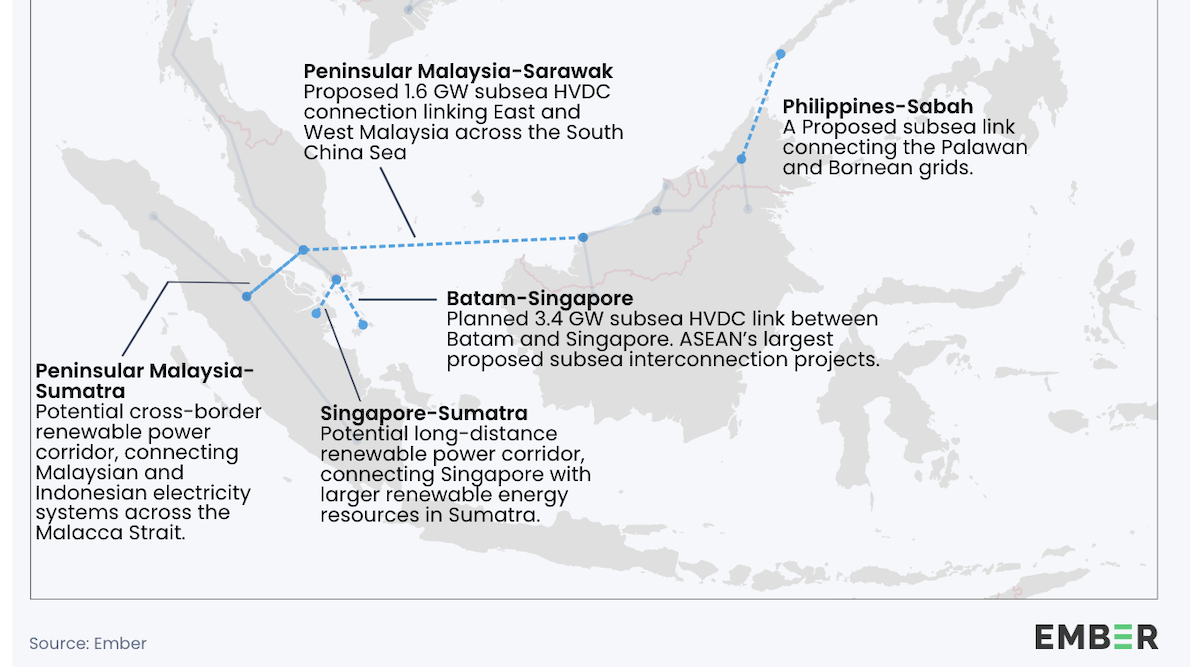
When the lights flicker on in Manila, they might one day be powered by solar farms in central Thailand or wind turbines off the coast of Vietnam—linked not by smokestacks and fuel tankers, but by a network of subsea power cables weaving beneath the South China Sea. By 2040, Southeast Asia could host five major subsea interconnector projects, part of a broader vision to more than double the region’s cross-border electricity capacity from 7.7 gigawatts today. The technology is ready. What’s missing isn’t engineering—it’s governance.
The ASEAN Interconnection Masterplan Study III has already mapped out 18 critical interconnectors needed to unlock cleaner, cheaper, and more resilient energy across the region. Countries like Indonesia and the Philippines, made up of thousands of islands, already rely on subsea cables for domestic power stability. Now, the ambition is regional: to transform Southeast Asia’s fragmented grids into a unified, low-carbon energy market. But as Ember’s new analysis shows, the real bottleneck isn’t cables or currents—it’s coordination.
"The challenge of cross-border subsea interconnection in ASEAN is increasingly institutional rather than purely technical," says Alnie Demoral, Energy Analyst at Ember. And the stakes are high. With renewable resources scattered unevenly—hydropower in the Mekong, solar surging in Vietnam, offshore wind emerging in the Philippines—subsea links offer a way to balance supply and demand across borders. Europe’s submarine network, with about 22,290 megawatts of capacity across 25 interconnectors by 2025, already generates up to €500 million in annual value through energy trading and grid services. Southeast Asia could replicate that success—if it gets the governance right.
Three key gaps stand in the way. First, regional planning needs to evolve from vision to action, with clear processes to prioritize which projects deliver the most regional benefit. Second, cost-sharing remains a hurdle: without a common framework, countries must negotiate each project individually, slowing progress. The proposed Brunei Darussalam-Indonesia-Malaysia-Philippines Power Integration Project, for example, could face years of delays without agreed-upon rules for who pays and who gains. Third, subsea cables don’t just carry electricity—they cross maritime zones, fishing grounds, and shipping lanes, requiring coordination across energy, environmental, and ocean authorities.
The solution? Strengthen the ASEAN Power Grid’s planning function, establish a dedicated submarine cable working group, and build shared methodologies for cost-benefit analysis. Europe didn’t get it right overnight; its systems grew through decades of adaptation. But it had institutions that learned, adjusted, and endured. As ASEAN moves forward, the lesson is clear: the most powerful current running beneath the sea may be the one we can’t see—cooperation.