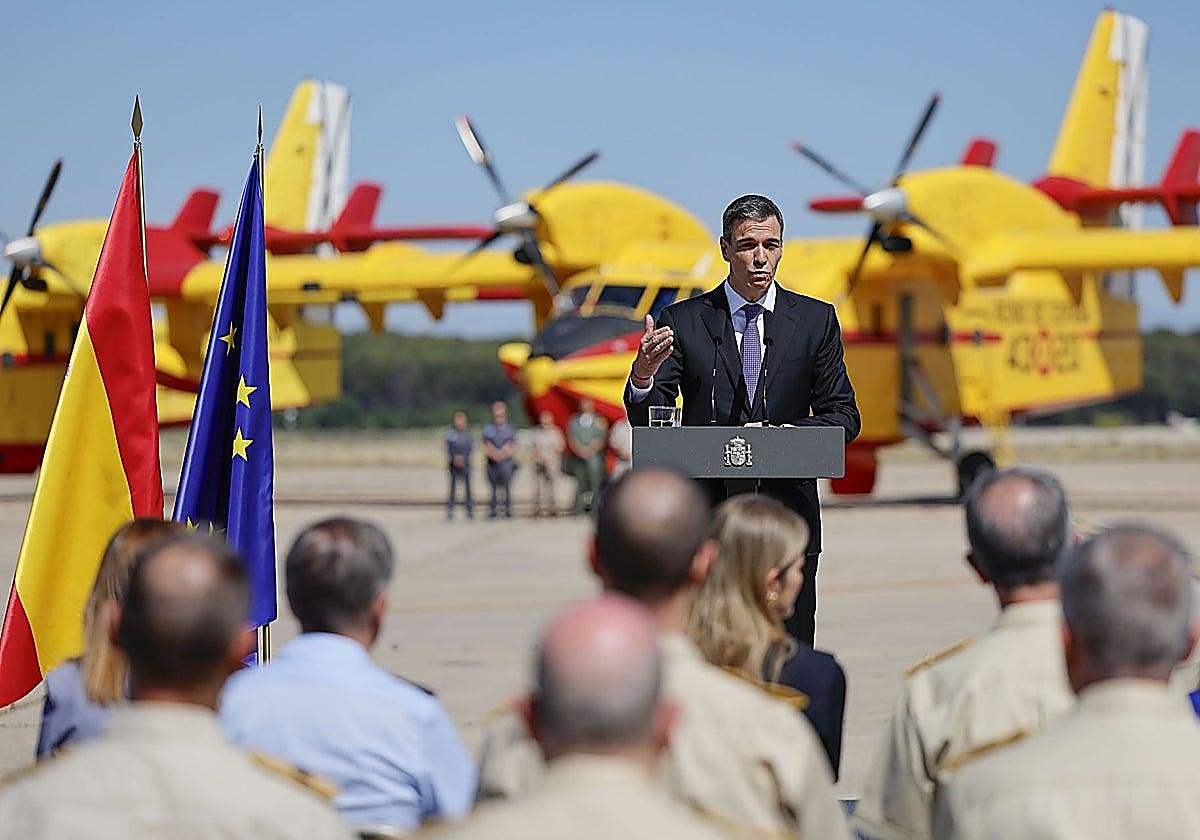
At the Torrejón de Ardoz airbase, Prime Minister Pedro Sánchez unveiled an operation unprecedented in Spanish history: 70 aircraft, 3,000 police officers, and 2,900 military personnel mobilized across 33 airbases to fight the wildfire emergency that ravaged the country in 2025.
The scale of the deployment reflects a crisis that has become impossible to ignore. Last summer, Spain burned nearly 400,000 hectares of forest—the highest figure recorded since the European Forest Fire Information System began keeping records. Sixty-three "big fires," each consuming at least 500 hectares, tore across the landscape, with 37 of them scorching more than 1,500 hectares each. The devastation claimed four lives, forced 30,000 people to evacuate, and turned August's 16-day heatwave into a furnace that alone consumed 300,000 hectares. The numbers demanded a response that went beyond incremental adjustments.
Spain's answer is the "State Campaign for the Fight against Forest Fires," a multifaceted strategy that treats wildfire suppression not as a seasonal worry but as a national security concern. The high-risk period has been moved forward by 15 days, now beginning on June 1 rather than mid-June. The air fleet includes "Focas" amphibious planes and high-capacity helicopters, all managed by the Ministry for Ecological Transition. On the ground, the Ministry of the Interior has deployed 3,000 personnel from the Guardia Civil and Policia Nacional focused on surveillance and investigation, while the Military Emergencies Unit (UME) contributes 1,400 troops for direct fire-fighting and 1,500 in support roles, along with 500 vehicles.
Yet Sánchez emphasized that hardware alone cannot win this battle. "Institutional loyalty is the most effective weapon against fire," he said, calling for seamless coordination between the central government and Spain's Autonomous Communities. While regional governments hold primary responsibility for fire management, the state is providing this massive reinforcement as a safety net—acknowledging that wildfire respects no administrative boundary.
The strategy extends beyond suppression to prevention and accountability. Advanced technology plays a critical role: drones and the Copernicus satellite system now provide real-time monitoring and rapid mapping of active fire fronts, giving commanders a clearer picture of the threat as it unfolds. Perhaps more significantly, the specialized Seprona unit of the Guardia Civil will intensify investigations to ensure legal consequences follow ignition. With 95 percent of fires caused by human action—whether negligence or intent—enforcement becomes as important as firefighting.
This shift reflects a broader recognition that Spain faces not a temporary problem but a chronic one made worse by climate change. The summer of 2025 was not an anomaly but a preview of what lies ahead if the world continues its current trajectory. By positioning record-breaking resources at 33 airbases and launching the largest emergency operation in its history, Spain is placing a bet that institutional coordination, technological innovation, and human determination can still bend the curve of destruction.
The question now is whether this show of force can hold back a threat becoming "increasingly virulent," in Sánchez's own words. The answer will arrive in summer 2026.