When India's vulture populations suddenly collapsed across the subcontinent in the 1990s, scientists traced the catastrophe to an unexpected culprit: a common anti-inflammatory drug called Diclofenac, used to treat livestock. This detective work sparked a profound shift in India's conservation thinking—and led to the creation of a Species Recovery Programme that treats extinction not as inevitability, but as a solvable biological puzzle.
General habitat protection and national parks have their place, but when a species plummets toward oblivion, it needs something more targeted. The Ministry of Environment, Forest and Climate Change launched this dedicated programme as a sub-component of the Integrated Development of Wildlife Habitats (IDWH), working closely with premier scientific bodies like the Wildlife Institute of India to design and execute recovery plans tailored to each species' unique biological crisis. The need is urgent: rapid industrialization, highway expansion, invasive species, and poaching have triggered localized population collapses that territorial forest management alone cannot address.
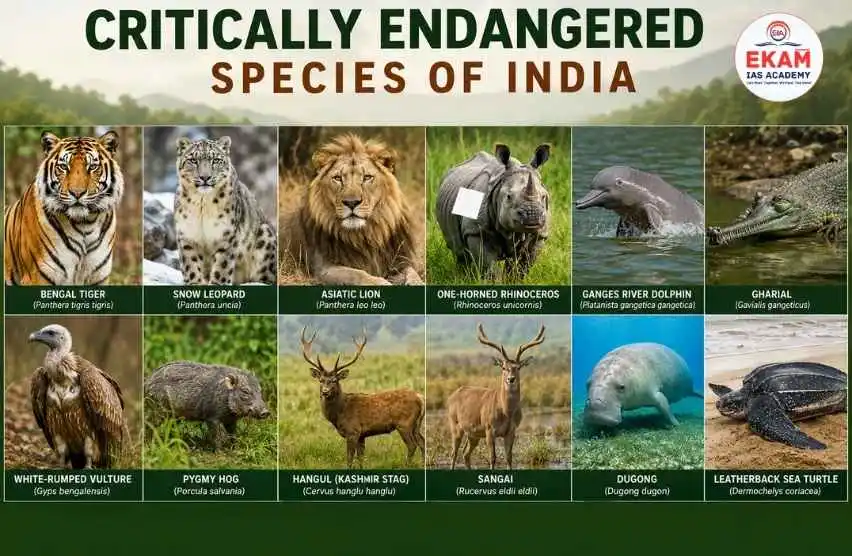
The programme operates through a four-stage conservation framework, focusing on species from India's most vulnerable roster. The list spans an extraordinary diversity—from the Great Indian Bustard and Bengal Florican among birds, to the Hangul (Kashmir Stag) and Sangai (Brow-antlered Deer), the One-horned Rhinoceros, and the world's smallest wild pig, the Pygmy Hog. It includes marine mammals like the Gangetic Dolphin and Dugong, as well as reptiles such as the Gharial and Leatherback Sea Turtle. Each species faces its own ecological nightmare: critically endangered creatures are those with populations reduced by over 90% in a decade, or fewer than 250 mature individuals remaining in the wild.
The vulture story showcases what's possible. After the Diclofenac ban, the government established Vulture Conservation Breeding Centres across the country. The first soft-releases of captive-bred white-rumped vultures back into wild populations represent a rare conservation victory in a world of steady decline. Similarly, the Pygmy Hog—hunted to near extinction—has been brought back through structured captive breeding and reintroduction in Assam's Manas National Park, reclaiming grassland habitats where it hadn't roamed for generations.
But success demands unflinching honesty about the obstacles. When wild populations shrink to just a few dozen animals, genetic diversity collapses; relatives mate with relatives, weakening disease immunity and reproductive capacity. Securing large, undisturbed zones for releasing animals remains brutally difficult as highways, power lines, and agricultural expansion fracture landscapes. The programme operates under the Wild Life (Protection) Act of 1972, which places these species under Schedule I protection and enforces the highest criminal penalties for poaching. It draws long-term funding from the Compensatory Afforestation Fund Management and Planning Authority (CAMPA), anchoring financial support to scientific field research.
What makes this work matter, fundamentally, is that it demonstrates a choice: species decline is not inevitable if we commit the resources and science to reverse it. Preserving India's unique wildlife heritage requires funding research, establishing secure breeding centres, and ensuring local communities share in conservation benefits. The Species Recovery Programme suggests that reversing extinction, once we decide to try, is possible.