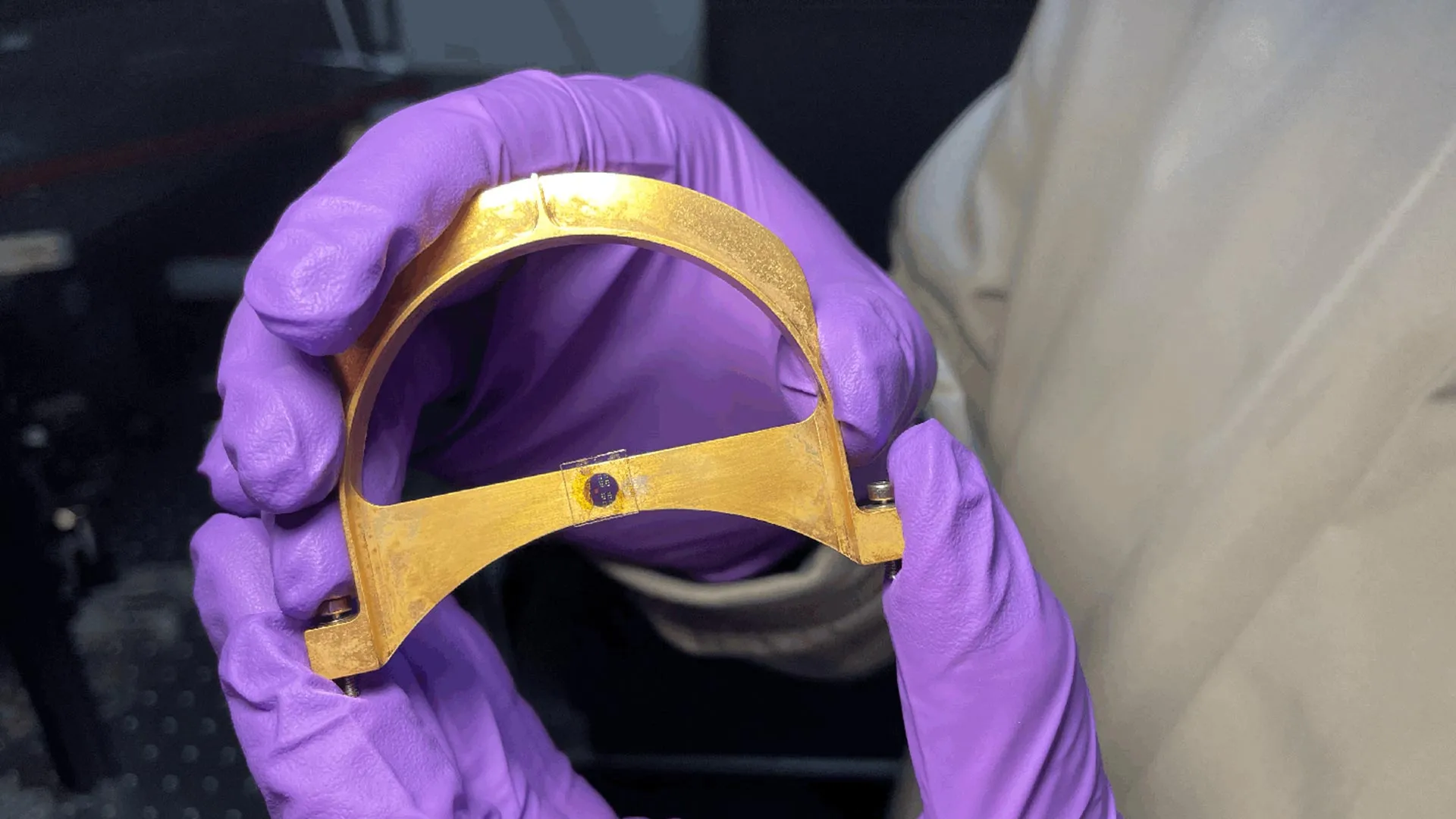
At Stanford University, researchers have cracked a problem that has bedeviled quantum computing for decades: they've built a quantum device that works at room temperature, without the need for the extreme cooling that makes most quantum computers prohibitively expensive to operate and maintain.
The breakthrough hinges on an elegant combination of materials and a counterintuitive approach to manipulating light itself. Most quantum computers today require temperatures near absolute zero—about minus 459 degrees Fahrenheit—to keep quantum states stable enough for computation. This thermal isolation is one of the biggest barriers to widespread quantum technology adoption. Now, a team led by materials science professor Jennifer Dionne has demonstrated that quantum entanglement between photons and electrons can happen at room temperature, opening a path toward smaller, cheaper quantum technologies that could transmit information across long distances.
The device layers a thin material called molybdenum diselenide (MoSe2) onto a nanopatterned silicon substrate. What makes this combination powerful is how the silicon nanostructures generate what researchers call "twisted light"—photons that spin in a corkscrew fashion. These spinning photons can then impart spin onto electrons, the foundation of quantum computing. The nanostructures themselves are impossibly small, about the size of visible light wavelengths and invisible to the naked eye, yet they allow researchers to manipulate photons with remarkable precision.
"The photons spin in a corkscrew fashion, but more importantly, we can use these spinning photons to impart spin on electrons that are the heart of quantum computing," explains Feng Pan, a postdoctoral scholar in Dionne's lab and the paper's first author. The twisted light becomes entangled with electron spins to create qubits—the basic units of quantum information—in a stable, sustained way at ordinary temperatures.
One of the most intractable challenges in quantum computing is a phenomenon called decoherence, in which delicate quantum information degrades and is lost. This happens faster in warmer environments, which is why current systems require extreme cooling. By operating at room temperature, the Stanford device sidesteps this major obstacle. The compact design is also relatively inexpensive and practical compared with many existing quantum systems, potentially lowering barriers to development and deployment.
The researchers selected transition metal dichalcogenides (TMDCs) like molybdenum diselenide because of their unusual quantum characteristics. As Dionne notes, the concept itself isn't entirely novel—what matters is how they're being used. "It provides a very versatile, stable spin connection between electrons and photons that is the theoretical basis of quantum communication," she says. The silicon chip and material work together to efficiently confine and enhance the light's twist, creating strong coupling between photons and electrons that preserves the quantum properties needed for both communication and computing.
The implications extend well beyond quantum computing itself. If further developed, the technology could advance secure communications, advanced sensing, high-performance computing, and artificial intelligence. The researchers are already exploring whether other TMDC materials or combinations might deliver even better performance, and they're investigating whether these room-temperature systems might reveal entirely new quantum capabilities that weren't possible before.
The longer-term vision is ambitious: integrating devices like this into larger quantum networks and eventually miniaturizing them enough for everyday electronics. While that remains years away, the work represents a crucial step toward making quantum technology accessible rather than confined to elite laboratories with elaborate cooling systems.