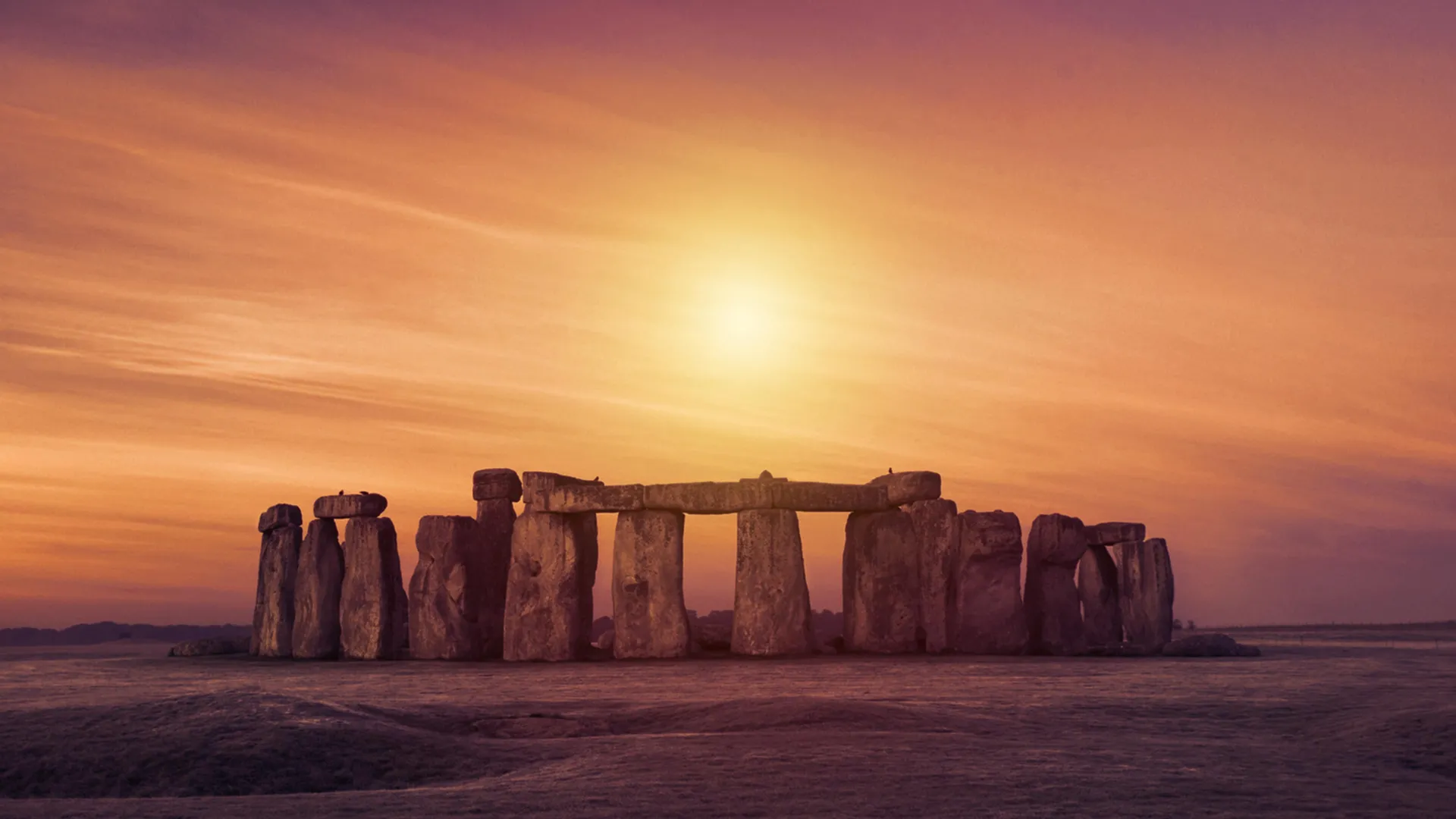
Six tons of sandstone, quarried in the rugged highlands of northeast Scotland, somehow crossed 700 kilometers of rivers, forests, and rolling hills to stand at the heart of Stonehenge—long before the wheel reached Britain. For decades, archaeologists have puzzled over how the Altar Stone, the monument’s central megalith, made this improbable journey. Now, new research confirms it wasn’t glaciers or chance that brought it there, but the deliberate effort of Neolithic people who moved it by hand, in a feat of cooperation and navigation that reshapes our understanding of ancient Britain.
The mystery of the Altar Stone has long intrigued scientists. Unlike the smaller bluestones from Wales, this six-ton centerpiece stood out not just for its size but for its origin. Previous geological work traced its composition to the Orcadian Basin in northeast Scotland, a staggering 700 kilometers from Salisbury Plain. That distance alone suggests a level of social organization once thought beyond Neolithic capabilities. The new study, led by Curtin University and published with collaborators from Sheffield Hallam University, the University of Sheffield, Wessex Archaeology, and the University of Bristol, used mineral grain dating and advanced ice sheet modeling to test whether glaciers could have carried the stone south during the last Ice Age. The answer? No.
While glaciers may have shifted rocks as far as Dogger Bank beneath the North Sea, the models show no viable glacial route reached southern England. That means the Altar Stone—after possibly being exposed by retreating ice—had to be moved the remaining hundreds of kilometers by human hands. "Rather than being carried naturally by ice, the evidence points to a deliberate, carefully planned movement across a challenging and varied landscape," says Dr. Anthony Clarke of Curtin’s Timescales of Mineral Systems Group. The journey likely combined overland hauling with river or coastal transport, requiring coordination across multiple communities, seasonal planning, and deep knowledge of terrain and tides.
This wasn’t just a logistical triumph—it was a cultural one. Transporting such a stone across Britain suggests shared beliefs, communication networks, and collective purpose stretching from Scotland to Wiltshire. The effort implies that Stonehenge wasn’t just a local monument but a focal point for a much broader cultural landscape. As researchers continue to pinpoint the stone’s exact quarry and reconstruct possible transport routes, one thing is clear: the people who built Stonehenge were connected in ways we are only beginning to understand. And their legacy isn’t just stone—it’s the enduring power of human collaboration.