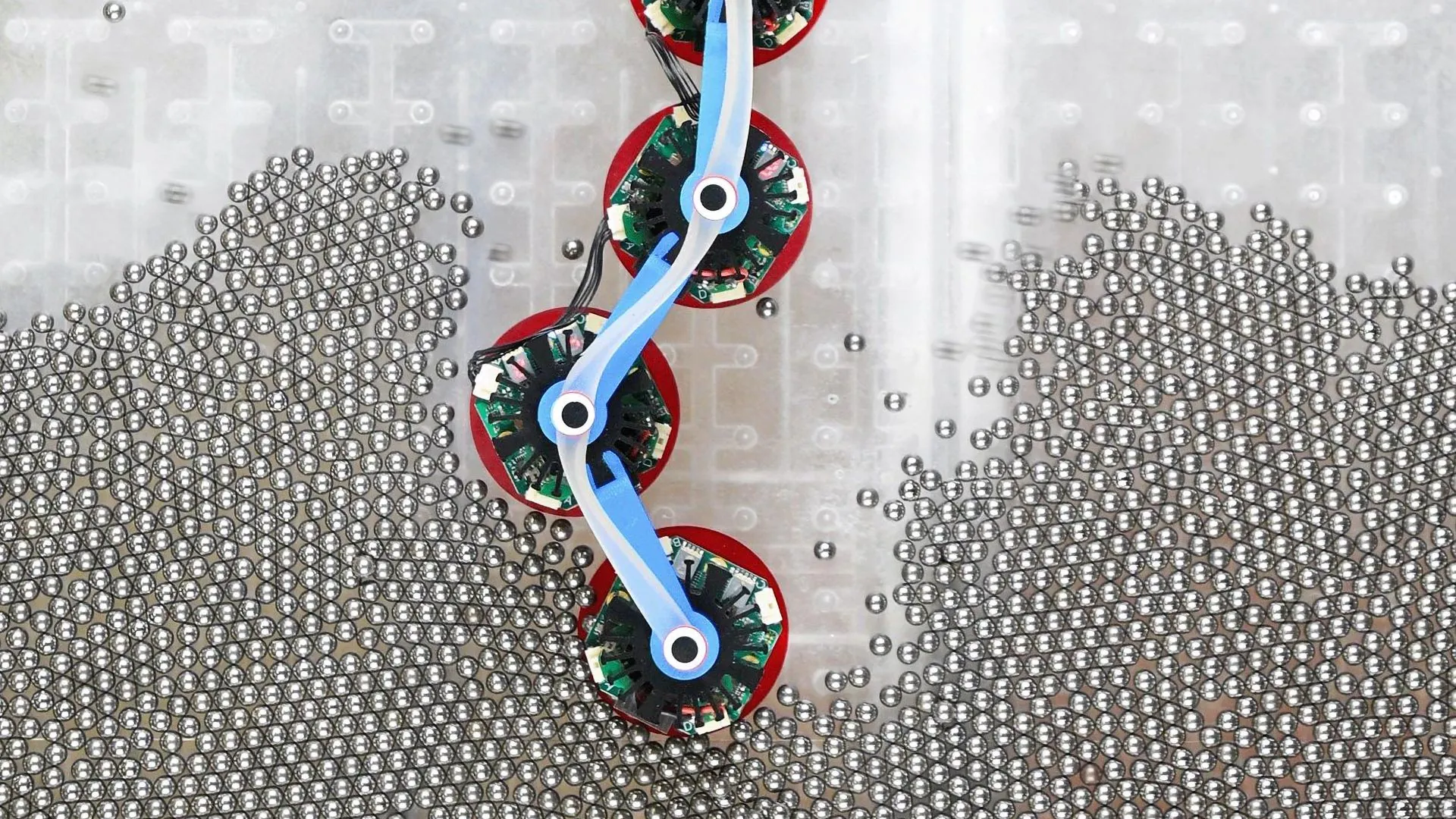
A chain of tiny motors and rods can keep bending and snapping long after a one-time push would have stopped. Built by physicists from Amsterdam, New South Wales and Cambridge, the experimental material points to a new way for soft robots to move: with motion generated by their own bodies rather than directed by a central controller.
Most familiar materials are passive. Metal, glass, concrete and rubber change shape when an outside force acts on them, and that force supplies the energy. Active matter is different: it has an internal source of energy, so it can respond to its surroundings in new ways. Living systems offer examples, such as a flock of birds adjusting its shared movement as the wind or landscape changes. Researchers are now building active materials in the laboratory from simple parts, including miniature motors, rods and rubber bands.
In one set of experiments, the team connected rods into a flexible chain and placed small motors at the joints. The motors created uneven interactions: moving one rod could affect its neighbor differently from the way the neighbor affected it in return. That difference changed how the chain reacted to a push.
The researchers focused on buckling and snapping. A paper ticket squeezed between fingers, for instance, bends as pressure rises and can suddenly flip when pushed from the other side. In ordinary passive materials, an outside force provides the energy, and the bend or snap is a one-time event. The motor-powered chains could instead buckle and snap again and again, creating ongoing oscillations.
The physics behind this shift involves a critical point—the point where snapping begins—changing into what scientists call a critical exceptional point. The team says the resulting movements can resemble crawling, walking and digging. The findings were published in the Proceedings of the National Academy of Sciences. Sami Al-Izzi of the University of New South Wales and Yao Du of the University of Amsterdam were joint first authors, and one of the buckling chains appeared on the journal’s cover.
A second investigation by the same international team points to another surprise: active materials can challenge a rule engineers often rely on. Le Chatelier’s Principle, as applied to mechanical systems in the study, suggests that changing the parts of a structure should lead to a corresponding change in the whole. For example, making the components stiffer would generally be expected to make the full structure stiffer. But the researchers found that, in some cases, increasing activity in individual components can reduce activity across the material as a whole.
Together, the results show that adding energy and uneven interactions can give simple structures behaviors not seen in ordinary materials. That could matter for soft robots, which need flexible bodies to move through changing environments. A body that produces complex motion on its own might need less centralized control. The work is still a laboratory finding, but it offers a practical direction for designing machines that crawl, walk or dig through the way their materials move.