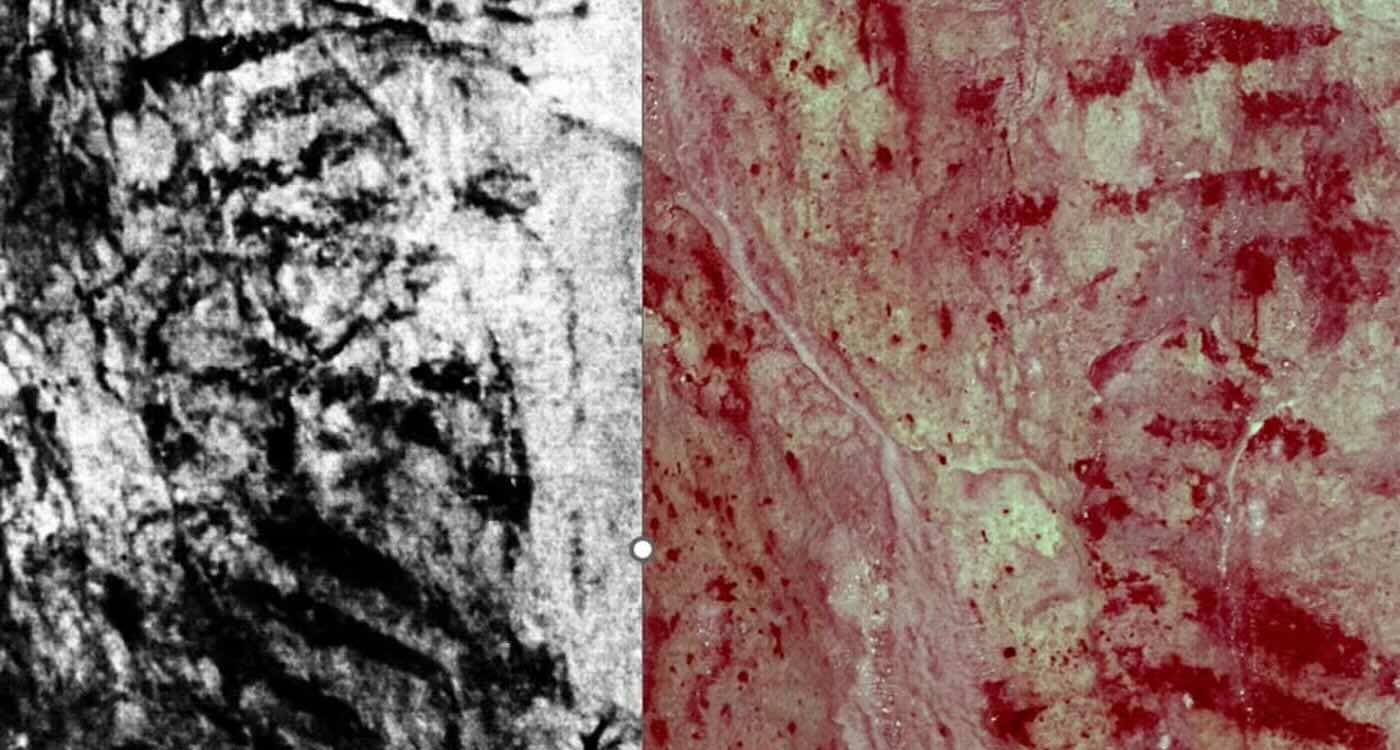
In 1912, red streaks appeared on the limestone wall of Bacon Cave near Mumbles, Wales, and early archaeologists knew they were looking at something ancient. But a 1928 reassessment changed everything: those marks were dismissed as iron oxide seeping naturally through cracks in the rock, a verdict that would stand unchallenged for nearly a century. Now, thanks to uranium-thorium dating technology unavailable to previous generations, the striped panel has been vindicated—and reclassified as the oldest known cave painting in the British Isles, dating back approximately 17,100 years.
The reversal matters because it reframes our understanding of Paleolithic Britain. At the end of the last ice age, around 17,000 years ago, the landscape near the Bristol Channel where Bacon Cave sits was emerging from a severe cold period. The region would have been a natural corridor for migrating megafauna and teeming with fish—an ideal sanctuary for semi-nomadic hunter-gatherers. The red pigment on the cave wall is evidence of their presence, their artistry, their place in the world at a moment when Britain was still being recolonized by humans after glacial retreat.
Dr. George Nash, a British specialist in prehistoric art who led the international research team, described the moment of rediscovery with understandable wonder. "I was taken aback that we were able to date it and analyze the pigments," he said. "This is an exciting rediscovery, significant in understanding what was going on in Wales in the deep past." The team examined traces of clay pigments embedded within the local limestone rock, isolating them from the calcite using methods that would have seemed like science fiction to the cave's original discoverers. Two early researchers, Henry Breuil and William Solas, had actually identified the pigmentation correctly in 1912, writing that "the pigmented lines were intentionally created by human agency, rather than resulting from natural processes." Their field observations and laboratory work had been right all along; they simply lost the argument to doubters.
The full scope of Bacon Cave's artistic record has never been fully appreciated, partly because a fisherman in 1894—more than a decade before the main discovery—scratched his own graffiti onto the opposite wall, complicating later analysis. Still, the newly authenticated painting stands alone as a window into the minds and hands of people living in one of humanity's most transformative periods. The fact that we can now see it clearly, date it precisely, and understand its context speaks to both archaeological progress and the humility required when earlier evidence is overshadowed by earlier skepticism.
Researchers now believe Bacon Cave, and the broader Gower Peninsula limestone landscape, should receive formal protection equivalent to a US National Monument—comparable to the Canyon of the Ancients in Colorado. The painting deserves that recognition not just as an artifact, but as a testament to human creativity in the shadow of retreating ice sheets, when people were learning again how to live in a changing world. What the 1928 analysis dismissed, modern science has restored: proof that art, intentionality, and community flourished in Wales fifteen millennia before the written word.