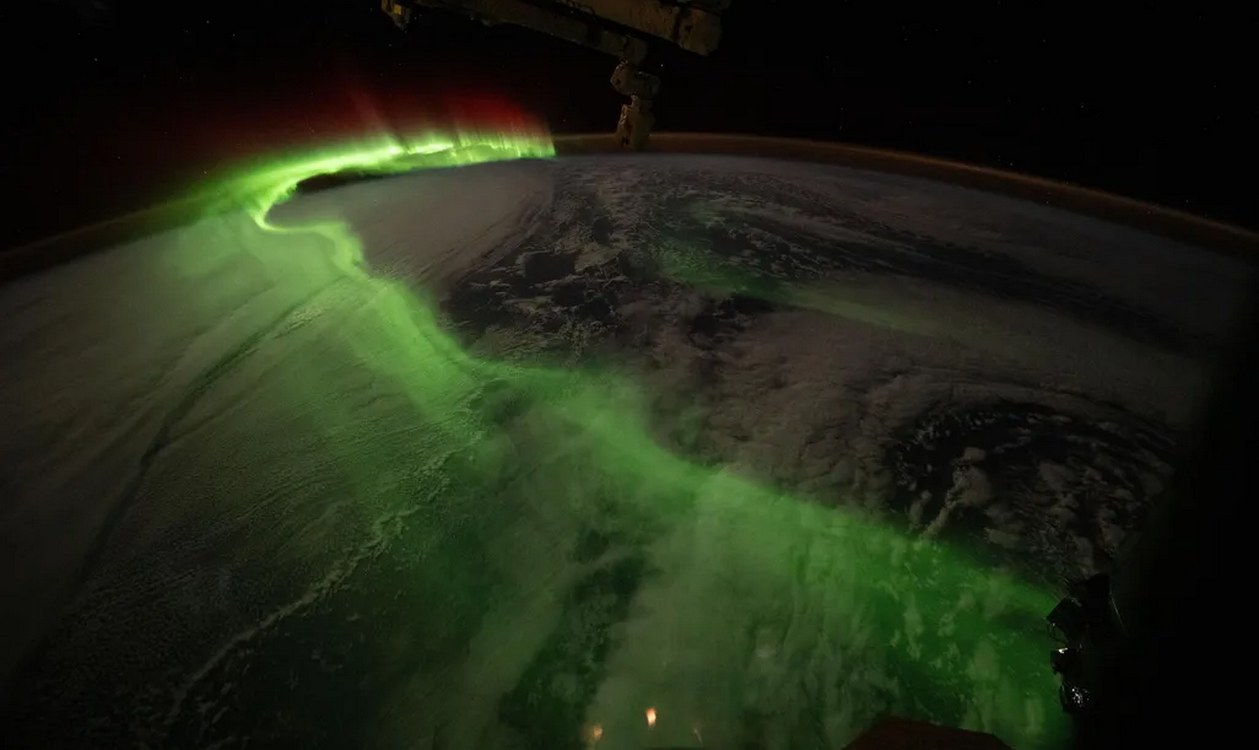
Jessica Meir floated inside the SpaceX Dragon capsule, her breath catching as ribbons of emerald and violet light coiled beneath her like living serpents across the southern sky. From 260 miles above Earth, the astronaut watched the Aurora Australis erupt in full fury, a luminous spectacle unfurling from the edge of Antarctica and surging toward the South Pole. "As opposed to the previous aurora I’ve seen, this one danced and snaked its way directly below us, putting on quite a show," Meir wrote on X, her words echoing the awe so many feel when confronted with nature’s most electrifying display.
This celestial performance, captured in a now-viral timelapse video posted on June 7, 2026, was triggered by a powerful burst of solar wind from a recent coronal mass ejection. When charged particles from the Sun collide with Earth’s magnetosphere, they funnel toward the magnetic poles, energizing oxygen and nitrogen in the upper atmosphere and transforming them into glowing plasma. The result is a shimmering aurora—green when oxygen is excited at altitudes of 60 to 180 miles, red when it occurs higher up, and purples and blues from ionized nitrogen.
Meir, who arrived at the International Space Station in February for an eight-month mission focused on space medicine and human biology, shared the footage just after she and fellow NASA astronaut Chris Williams took precautionary shelter in the Dragon capsule. The move came as Russian Roscosmos crew members located and repaired an air leak on their side of the station. Despite the tension, Meir emphasized their safety and marveled at the aurora’s timing: "We are all safe and witnessed a spectacular southern aurora show yesterday thanks to a recent solar event."
The Southern Lights, less frequently seen than their northern counterpart, are a reminder of Earth’s dynamic relationship with the Sun. They also underscore the importance of space-based observation—not just for science, but for perspective. From orbit, the aurora isn’t just a light show; it’s a visible map of invisible forces, a dance of particles that connects our planet to the wider solar system.
As Meir continues her mission—studying everything from pneumonia-causing bacteria in microgravity to synthesizing IV fluids in space—her moment of wonder reminds us that even in the midst of rigorous science, beauty still has the power to stop us in our tracks. And from the quiet dark of space, Earth continues to shine, not just with light, but with life.