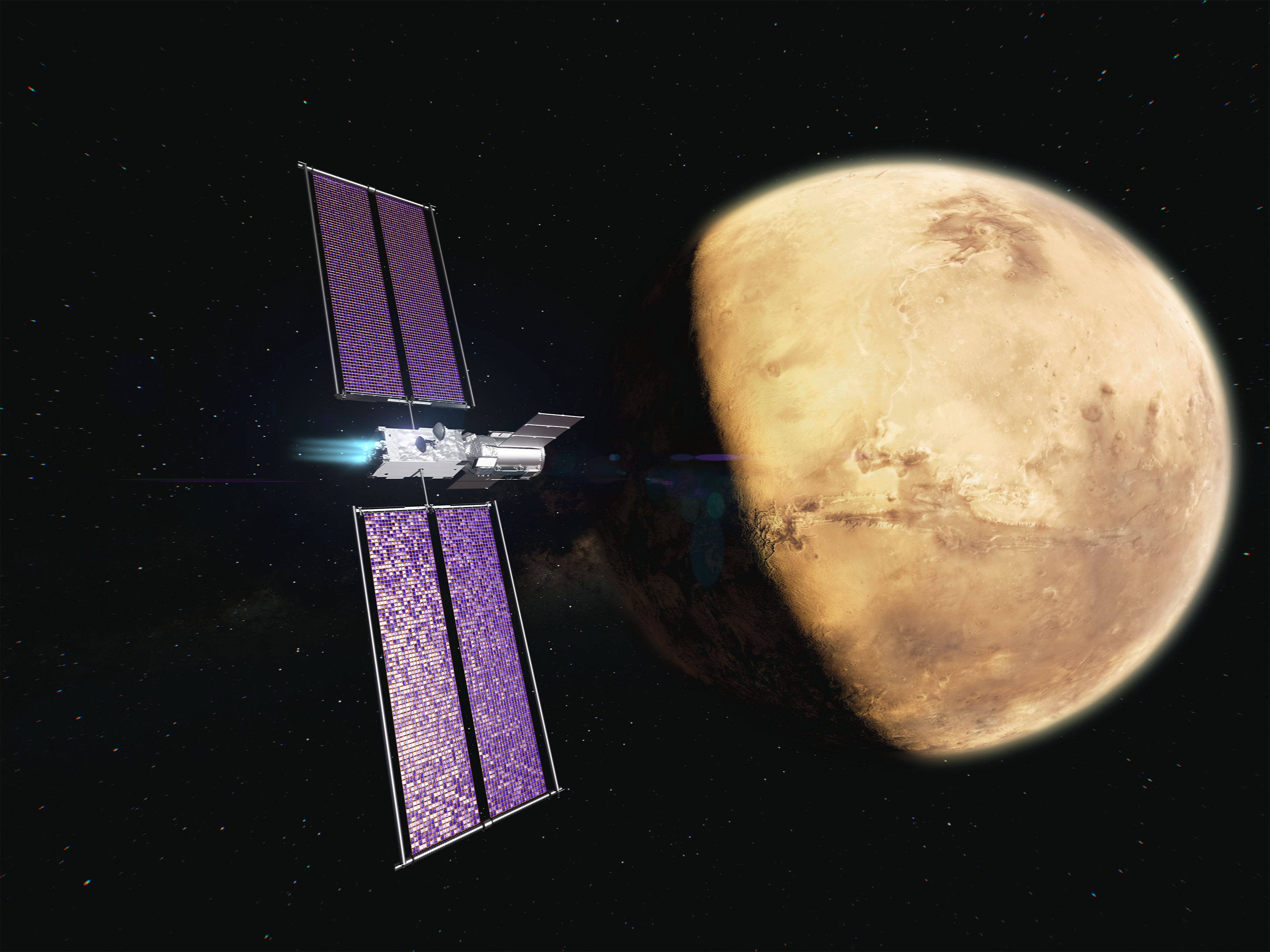
At NASA’s Glenn Research Center in Cleveland, teams have settled several key design choices for SR-1 Freedom, a spacecraft meant to test nuclear electric propulsion on a journey to Mars. The mission is targeted to launch in late 2028, and its design is moving from an early concept toward a defined plan.
The review in October brought together experts from NASA, the U.S. Department of Energy and industry. Their work matters because future missions may need more power than today’s spacecraft can provide, especially in places where sunlight is weak or unavailable. SR-1 will use both nuclear and solar power to show how fission energy could support long trips through deep space and, one day, reliable power systems for a future NASA Moon Base.
The spacecraft is planned to carry SkyFall, a capsule containing three next-generation helicopters, to Mars. After SkyFall reaches Martian orbit, the helicopters are intended to study the planet’s geology and climate history, explore new terrain and look for signs of ice beneath the surface. The mission will also test how a spacecraft’s nuclear power system performs beyond Earth.
One notable design change is a shorter boom separating the reactor from the spacecraft’s main section, called the Power and Propulsion Element. NASA says the shorter boom should cut weight, make assembly easier and simplify the overall design. Agency and Energy Department experts also found that improved shielding and spacecraft design could let the reactor sit closer to the rest of the craft while still protecting its electronics and SkyFall from radiation.
Some major choices remain open. Teams are still studying how many radiator panels the spacecraft needs, how much power its nuclear module should produce and how long the reactor should run. The Power and Propulsion Element will also get larger X-band antenna dishes, which will send data across deep space back to Earth.
NASA has awarded a $39.3 million contract to Johns Hopkins University’s Applied Physics Laboratory to develop the nuclear module’s heat rejection system. It will remove excess heat so the system can operate safely and efficiently. Advanced Cooling Technologies is working with the lab on heat pipes and composite radiator technology. The contract covers designing, building, testing and evaluating the system, as well as producing flight hardware.
The mission plan calls for the reactor to start after SR-1 leaves Earth orbit and gradually increase its power. It will run for an initial period while the spacecraft gathers and sends performance data, then shut down as solar arrays power the cruise to Mars. After SR-1 delivers SkyFall to Martian orbit, it will restart the reactor and collect more data.
Steve Sinacore, SR-1 Freedom program director, called the mission “the first freight run on the railroad of the solar system.” The decisions made now, he said, will help lay the tracks for later nuclear-powered spacecraft. With its launch targeted for late 2028, the team is continuing to refine the design, manage risks and keep the mission on schedule.