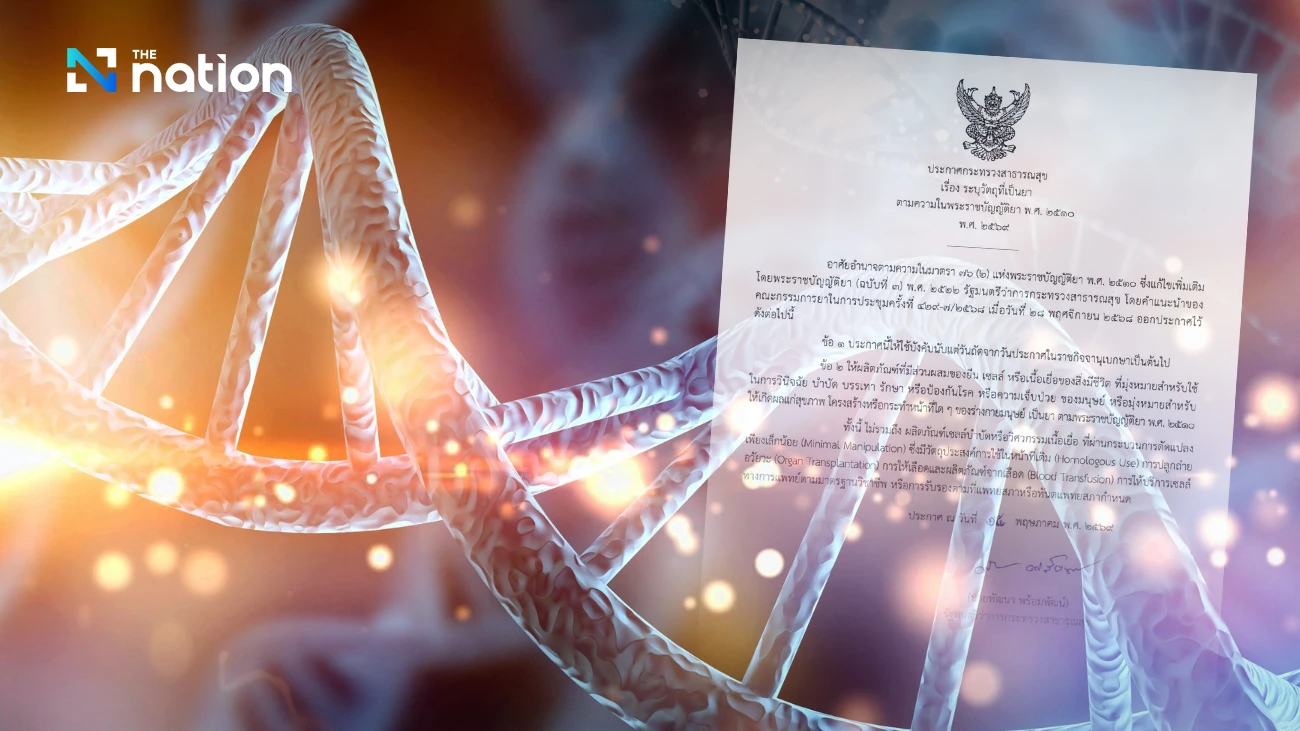
Health Minister Pattana Promphat has just redrawn the map of medical possibility in Thailand. On May 31st, 2024, he signed a landmark ministerial decree that formally classifies stem cell and cell-based therapies as medicines—a legal milestone that ends more than a decade of regulatory fog and positions Thailand as a regional pioneer in advanced medical innovation.
For years, stem cell therapy occupied an uncomfortable limbo in Thailand's legal system. Scientifically promising, yet undefined under law, these therapies existed in a space too uncertain to unlock their full therapeutic potential. Health officials and researchers navigated a landscape where the rules simply did not account for the reality of the science. That ambiguity has now been decisively resolved.
The decree distinguishes between two categories of cell-based products with scientific precision. Products that undergo only minimal manipulation—cutting, centrifugation, cryopreservation, or cell separation—remain outside the drugs framework and are governed by Good Tissue Practice standards. This includes haematopoietic stem cell transplantation, platelet-rich plasma, and amniotic membrane transplantation, all established procedures that can continue without new regulatory barriers.
The second category captures the transformative innovations. Products involving "more than minimal manipulation"—cell expansion in culture, genetic modification, enzymatic digestion, and tissue engineering—are now formally classified as Advanced Therapy Medicinal Products. This classification includes mesenchymal stem cells, CAR-T cells, natural killer cells, dendritic cells, and induced pluripotent stem cells. These treatments must now meet rigorous Good Manufacturing Practice standards under the international PIC/S benchmark and undergo full product registration with Thailand's Food and Drug Administration.
What makes this framework exceptional is its alignment with global standards. Thailand's FDA has directly adopted the European Medicines Agency's ATMP classification guidance, ensuring that Thai-developed therapies will be scientifically credible and internationally recognized. This interoperability opens pathways for global collaboration and investment.
The scientific promise underlying this regulatory shift is substantial. Mesenchymal stem cells have demonstrated the capacity to modulate immune responses, reduce inflammation, and support tissue repair across conditions ranging from osteoarthritis to degenerative liver disease. Natural killer cells, derived from cord blood, are proving capable of identifying and destroying malignant cells without prior sensitisation—a property that has sparked pioneering oncology trials worldwide. Formalizing these therapies under rigorous preclinical and clinical evaluation, batch-release testing, and ongoing pharmacovigilance provides the evidentiary scaffolding that will allow such treatments to reach patients with the scientific credibility healthcare professionals require.
Thailand's ambitions are bold and concrete. The global ATMPs market was valued at $22.8 billion in 2024, with individual treatment costs ranging from THB 3 million to THB 30 million per session. Thailand has set a target for its citizens to access standardized ATMPs by 2025, with at least two domestically developed products reaching the market in 2026. The government plans to open five dedicated research and service centres—an initiative projected to generate economic value of THB 1.5 billion annually.
This decree represents far more than paperwork. It is a commitment to transforming advanced medicine from promise into practice, and positioning Thailand as a destination where cutting-edge cellular therapies become accessible reality.