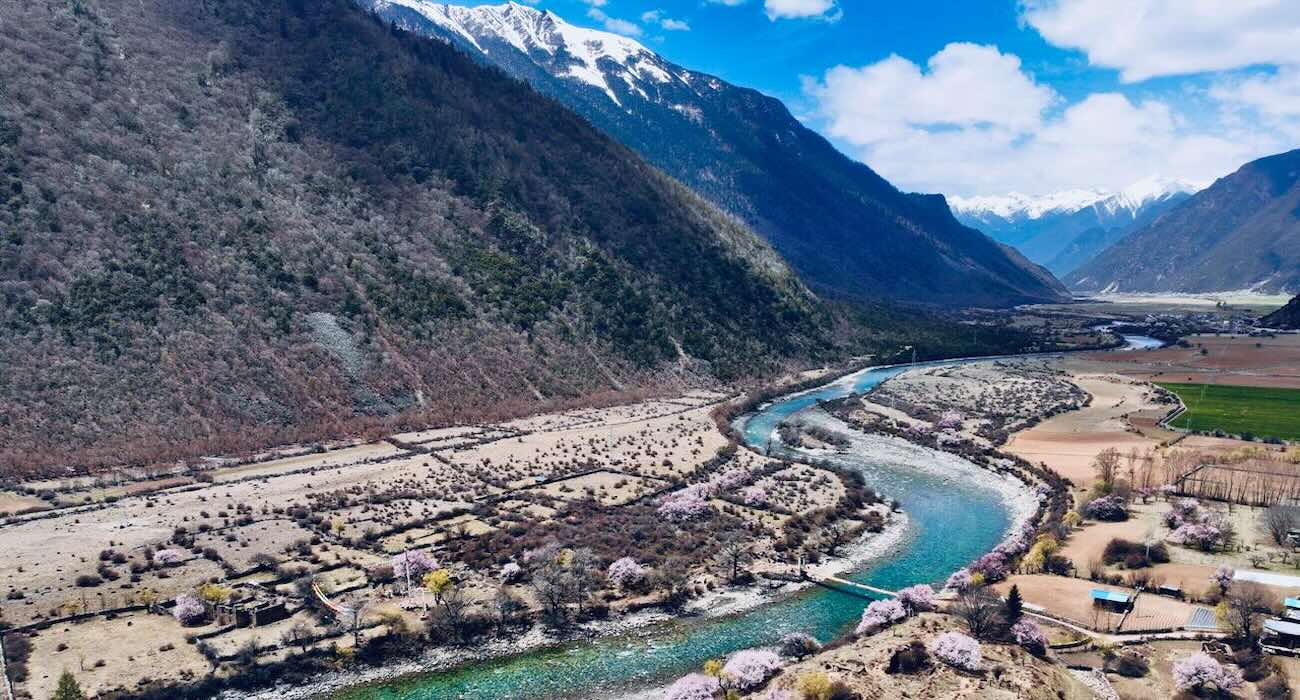
Liwei Zhang knelt by the edge of a rushing stream on the Qinghai–Tibet Plateau, water samples in hand, where the ground beneath his feet is slowly coming undone. Permafrost—frozen for millennia—is thawing across this vast, high-altitude expanse, long feared as a ticking time bomb of ancient carbon emissions. But Zhang and his team have uncovered a quiet counterforce at work: as the ice retreats, the Earth begins to breathe differently, not just releasing carbon but, in some places, pulling it back in. Their landmark study, published in Nature, reveals that thawing permafrost is unlocking a hidden geological carbon sink—one driven by rock weathering that consumes atmospheric CO2. Across 50 rivers on the “Roof of the World,” the team found that chemical reactions between water and newly exposed minerals are transforming the landscape into an unexpected climate ally.
For decades, scientists have warned that thawing permafrost would accelerate global warming by releasing vast stores of organic carbon as CO2 and methane. But this research, led by scientists from Umeå University in Sweden and East China Normal University, shows that the story is more complex. As permafrost degrades, it exposes reactive minerals like silicates and carbonates to flowing water, speeding up chemical weathering—a natural process that draws CO2 from the air and converts it into dissolved inorganic carbon. This carbon is then transported to oceans, where it can be stored for centuries. In doing so, the process offsets a significant portion of the CO2 escaping from rivers fed by thawing ground.
The numbers tell a surprising story. On average, rock weathering across the plateau absorbs enough CO2 to offset 35% of river emissions. But in areas where permafrost has become patchy—what scientists call discontinuous or isolated zones—the balance tips further. Here, weathering-driven carbon uptake doesn’t just compensate; it surpasses emissions, reaching over 100% in some catchments. "In some catchments where permafrost has become patchier, weathering-driven carbon uptake was large enough to offset or even exceed river CO2 emissions," Zhang explains. This means that, locally, these thawing landscapes are no longer just carbon sources—they are becoming carbon sinks.
The implications are profound. Climate models have traditionally treated thawing permafrost as a one-way street of carbon release, overlooking the geological processes unfolding beneath the surface. This study urges a shift: to understand the full picture, we must account for both biological emissions and geological absorption. As the cryosphere retreats, Earth’s rocky skeleton may be stepping in to help stabilize the climate, at least in part.
While this is not a fix for climate change, it reveals a resilience in Earth’s systems that was previously unseen. In the high silence of the Tibetan Plateau, where ice gives way to water and stone, nature is recalibrating—one chemical reaction at a time.