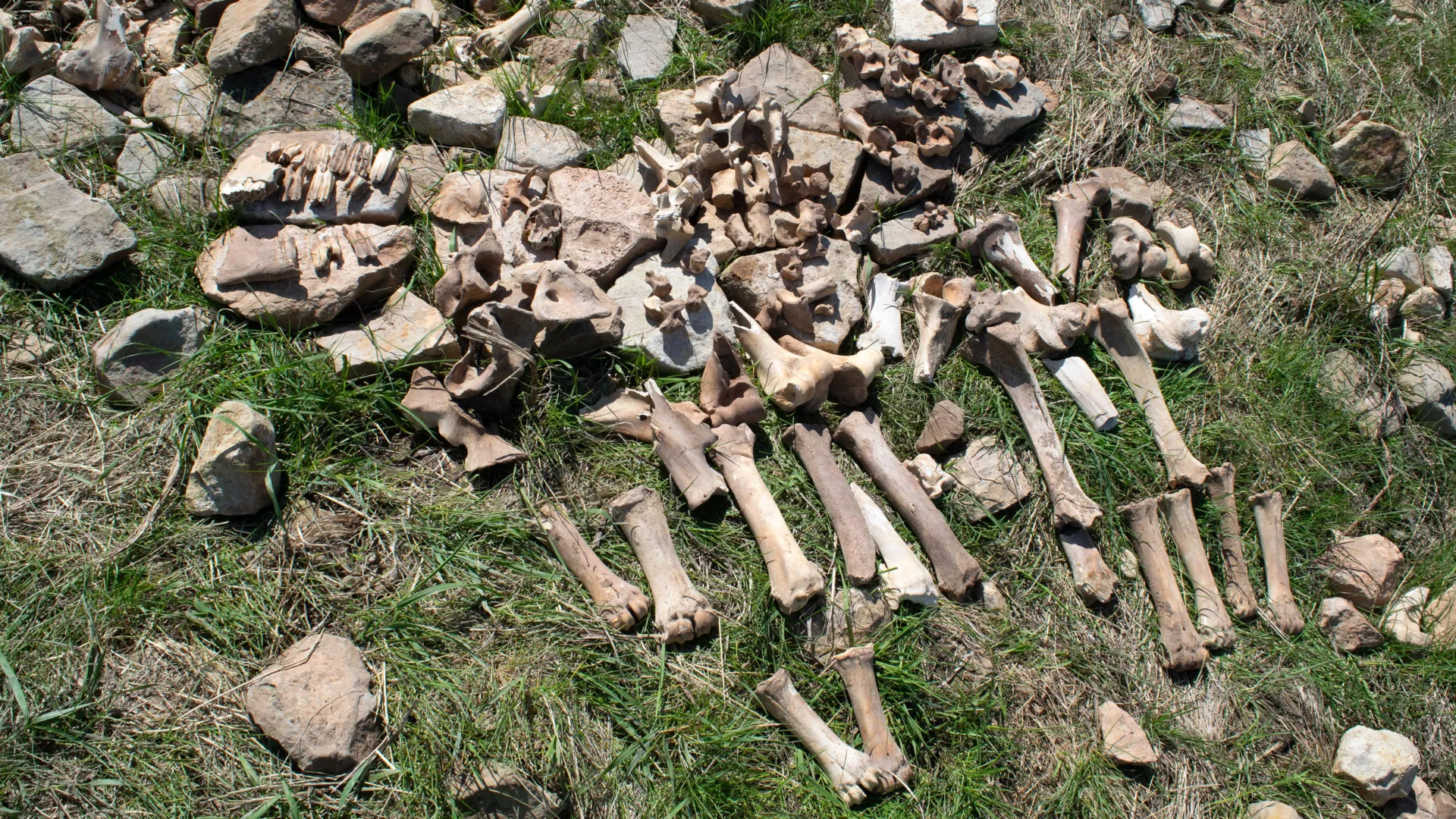
When archaeologists excavated nine test pits at the Bergstrom site in central Montana in spring 2019, they were hunting for answers to a 1,100-year-old riddle: why had Indigenous bison hunters walked away from a hunting ground that had sustained them for roughly 700 years—even though bison remained abundant across the region?
The answer, revealed in a new study published in Frontiers in Conservation Science, speaks to how Indigenous communities adapted to environmental stress with remarkable ingenuity, and how the decisions made over a thousand years ago still offer lessons for today.
For millennia, bison roamed the Great Plains as the lifeblood of Indigenous economies. Hunting these massive herds was intricate work—requiring knowledge of animal behavior, landscape features, and social coordination passed down through generations. The Bergstrom site, used intermittently over centuries, was one of many such locations where hunters employed strategies to harvest bison. But around 1,100 years ago, they stopped coming.
"Abandonment wasn't because the site became ecologically unsuitable in any absolute sense," explained Dr. John Wendt, a paleoecologist at New Mexico State University and first author of the study. "Bison were still around, vegetation hadn't changed, and there was no substantive shift in fire activities." Yet hunters had abandoned the site nonetheless—a mystery that prompted Wendt's team to combine archaeological excavation with environmental detective work: sediment coring, pollen and charcoal analysis, radiocarbon dating, and climate reconstructions.
What emerged was a story of environmental pressure meeting strategic adaptation. Severe, recurring droughts had gripped the region both before and after the site's abandonment, dramatically reducing water availability. The Bergstrom site's proximity to a small creek had once made it ideal for processing animals, but without reliable water, that advantage evaporated. More crucially, hunting practices themselves were transforming. Smaller, mobile groups that hunted opportunistically were giving way to larger, coordinated operations capable of producing substantial kills—surplus that could be stored for winter or traded with neighboring communities.
These larger hunting efforts came with higher stakes. They demanded reliable access to water, forage to support bigger animal herds, and fuel for processing fires. They needed landscape features ideally suited to driving and containing bison—cliffs for bison jumps, natural barriers, features that couldn't be easily replicated elsewhere. Once such specialized locations were established, they were used repeatedly for centuries. But finding suitable sites became harder in a changing climate.
"These larger operations were based on large kills and could produce surplus for trade and winter storage, but they also meant more dependence on specific resources like water, forage for larger herds, and fuel for processing fires," Wendt noted. That increased dependence made communities more vulnerable when drought stressed the landscape.
The resilience of these hunting systems, the researchers suggest, came from flexibility—an ability to adjust strategies and knowledge as conditions shifted. Hunting communities adapted across generations, enabling their systems to weather periods of climate instability and resource scarcity.
Today, as modern bison management programs navigate their own uncertainties, Wendt's team proposes that maintaining adaptability—the capacity to shift where and how animals are managed—could strengthen resilience against changing environmental conditions. A thousand years later, the lessons of the Bergstrom site endure.