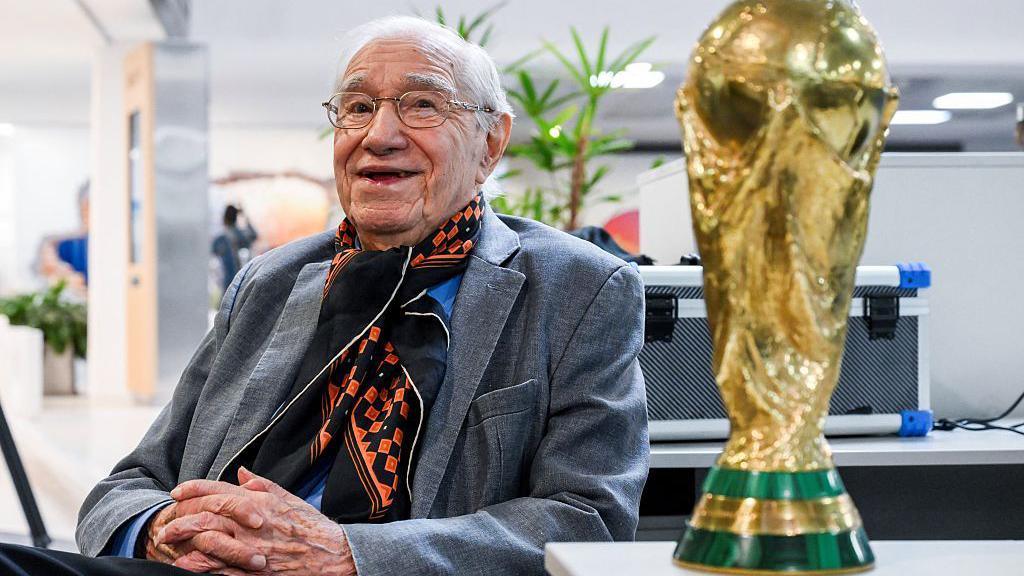
In Sweden in 1958, a 24-year-old reporter named Enrique Macaya Marquez arrived to cover his first World Cup. His assignment that day was to watch Brazil face Austria — where he would witness a 17-year-old phenomenon named Pele. Nearly seven decades later, Macaya is still going. At 91, he has now covered an extraordinary 18 consecutive men's World Cups, making him one of the most enduring voices in football history.
Macaya works as a commentator for DSPORTS Radio in Argentina. His career began at a tournament that left Argentine fans heartbroken. "It remains etched in my memory as a tremendous thrashing for the Argentine national football team," he says, recalling the infamous 6-1 loss to Czechoslovakia — a match that became known as the "Disaster of Sweden." He had almost no information about the Czechoslovakian team. "We knew almost nothing. We had no data, and they surprised us."
That early lesson in humility shaped his approach ever since. When Lionel Scaloni was unexpectedly appointed Argentina's manager in 2018, many questioned the choice. "I didn't have high hopes. I didn't know him," Macaya admits. Yet Scaloni has since led Argentina to Copa America, Finalissima, and World Cup glory — one of football's greatest success stories. "You can't pass judgement without a much deeper, more complete understanding of the person being judged," Macaya reflects. It is a philosophy that helps explain why he has remained respected for seven decades.
Over the years, Macaya has watched football transform beyond recognition. Television went digital. Statistics became instant. The tournament expanded into a global spectacle. Yet he has witnessed something else too: the careers of Pelé, Diego Maradona, and Lionel Messi — three of the greatest players ever to kick a ball.
When asked to name his favorite Argentina player, Macaya does not hesitate: "Clearly, it's Messi." But ask him who is the greatest of all time, and the certainty vanishes. "That question deserves a smile. There's no way to measure players throughout history. Times have changed. Opponents have changed. Every player is unique." The same goes for comparing Pelé's Brazil with Maradona's Argentina in 1986. "There is no way to compare them. The style is completely different."
Now, with Argentina preparing for another World Cup semi-final, Macaya believes they can win again. "If we're talking about what is possible, about the future, I believe Argentina is capable of winning." As for his own future, retirement is quietly approaching. "I'm going to retire at some point," he says with a laugh. "I'm retiring now... so I'll hang up and leave it for another time."
For someone who has spent a lifetime documenting football history, it would be a fitting end to a remarkable career. Though true to his nature, Macaya Marquez's farewell never feels final.