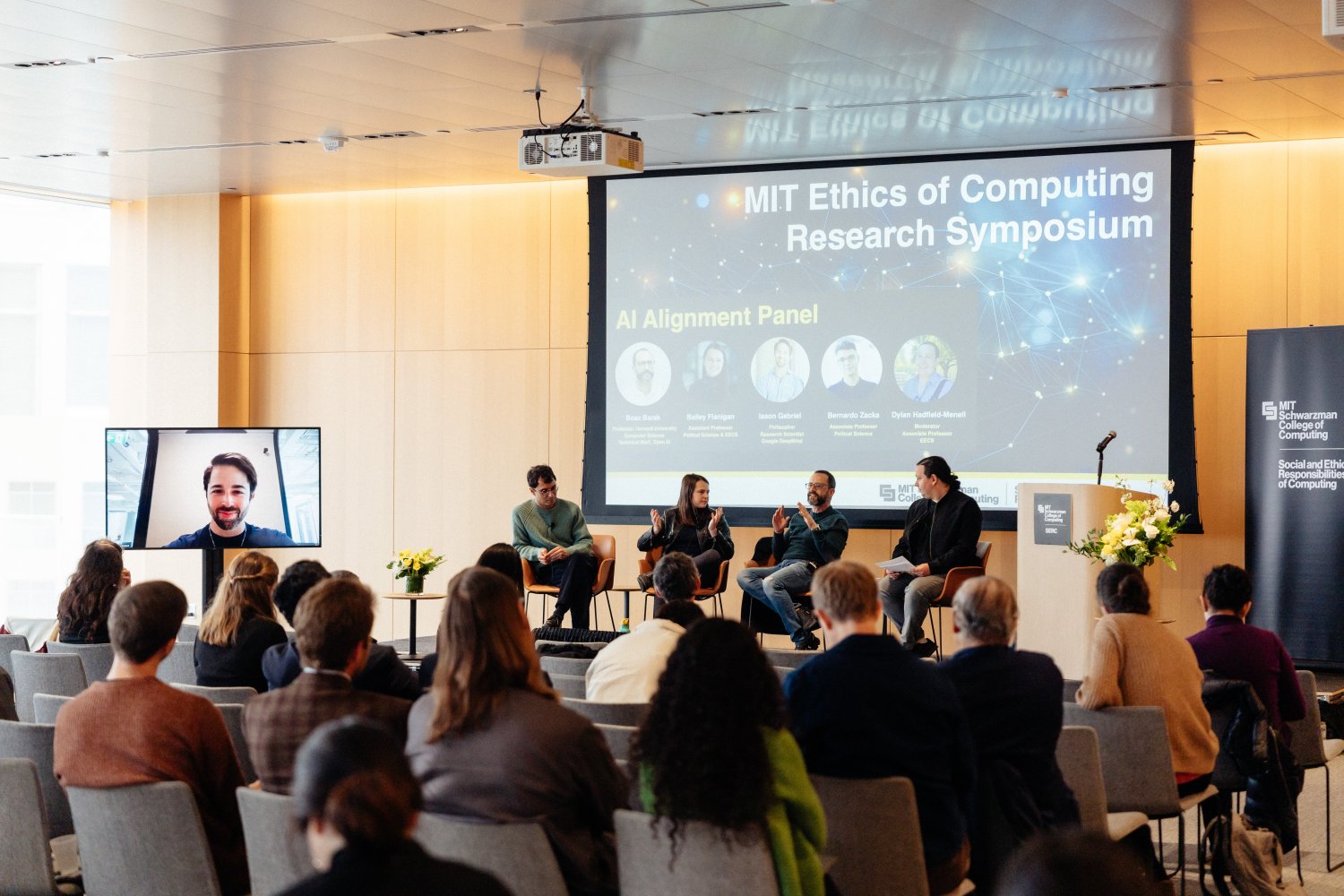
On April 30 in Cambridge, MIT's Schwarzman College of Computing convened a full day of research and conversation that cut to the heart of a question haunting our technological moment: Who gets to decide what values an artificial intelligence system should embody? The answer, speakers made clear, cannot come from engineers alone.
The Social and Ethical Responsibilities of Computing (SERC) initiative hosted the symposium with presentations from seed grant recipients exploring air pollution forecasting and responsible computer vision deployment, alongside panels that probed the deepest tensions in AI development. Jon Kleinberg, the Tisch University Professor of Computer Science at Cornell, delivered the keynote, while faculty and students across MIT showcased work that treats AI not as a neutral tool but as something requiring constant moral reckoning.
The day's most pressing theme emerged during a panel on AI alignment moderated by Dylan Hadfield-Menell, an associate professor of electrical engineering and computer science. Iason Gabriel, a philosopher and research scientist at Google DeepMind, offered a striking analogy: a judge should have good character and interpret rules with wisdom, not perfection. "AI should be doing what we tell it to do, while using its character to interpret according to our moral values," Gabriel said. But this raises an uncomfortable question that Bailey Flanigan, an assistant professor of political science with a shared appointment in the MIT Schwarzman College of Computing, posed directly: Who is entitled to govern different types of AI systems in the first place? Bernardo Zacka, also an associate professor of political science, added another layer of urgency. As deployment pressure mounts, institutions are "building the plane as they fly it," he observed. Yet one of the most crucial tasks is understanding "the wisdom contained in the systems we are replacing, and why they function the way they do."
These aren't abstract philosophical exercises. They reflect a deepening awareness among MIT's computing community that technical progress and ethical reflection must advance together. "As computing and AI become increasingly embedded in nearly every dimension of society, SERC's mission is to help ensure that ethical reflection and technical progress advance together," said Nikos Trichakis, co-associate dean of SERC and the J.C. Penney Professor of Management.
The symposium's other major panel turned to a question reshaping classrooms globally: how can students learn from AI tools without offloading their intellectual struggle entirely? Samuel Madden, the MIT College of Computing Distinguished Professor and faculty head of computer science, highlighted the paradox. "Learning is done through a series of trials and failures," he explained. But when students "hit that wall, their first instinct is to ask AI. They don't see this as excelling in this process, and they haven't actually acquired the skill you're assessing." Eric Klopfer and Madden, co-chairs of MIT's Ad Hoc Committee on AI Use in Teaching, Learning, and Research Training, grappled with how to maintain cognitive struggle—that productive challenge essential to learning—in an age when answers arrive instantly.
The symposium's message was neither utopian nor despairing. "There is so much amazing research being done at MIT on how AI and computing can be forces for good that benefit humanity," said Brian Hedden, co-associate dean of SERC and a professor of philosophy. The panelists overall seemed optimistic about the trajectory of AI alignment, emphasizing how crucial human components are to shaping these systems. The question is not whether AI will transform society—it already is. The question is who ensures that transformation reflects our values.