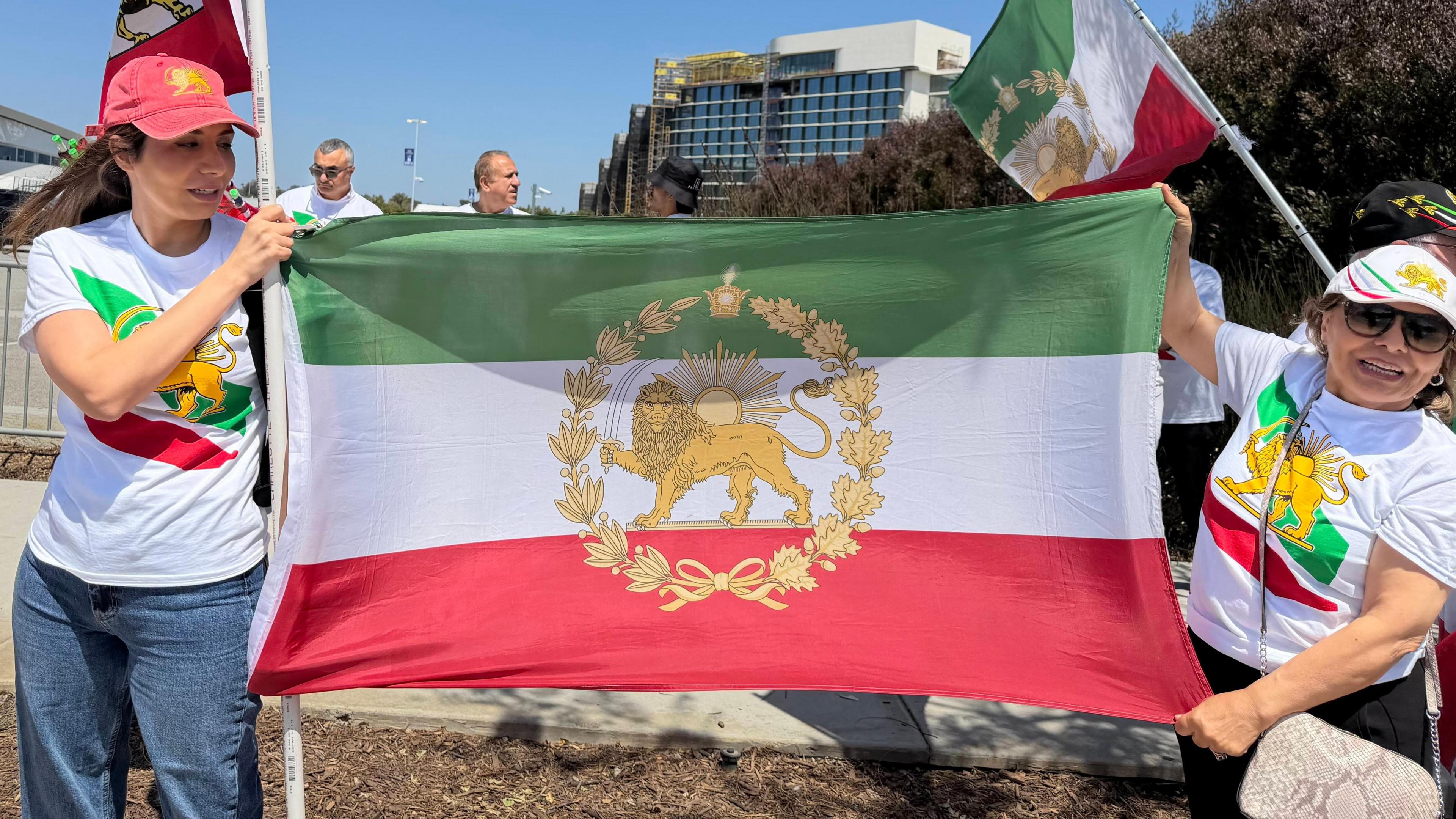
In the shadow of SoFi Stadium, where Iran's national football team would face New Zealand on June 15th, something remarkable was happening on the streets of Los Angeles. The neighborhood of Westwood has long been known as "Tehrangeles" — a enclave where Iranian American culture has taken root far from Tehran. But on this day, it was serving as an unlikely stage for a demonstration of resistance that has grown deeper and more urgent with each passing year.
Among the protesters was Hamid Farahanipour, whose opposition to the government in Tehran is not abstract — it is carved into his personal history. "My mother was killed. My cousin and friends were killed," he says. Yet in the same breath, he rejects the idea that the answer lies in war. "I hate this regime and I hate this war. Nothing justifies killing innocent people." That tension — rage without militarism, grief without vengeance — is becoming a familiar posture for Iranian Americans watching their homeland from across an ocean.
The gathering crowd waved flags that might be mistaken for Iran's current banner from a distance. But a closer look revealed the Lion and Sun emblem — the symbol of Iran before the 1979 Islamic revolution. For those assembled outside the stadium, it is not a nostalgic relic but a living statement. "It is a stance against the Islamic Republic. This is the real flag of Iran," says Arezo Rashidian, one of the protest organisers. She frames the demonstration not as opposition to football, but as solidarity with Iranians still inside the country. "Regime change is the goal. We're here to show solidarity with the people of Iran."
The protests reference a wave of anti-government demonstrations in January and February, when thousands perished under a fierce crackdown by regime forces. State officials acknowledged several thousand casualties, while activist groups and medical sources documented mass shootings, overwhelmed hospitals, and mortuary records that hinted at the true scale of the violence. For those waving the Lion and Sun in Los Angeles, the World Cup is inseparable from that history — and from a fundamental question: can sport and politics ever truly be separated?
The players themselves have repeatedly called for politics to be kept out of football. But for many of the protesters, that is impossible. "I wish I could," says Tannaz Parsi, her voice catching. "This is not an easy thing for us to do — demonstrating against our people — these are our kids." Farahanipour, too, expresses sympathy for athletes caught in an impossible position. "I feel bad for them. They have to play under so much pressure." Yet his position remains firm: "Only if they separate themselves from the Islamic Republic's anthem and flag" can he imagine cheering for Team Melli.
When Iran takes the field in Los Angeles and Seattle, football will be the spectacle. But for a community that has transformed personal loss into peaceful protest, geopolitics will be hovering over every cheer and every silence.