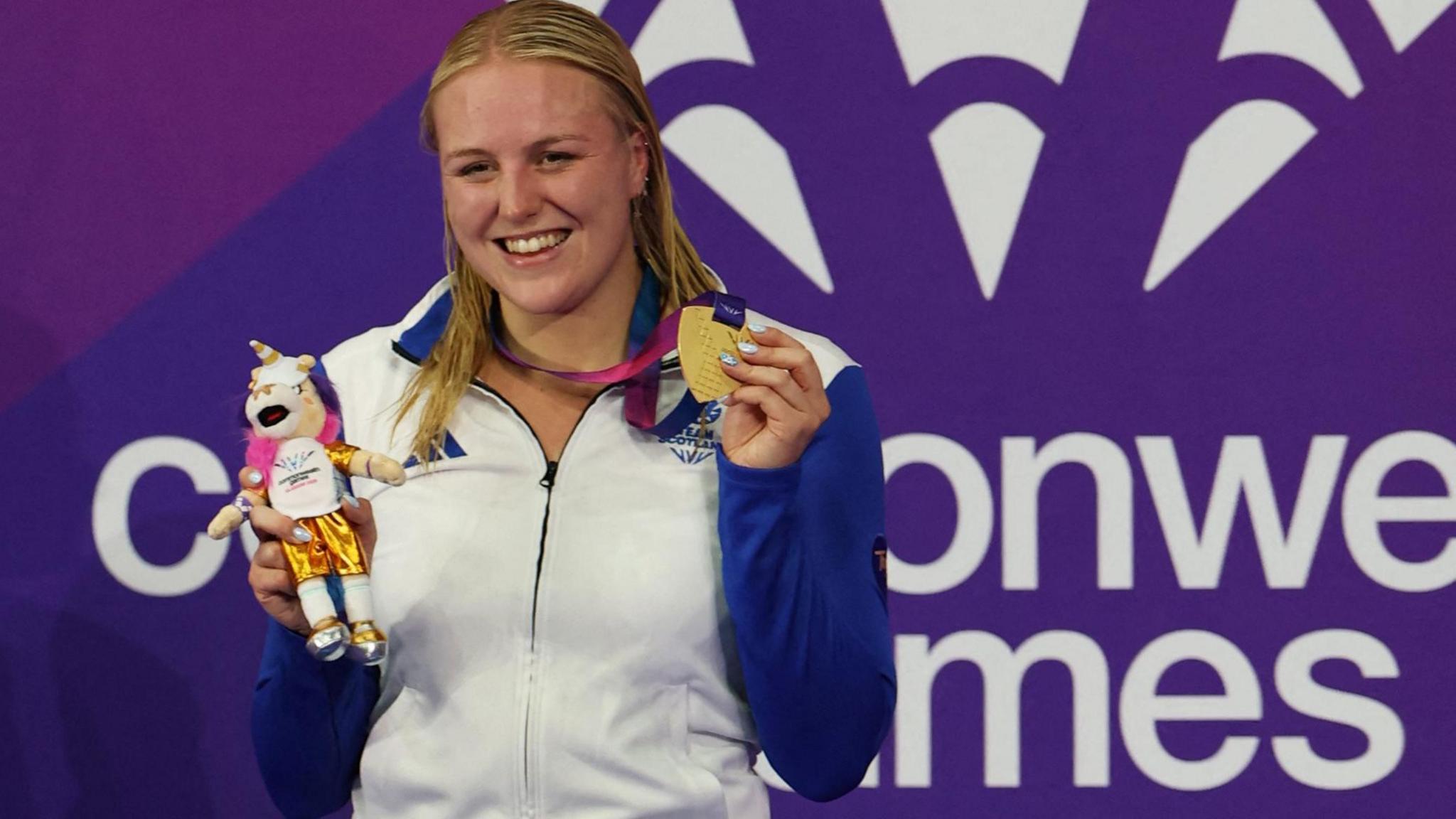
Faye Rogers won gold at the Commonwealth Games, finishing 2.5 seconds ahead of everyone else in her race. But that was not the most remarkable part of her story.
The 23-year-old from Scotland had already beaten odds that doctors said were unbeatable. Five years ago, Rogers was on her way to begin training in Aberdeen when her car was struck in a serious accident. She suffered a complex open fracture to her right arm, multiple dislocations, and a severed ulnar nerve — the nerve that controls hand and finger movement. Medical experts told her she would never swim competitively again.
Twelve weeks later, Rogers was back in the pool doing rehabilitation.
"I never in a million years thought that I could be faster," Rogers, who cannot fully straighten her right arm, told BBC Sport. "Yes, it looks a bit different and there is definitely an impairment there. But I've worked harder, I'm fitter, I'm stronger."
By summer 2024, she had won Paralympic gold in Paris. And at this year's Commonwealth Games in Edinburgh, she claimed the S10 200-meter individual medley title by a margin of just over two and a half seconds — an enormous gap over four lengths of the pool.
Now comes her next challenge. On Wednesday, Rogers will compete in the 200-meter butterfly — an event she swam before the accident. She had qualified for Team GB Olympic trials in that event and was set to study and train under Patrick Miley, father of Olympic swimmer Hannah Miley. The accident derailed those plans, but Rogers never stopped fighting.
Last year, she decided to test where she stood in the butterfly again. The first time she swam it, she discovered she was only a fraction shy of her pre-accident personal best.
"I found out a couple of weeks ago and I've been so, so excited ever since," said Rogers, who studies at Edinburgh University. "There's no pressure. I think it's such a privilege to have the opportunity to stand up there and show other people with impairments that, no matter what you are told, and no matter what gets thrown at you, there's a way through it."
Making the final would be a huge achievement. But Rogers sees this race as bigger than herself. Not many athletes with disabilities compete in races open to all swimmers. By stepping onto the block, she hopes to prove a point.
"We quite often get told we can't," she said. "And this is my way of proving that we can."