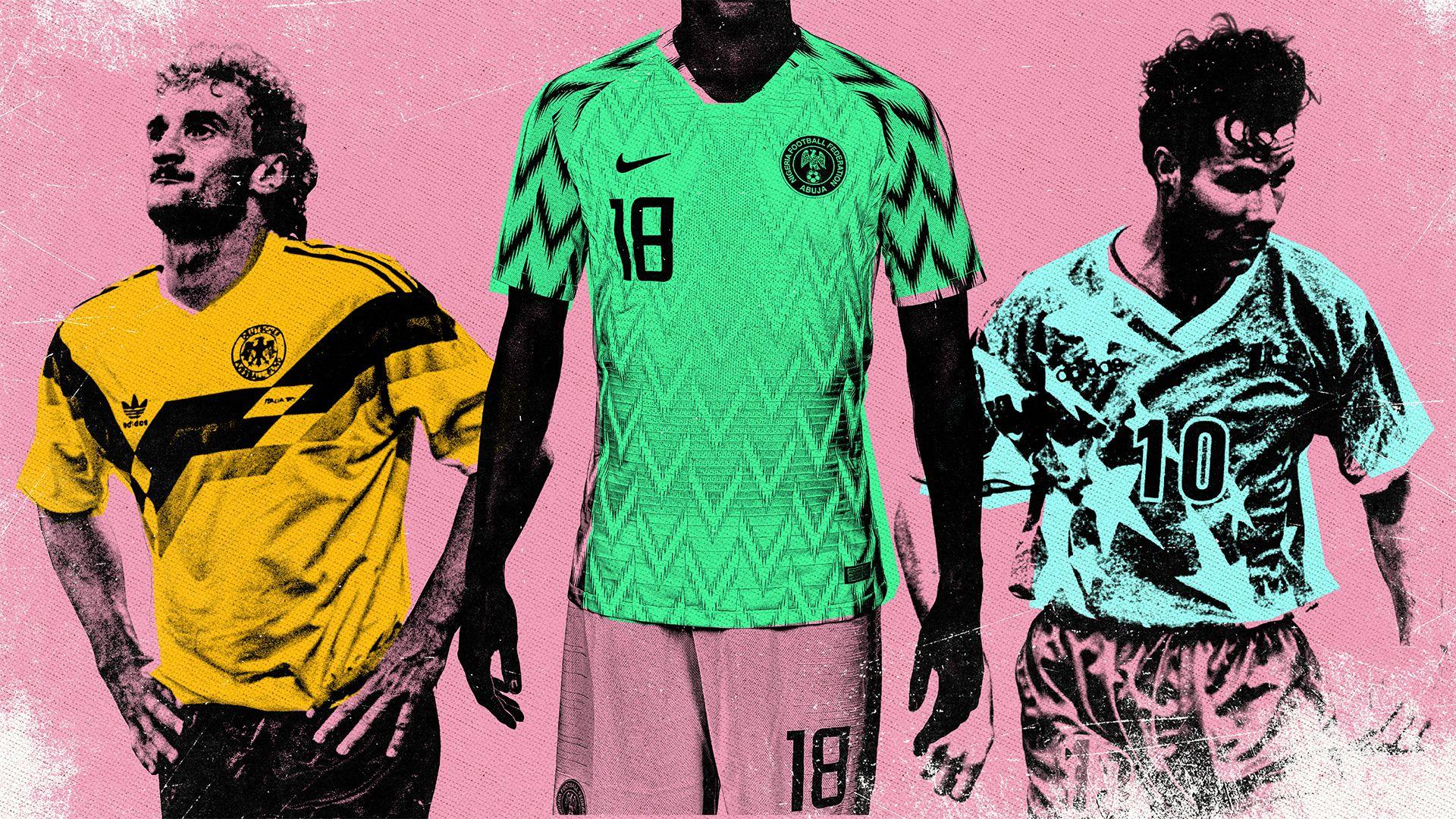
Matthew Wolff, the designer behind France's World Cup-winning kit and Nigeria's hugely popular 2018 outfits, has spent his career studying what transforms a football jersey from mere uniform into something timeless. His answer reveals something deeper than fabric and colour: a kit becomes iconic partly because of what happened while someone was wearing it, and the passage of time changes how we perceive and appreciate these garments in ways that are almost impossible to predict when they're first unveiled.
The nostalgia is real, and it's powerful. Wolff's own favourite kits span from the 1990s and early 2000s—Mexico 1998, USA 1994, Germany 1990 and 1994, Japan 1998, and Cameroon's banned sleeveless top from 2002. "That's the phase of life when the players really feel like superheroes and their kits feel so magical," he explains. These shirts carry the weight of childhood wonder, of heroes who seemed larger than life, of a time when a jersey could genuinely captivate the imagination.
Yet Wolff also sounds a note of caution about the modern era. The landscape has changed fundamentally. "The global market is saturated," he observes. "There are so many teams and so many new kits now—for both clubs and countries—that it's genuinely difficult for any single shirt to break through." The sheer volume of new designs, released with relentless frequency in response to commercial cycles rather than cultural moments, means that achieving truly iconic status has become harder than ever. What once felt magical now risks feeling disposable.
This tension between cultural expression and consumerism runs through any honest conversation about football kits. A shirt that represents a nation's aesthetics and identity on the world's biggest stage is also a product, manufactured to move units, replaced by next season's model. The question of how much is genuine expression versus commercial calculation has become unavoidable.
The enduring power of certain kits suggests that when design and history align, something remarkable happens. England's 1966 red away jersey is instantly recognisable because it conjures Geoff Hurst's hat-trick and Bobby Moore lifting the Jules Rimet Trophy—the nation's only World Cup triumph. France's 1982 home kit carries the memory of Michel Platini's "most beautiful game," a semi-final defeat that was simultaneously heartbreaking and breathtaking, played in sweltering Seville heat against West Germany. These kits don't just sit in museums; they're spotted at barbecues and beer gardens, worn by people who weren't even born when they were first worn on the pitch.
Cameroon's sleeveless 2002 kit, though it never actually made it to a World Cup, demonstrates the power of cultural design in a different way. FIFA deemed it unsuitable, forcing Puma to add sleeves for the tournament in Japan and South Korea. Yet "everybody in Africa wanted to wear that shirt," according to former midfielder Eric Djemba-Djemba. Even Serena Williams was inspired to wear something similar at that summer's French Open. The kit became iconic precisely because it was forbidden—a symbol of African aesthetic and identity that transcended football.
What makes a kit's legacy enduring, then, is a delicate alchemy: strong design, cultural resonance, and the historical moment it occupies. In an era where new jerseys emerge constantly, those three elements rarely align. Yet when they do, a shirt becomes more than sportswear. It becomes a vessel for memory, a tangible connection to childhood wonder and the moments that shaped how we see the beautiful game.