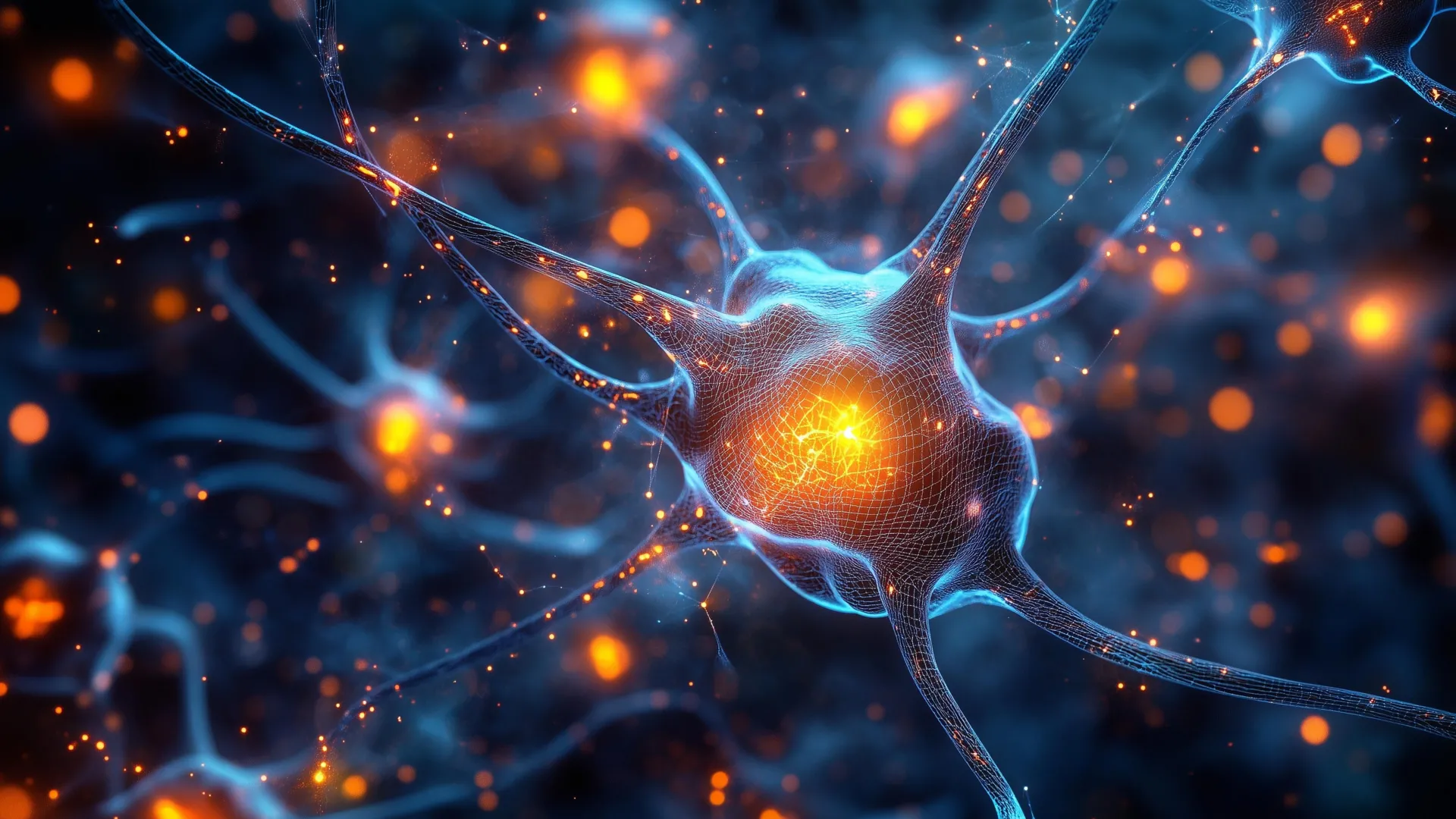
Deep inside your brain, every tiny cell is constantly making decisions about what to let in. Nutrients, signaling molecules, and fragments of other cells float by, and brain cells must carefully choose which ones to absorb. Scientists at Penn State have now discovered the hidden structure that acts as the gatekeeper for this process — and it could help us fight Alzheimer's disease.
The structure is called the membrane-associated periodic skeleton, or MPS for short. It's a tiny scaffold located just beneath the surface of neurons, built from repeating rings of proteins. For years, scientists thought the MPS mainly helped neurons keep their shape, like internal scaffolding on a building.
But researchers at Penn State have now found that the MPS does something much more important. It controls nearly every major type of endocytosis — the process by which brain cells pull material in from the fluid around them. Endocytosis is essential for learning, memory, and keeping neurons healthy.
The team, led by Ruobo Zhou, an assistant professor of chemistry, biochemistry, and molecular biology at Penn State, used powerful microscopes that can see things 10,000 times smaller than the thickness of a human hair. By studying neurons grown in petri dishes, they discovered that the MPS acts like a cellular traffic controller, regulating when and where substances enter the cell.
"You can think of it as a gatekeeper, guarding this physical barrier to not allow nutrient uptake to happen," Zhou said. "When a neuron needs to take in a specific nutrient, this gatekeeper will open the gates and let it in."
This discovery matters because when this gatekeeping process goes wrong, toxic proteins can build up in the brain — the hallmark of diseases like Alzheimer's and Parkinson's. When the researchers weakened the MPS in their experiments, neurons began absorbing material much faster. In tests with amyloid precursor protein (APP), a key marker linked to Alzheimer's, neurons with a damaged MPS took in APP more rapidly. Once inside, APP was cut into toxic fragments that accumulated and caused more cell damage.
The researchers also found something troubling: faster absorption actually broke down the MPS further, creating a harmful cycle. More uptake triggered signals that cut apart sections of the lattice, opening even more entry points for more material to flood in.
The good news is that this research points to a promising new target for treatment. If scientists can develop ways to strengthen or protect the MPS, they might be able to slow or prevent the neuron damage that leads to Alzheimer's disease.
"When endocytosis — this nutrient uptake and regulation — goes wrong, then there's protein aggregation that will build up in the brain, which is the hallmark of neurodegenerative diseases," Zhou explained. Understanding exactly how the MPS works gives researchers a clearer picture of what goes wrong in these diseases — and how to fix it.