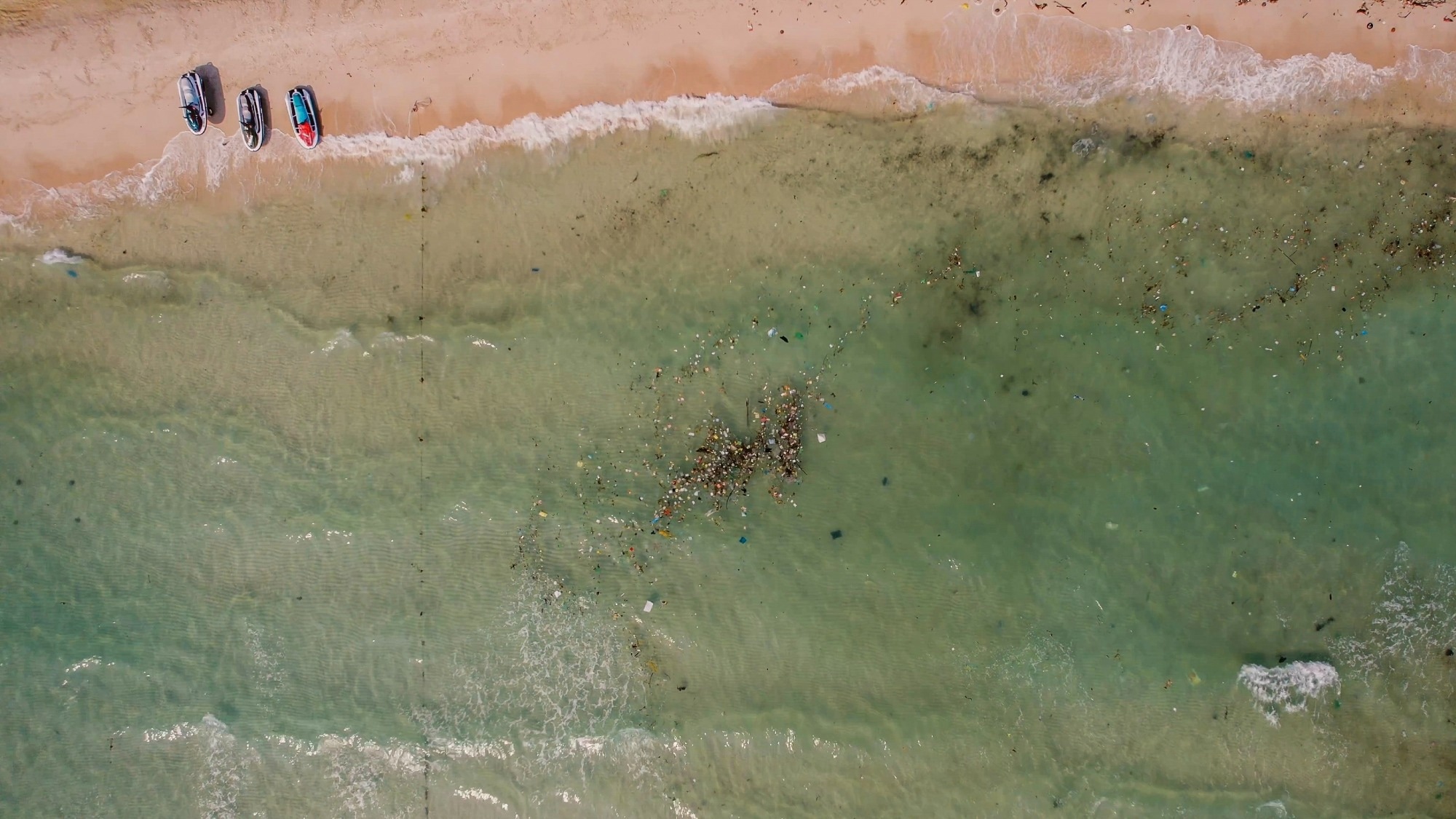
Boyan Slat was 18 years old when he decided to clean up the ocean. A decade later, the Dutch inventor's organization, The Ocean Cleanup, has removed over 53 million kilograms of plastic from the world's waters—making it the largest ocean cleanup operation in history.
The scale of the problem The Ocean Cleanup confronts is staggering. An estimated five trillion pieces of plastic have accumulated in the world's oceans, settling across surface waters, the water column, and the seafloor. Most of this debris originates from land, traveling through rivers, stormwater systems, and coastal runoff before ocean currents concentrate it into five major gyre zones. The largest is the Great Pacific Garbage Patch, sprawling across 1.6 million square kilometers between Hawaii and California. What makes this region particularly devastating is that roughly 75 percent of its mass consists of ghost gear—abandoned fishing nets and equipment—which creates catastrophic entanglement and ingestion risks for marine life.
The real threat extends far beyond the immediate harm to animals. These plastics don't break down meaningfully; instead, they fragment into microplastics smaller than 5 millimeters that are practically impossible to recover at scale. In doing so, they disrupt the ocean's ability to sequester carbon, causing annual carbon export losses between 15 and 30 million metric tons. The damage ripples through fisheries, tourism, and coastal food security, with mangrove ecosystems facing particular stress as plastic alters hydrology and root structures.
What makes The Ocean Cleanup's approach so promising is its pragmatic two-part strategy. Rather than tackle all five trillion pieces at once, the organization focuses on stopping new plastic at its source while removing existing debris from ocean gyres. The data reveals a powerful insight: just 1,000 of the world's 3 million rivers account for 80 percent of all riverine plastic discharge. By targeting these key waterways, The Ocean Cleanup multiplies its impact.
To find and measure plastic with precision, the organization has developed a suite of detection technologies that reads like a toolkit for the modern age. Bridge-mounted cameras with AI train models to identify and quantify plastic types in rivers. Vessel-mounted cameras create real-time global plastic density maps using GPS coordinates. Satellite imagery validates the success of river interception efforts in coastal regions. Drones equipped with infrared sensors monitor the Great Pacific Garbage Patch around the clock, feeding data into a continuously updated system. The organization's proprietary computer vision model classifies plastic by morphology and size from low-resolution imagery—and they've made the technology freely available for non-commercial use.
System 03, deployed in the North Pacific, represents the organization's flagship ocean cleanup platform. This floating barrier stretches approximately 2.2 kilometers and works with ocean currents rather than against them, passively concentrating plastic for collection.
Founded in 2013, The Ocean Cleanup set an audacious target: reducing ocean plastic pollution by 90 percent by 2040. That goal once seemed like fantasy. With 53 million kilograms already removed and a proven, scalable model for intercepting plastic before it reaches open water, the dream is beginning to look like a plan.