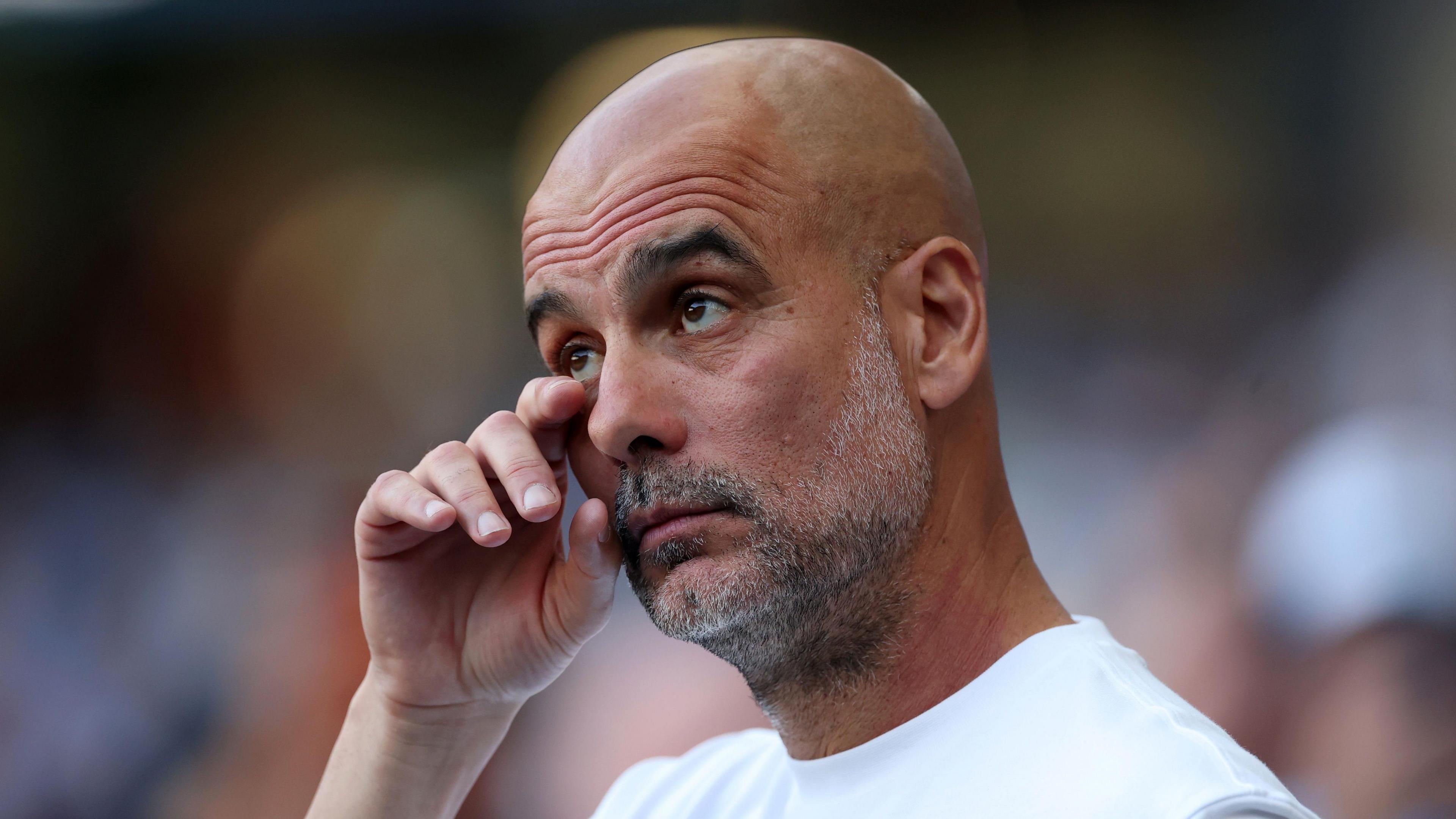
Pep Guardiola's composure finally shattered in the 59th minute, as captain Bernardo Silva's number 20 went up on the fourth official's board at the Etihad Stadium. The tears that followed were not the tears of defeat—his Manchester City side had just lost to Aston Villa, after all—but something far deeper: the visible grief of a man saying goodbye to a decade that fundamentally transformed English football.
The embrace between manager and player on the touchline was raw and unfiltered, captured by photographers who would hang it in the stadium's corridors alongside images of Kevin de Bruyne, Sergio Aguero, and Yaya Toure. "If you want to cry then cry, if you want to laugh then laugh," Guardiola would say afterward. "Emotions—you have to express them."
For ten years, the 55-year-old Spanish manager has been the architect of City's unprecedented dominance. He leaves behind six Premier League titles, one Champions League trophy, three FA Cups, and five Carabao Cups—a haul so staggering that only Sir Alex Ferguson's Manchester United and Bob Paisley's Liverpool in the 1970s and '80s can be mentioned in the same breath. His 593 games in charge yielded 416 victories, a 70.2 percent win ratio unmatched in the elite reaches of English football management. His points-per-game average of 2.28 stands alone among managers with 20 or more games under their belt.
Yet as Guardiola wiped his face dry with his white t-shirt and tried to regain composure in the Manchester heat, he seemed less concerned with the statistical immortality his record guarantees. Hundreds of supporters had lined the barriers before kick-off, clutching scarves and flags bearing his face. A massive banner in the East Stand proclaimed "10 years with Pep—Game changer, history maker, City forever." And the club had renamed the newly expanded north end the 'Pep Guardiola Stand,' ensuring his name would be immortalised at the stadium forever. His 95-year-old father, Valenti, was there to witness it.
"Many memories—forget the titles, it's the memories," Guardiola told the crowd, his voice cracking. "All of us, all the people here are extraordinary. Life is made of periods. We lived an incredible period." He spoke of the energy required to sustain such relentless excellence, acknowledging what everyone in the stadium already knew: that this was the natural end of something transcendent, not a failure or a falling away.
His rival across the touchline, Aston Villa's Unai Emery, had called Guardiola football's "only genius" in the build-up to the match and presented him with a memento before kick-off. Emery's players delivered a 2-0 victory, their goals scored by Ollie Watkins and Antoine Semenyo, but the result felt almost incidental to the occasion.
When Guardiola completed his final lap of honour and exited down the tunnel, City fans chanted his name one last time: "We've got Guardiola." The chant, of course, was no longer true. But the legacy he leaves behind—the trophies, the records, the transformed standard of what Manchester City could become—will echo through the corridors of the Etihad for generations. His peace, he said, was profound.