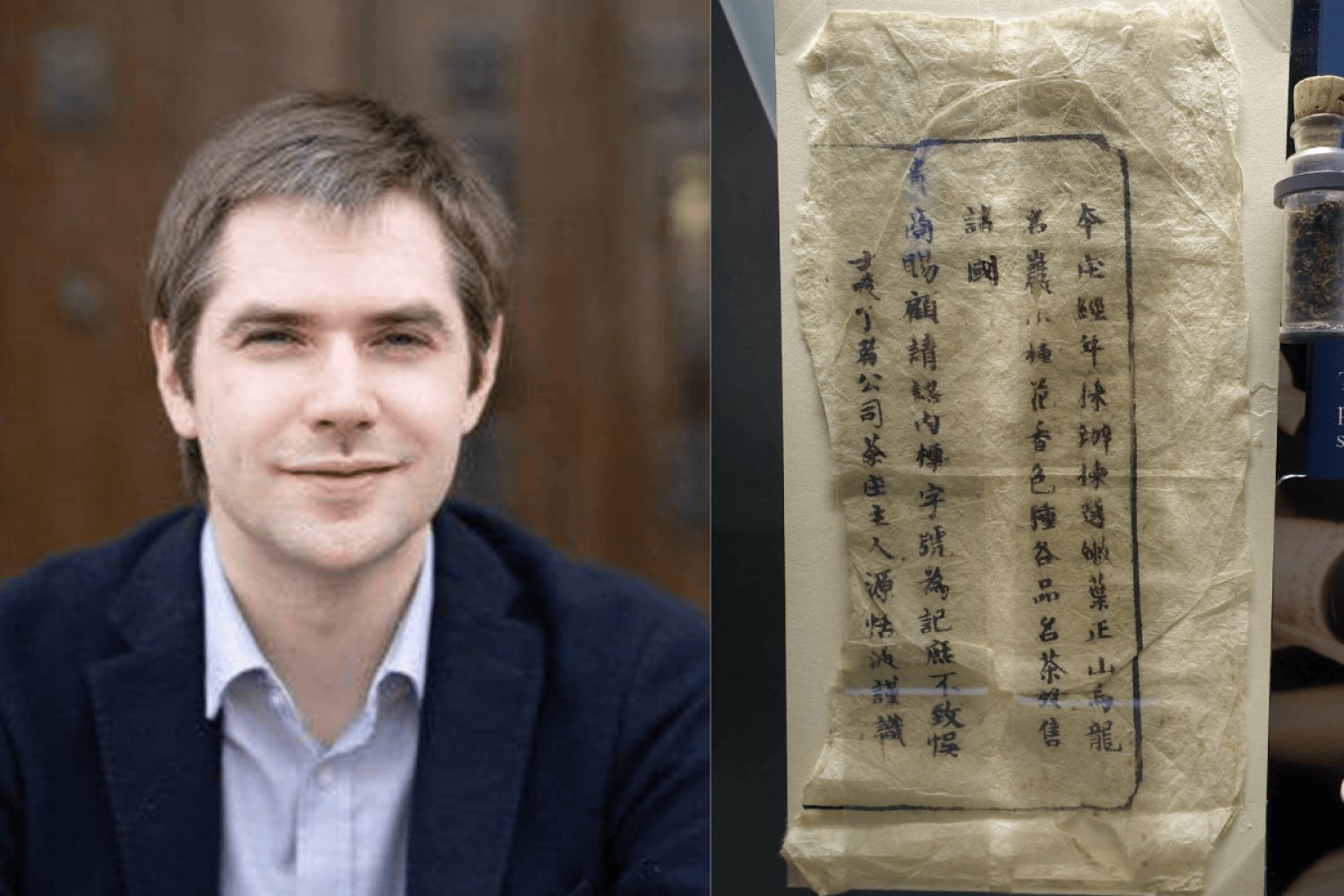
Thomas Wells never threw tea into Boston Harbor. But for decades, his descendants displayed a small Chinese label at the Old South Meeting House, claiming their ancestor had grabbed it during the 1773 Boston Tea Party — one of the most famous acts of protest in American history.
Now, a historian at the Massachusetts Institute of Technology has revealed that the label tells a completely different story.
Tristan Brown, who studies the history of China, spent about a year investigating the object after the American Historical Review asked scholars to write about 76 artifacts tied to 1776, the year the United States declared independence. Brown remembered seeing the curious Chinese label during a visit to the Old South Meeting House, the Boston building where colonists gathered before the Tea Party.
At first, Brown believed the label might really be from the 18th century. Scholars from the British Museum and Harvard University had examined it before, and none had ruled out that possibility. Plus, very few objects from the Tea Party survive. Destroying the tea was a crime, and participants hid their identities to avoid punishment by the British Crown — making any physical trace of the event feel precious.
The decisive clue turned out to be hiding in the label's Chinese text. Previous researchers had tried reading the characters using Mandarin, the official language of northern China. But Brown realized one sequence was being used for sound, not meaning. When he read it in Cantonese — the dominant language of 19th-century commerce — it spelled out "Smith, Archer."
That revealed the label came from Smith, Archer & Co., an American trading firm active in East Asia during the 1860s and 1870s. In other words, the object was made nearly a century after the Boston Tea Party, not during it.
The finding does not make the label worthless. In fact, Brown argues it reveals something equally fascinating: how Chinese migration, Pacific trade, family memory, and national mythology all tangled together to give this simple label a dramatic origin story.
Brown worked closely with members of the Wells family as the evidence shifted away from the Revolutionary era. He found them eager to learn the truth.
"The Wells family, especially Charles Wells, were extraordinary collaborators," Brown said. "They cared deeply about their ancestor's legacy and the label's history, and they wanted the truth as much as I did. This is their discovery as much as mine."
Brown published his findings in the American Historical Review in July 2026. The label remains on display at the Old South Meeting House — now with a richer, stranger, and more honest story behind it.