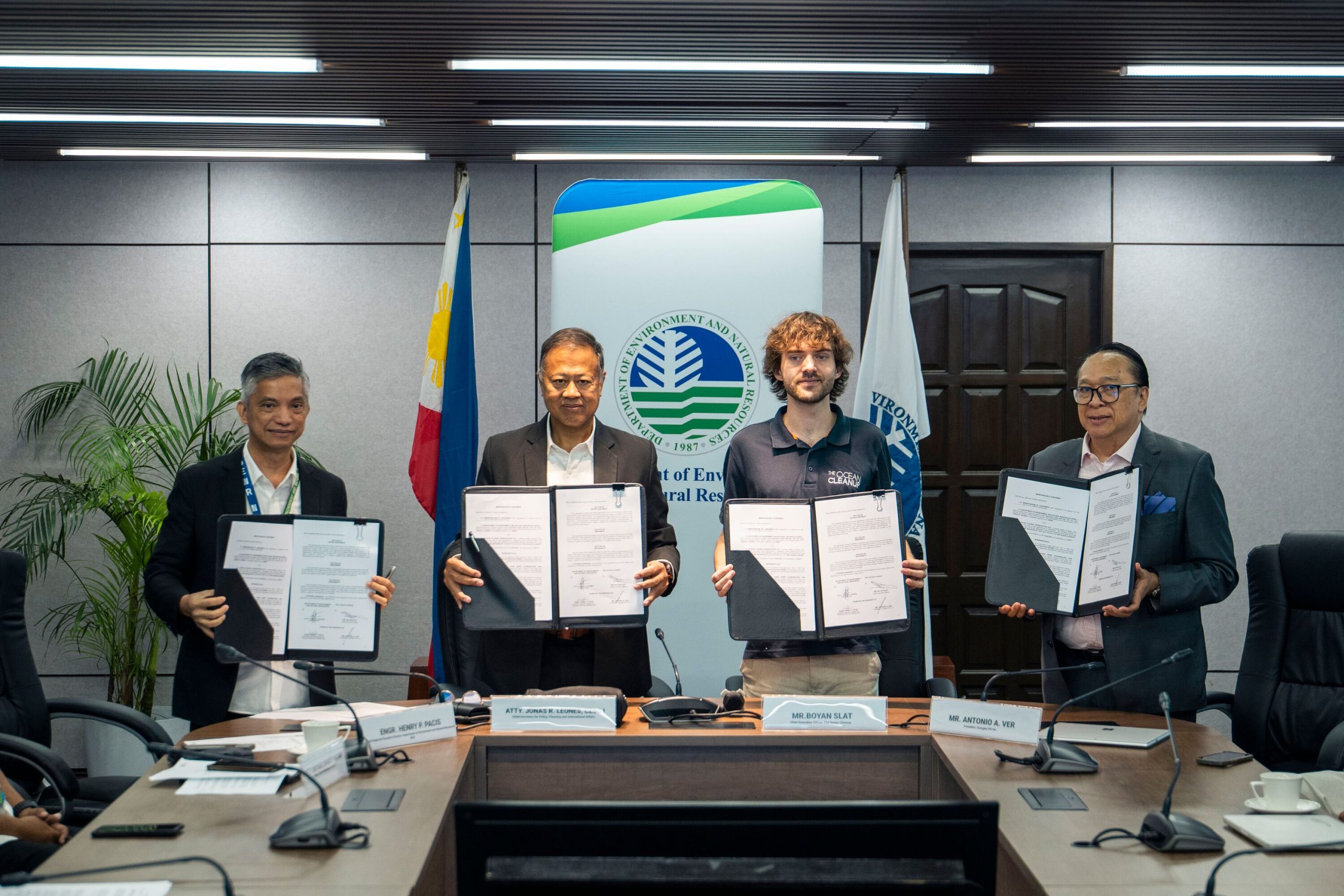
When Secretary Juan Miguel Cuna looked out at the Pasig River, he saw what decades of consumption had wrought: a waterway so choked with plastic that it functioned less as a river than as a pipeline funneling waste directly into Manila Bay and the open ocean. This June, the Philippine government decided to change that story. The Department of Environment and Natural Resources signed a five-year partnership agreement with The Ocean Cleanup, a global non-profit engineering firm, to deploy solar-powered Interceptor technology in one of the world's most critical coastal regions—a decision that marks a pivotal shift in how the Philippines tackles plastic pollution at scale.
The partnership, formalized on June 4th with support from the Philippine Embassy in The Hague and the Dutch Embassy in Manila, represents something unusual: a two-pronged strategy that attacks the problem from both directions simultaneously. The government is enforcing upstream accountability through Republic Act 11898, the Extended Producer Responsibility Act, which requires large companies to recover and recycle their own plastic packaging. At the same time, The Ocean Cleanup will deploy its proven Interceptor technology to capture waste already flowing through the river system—a race against the current, quite literally, to intercept trash before it reaches the ocean.
The Ocean Cleanup brings formidable credentials to this work. The organization has already deployed 21 Interceptors across 10 countries and collected more than 52 million kilograms of trash from aquatic environments as of April 2026. Its technology is elegant in its efficiency: solar-powered, fully automated, and engineered specifically for high-volume capture in the kinds of heavy, continuous waste loads that characterize the Pasig River. The Manila Bay region is now one of 30 key cities where The Ocean Cleanup is scaling its solutions, part of a global initiative launched last year with an ambitious goal—to eliminate up to one-third of all plastic flowing from the world's rivers into the ocean before 2030.
For the Philippines, this partnership carries broader significance than any single piece of technology. It directly serves President Ferdinand Marcos Jr.'s flagship initiative, the "Pasig Bigyang Buhay Muli" project—literally, "Pasig, Give Life Again"—a comprehensive restoration program aimed at making the river clean, navigable, and central to sustainable urban renewal. Secretary Cuna framed it precisely: "We cannot allow this river to remain a pipeline of plastic to the ocean. This agreement is a decisive step toward breaking that cycle."
What distinguishes this partnership is its commitment to knowledge transfer. Over the five-year agreement, The Ocean Cleanup will work directly with the Pasig River Coordinating and Management Office to train local authorities in the specialized skills and technological insights needed to maintain the river independently once the project reaches maturity. This ensures that foreign expertise becomes local capability—a model that invests in lasting change rather than temporary intervention. Boyan Slat, founder and CEO of The Ocean Cleanup, emphasized the collaborative spirit: "Plastic pollution is a global problem that requires strong local partnerships to solve it."
Preparations are already underway. The Ocean Cleanup has surveyed nearly 100 potential deployment sites and is working with the DENR to identify strategic locations for maximum impact. The first Interceptor barrier is set to deploy in the Meycauayan River in Bulacan. For a river that has carried the burden of consumption for far too long, momentum is finally shifting toward restoration.