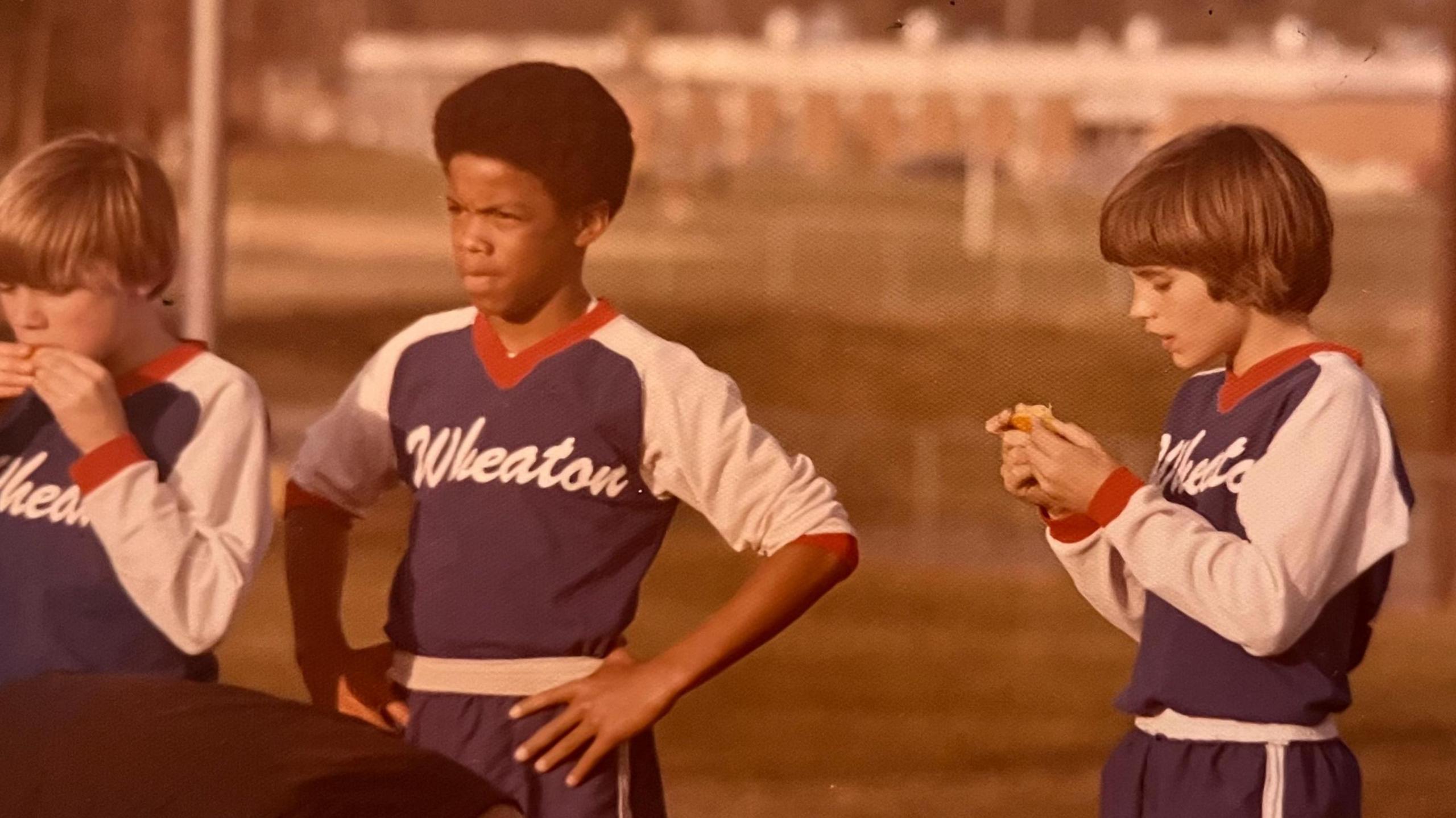
Desmond Armstrong's path to the world's biggest soccer stage began not with a ball at his feet, but with a television set in a white, suburban Maryland neighborhood. A coach called him over one afternoon to watch a Brazilian striker in a New York Cosmos jersey—Pele—whose elegant movement reminded Armstrong of the point guards he'd watched in basketball. "He was one of the few Black players on the team, so that connected me," Armstrong recalls. That moment of recognition would anchor him through a career forged against long odds.
In 1990, as Armstrong stood on the threshold of the World Cup in Italy, few Americans understood what was at stake. The sport itself remained marginal in a country where a professional league had collapsed, where grassroots development ran on privilege rather than investment, and where young players from modest backgrounds faced near-insurmountable barriers. Unlike Europe and South America, where clubs funneled resources into youth talent, American soccer operated on a pay-to-play model—families had to meet significant costs or secure sponsorship for their children to advance. "This is the simplest game with the easiest access. Everybody plays it around the world with no money, no soccer balls, no shoes," Frank Dell'Apa, the Boston Globe's soccer columnist, would later reflect. "And here, we had just the opposite thing going on."
Armstrong knew how fragile his own story was. "If my folks didn't move into the suburbs, then hands down I'm not playing soccer," he says. The collapse of the North American Soccer League in 1985, while he was still in college, had already truncated professional pathways for his generation. He turned to the Major Indoor Soccer League, where his performances earned a national team debut in 1987 and a spot at the 1988 Seoul Olympics. "I remember being on the field, hearing the national anthem and just thinking 'this is where I'm supposed to be,'" he says.
By 1989, FIFA had selected the United States to host the 1994 World Cup—the first time the tournament would be held outside Europe or Latin America. The federation made a bold gamble: with no elite outdoor professional league, they secured a core group of players on full-time contracts, essentially converting the national team itself into the country's professional infrastructure. It was an unorthodox strategy, more Eastern Bloc than American, and they appointed German-Hungarian coach Bob Gansler to lead this improvised team toward an impossible task: qualify for Italia '90.
On November 19, 1989, the USA pulled off a shock upset against Trinidad and Tobago in Port of Spain, securing the final qualifying spot. Armstrong watched from the sidelines, sidelined by an ankle injury, but ran onto the pitch at the final whistle anyway. "Everybody was going crazy," he says. "We got there with no pro league in the country. Unbelievable. But everybody in America couldn't care less."
At the Stadio Comunale in Florence, the Czechoslovakians humbled the Americans 5-1 in their opening match. But Armstrong's real test awaited in Rome: a matchup against the hosts, Italy, before 73,000 spectators at the Stadio Olimpico. The Azzurri fielded the full might of Serie A—Franco Baresi, Paolo Maldini, Roberto Donadoni—and so much depth that Roberto Baggio, Juventus' world record signing, sat on the bench. Armstrong's assignment was to contain Gianluca Vialli. Here was a Black American player from a Maryland suburb, raised by a single mother, standing against the football machinery of a European power.