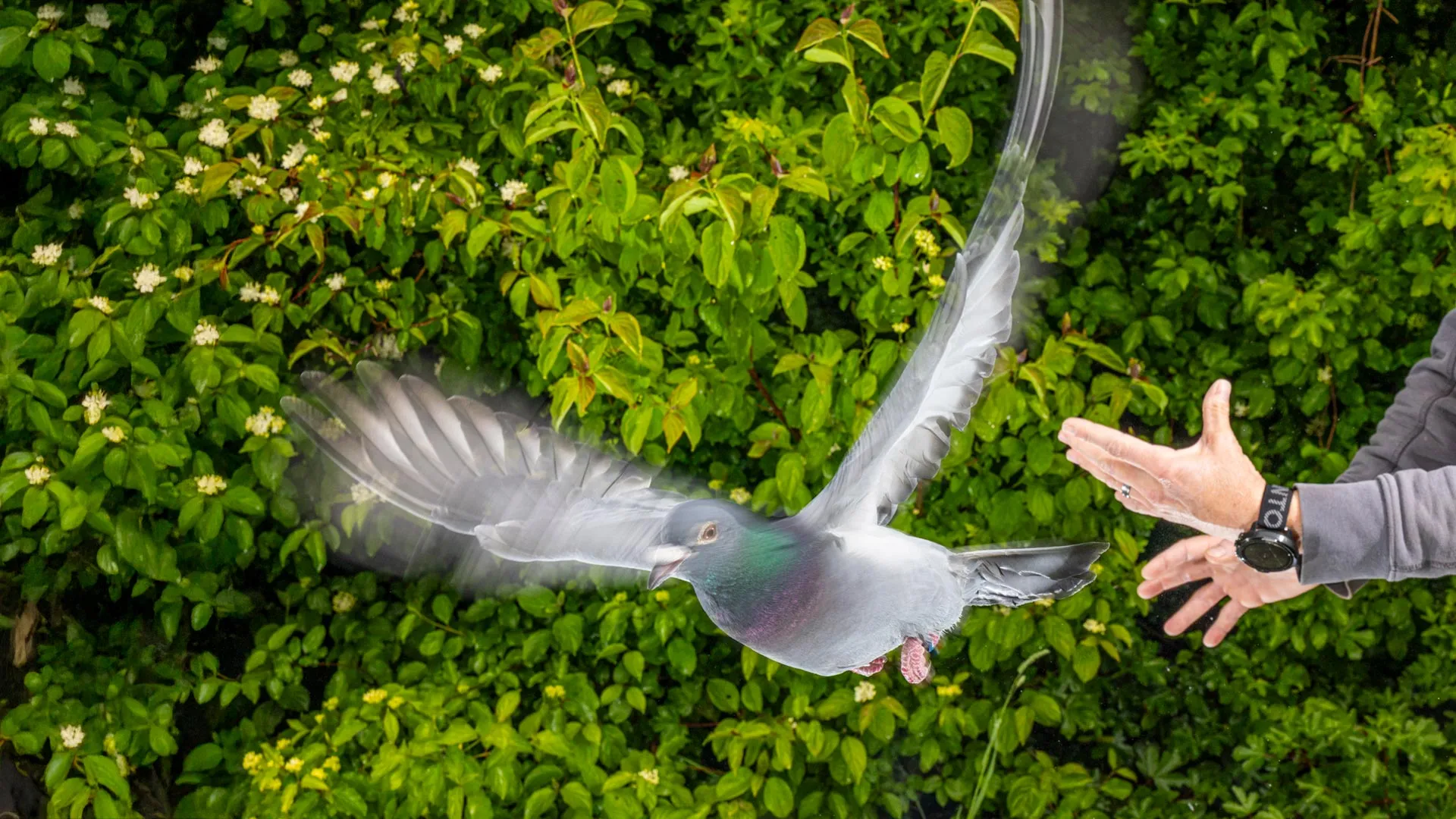
For decades, the mystery of how homing pigeons return to their lofts after traveling more than twenty kilometers through unfamiliar territory has captivated scientists—but the answer was never supposed to be in their liver. New research published in Science reveals that pigeons use specialized immune cells called macrophages in their livers to detect Earth's magnetic field, solving one of biology's most enduring puzzles through a mechanism no one expected.
The discovery matters because it fundamentally changes how we understand animal navigation. Scientists have long known that homing pigeons and migratory birds rely on Earth's magnetic field as one of several navigation tools, yet the biological mechanism remained elusive. Over the years, researchers proposed that birds might sense magnetism through light-sensitive molecules in their eyes or tiny magnetic particles in their beaks—theories that persisted despite lacking strong experimental confirmation. Now, researchers from the University of Bonn, the University Hospital Bonn, the University of Duisburg-Essen, and the Max Planck Institute of Animal Behavior have uncovered something more elegant: the answer was hiding inside immune cells all along.
The team, led by Dr. Clivia Lisowski, suspected the liver and spleen because both organs break down old red blood cells and accumulate iron in the process. Using advanced techniques including vibrating sample magnetometry and magnetic cell separation, they examined multiple tissues in pigeons. The results were striking. Among all organs studied—including eyes, beak, and brain—the liver contained the highest concentration of iron and produced the strongest magnetic response. Within those liver tissues, iron-rich macrophages crystallized into oxide nanoparticles, making the cells superparamagnetic and capable of responding to magnetic fields.
But identifying the cells was only half the puzzle. The researchers needed to prove these macrophages actually guided navigation. At the Max Planck Institute in Konstanz, Germany, they trained pigeons to navigate home from distant locations, then carefully removed the liver macrophages and monitored the birds' performance. The results revealed something profound: on overcast days when the sun was hidden, pigeons without the macrophages lost their sense of direction and struggled to find their way home. On sunny days, however, they navigated successfully, likely relying on solar cues instead of Earth's magnetic field. This suggests birds use magnetic information alongside other sensory cues, creating a sophisticated, redundant navigation system.
Perhaps most intriguingly, researchers used electron microscopy to discover that iron-rich macrophages sit close to nerve fibers—suggesting a direct pathway for magnetic information to travel from the liver to the brain. "These findings provide the first concrete evidence of how the Earth's magnetic field can be perceived within the body and passed on to the brain to guide movement," Dr. Lisowski explained. As Prof. Christian Kurts noted, "We didn't expect immune cells to act like sensors for magnetic fields at all."
The discovery illuminates how multiple biological systems—iron metabolism, immune function, and nervous system communication—work together to create what feels like instinct but has a measurable, physical basis. For pigeons returning home after months away, that gut feeling is anything but mysterious anymore.