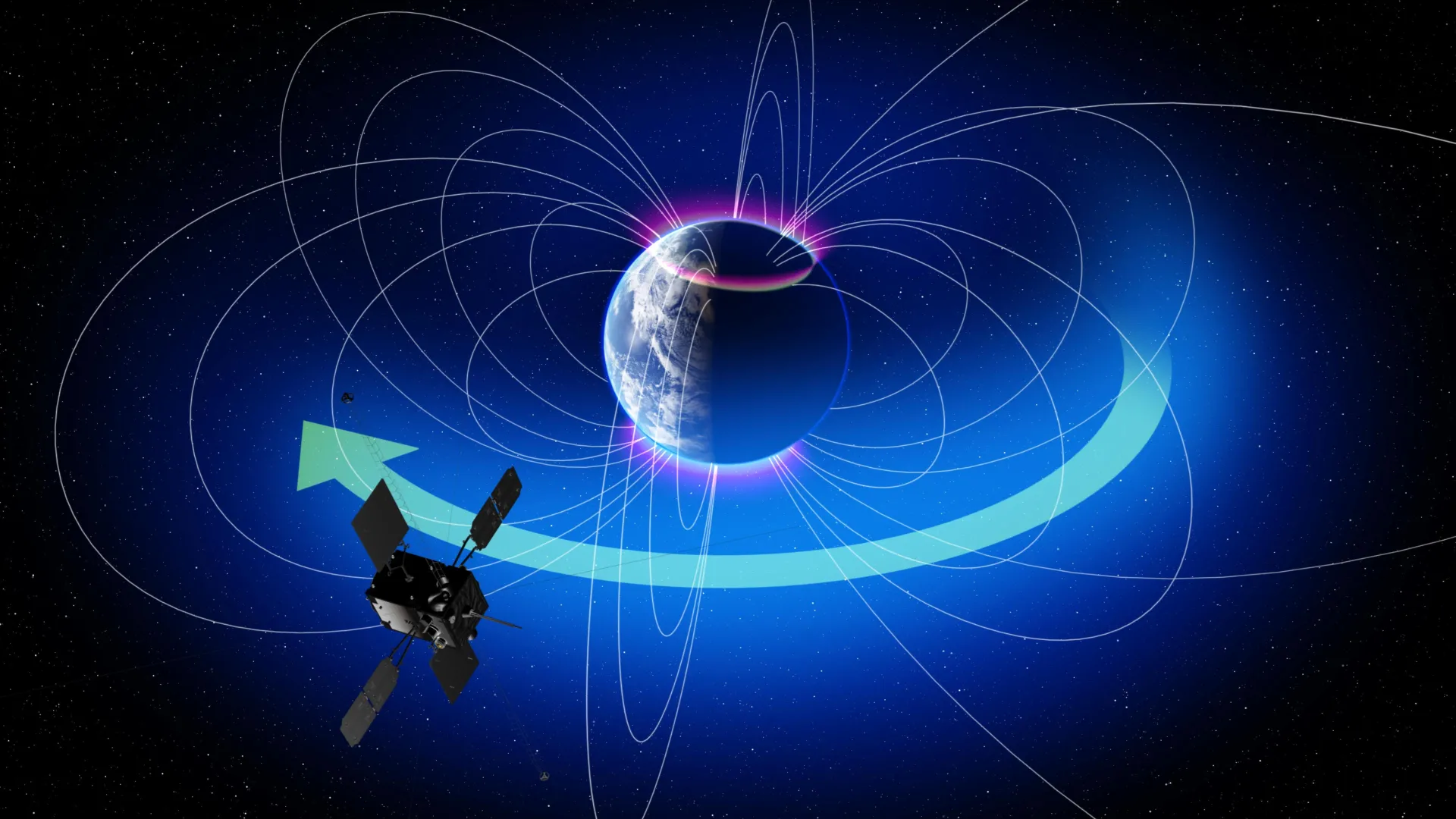
On May 10, 2024, Japan’s Arase satellite crossed Earth’s ring of charged particles just as a solar storm was building toward an extraordinary peak. Its measurements revealed a surprising source of the storm’s particles: Earth’s own upper atmosphere supplied most of them, while the solar wind from the Sun contributed very little.
The storm, known as the Gannon storm or Mother’s Day storm, began after a large sunspot fired several powerful eruptions in quick succession. Clouds of magnetized plasma raced toward Earth and merged before striking the planet’s magnetic shield, or magnetosphere. The impact produced the strongest magnetic disturbance ever measured in the ring current, a belt of energetic particles circling Earth thousands of kilometers above the equator.
The event also sent vivid auroras into skies where the northern and southern lights are rarely seen. But these displays were only one sign of what was happening. Geomagnetic storms can disrupt GPS signals and communications, expose spacecraft to radiation risks and, in some cases, contribute to power outages.
Researchers have long known that particles in the ring current can come from two places: the solar wind, a stream of charged particles from the Sun, and Earth’s ionosphere, an electrically charged layer high in the atmosphere. Scientists expected the solar wind to remain a major source during this storm, especially because it was unusually dense. Instead, the first direct measurements of the ring current’s makeup during a storm of this scale showed that particles from Earth dominated to an extent not previously observed.
The observations came from Arase, a Japanese spacecraft launched in 2016 and operated by the Japan Aerospace Exploration Agency, or JAXA. The satellite travels through the region where the ring current forms. Its instruments can measure the mass and energy of individual ions, letting scientists identify the particles. Arase passed through the ring current shortly after the storm began and again as it neared its peak, giving researchers a rare look at how the belt changed during an extreme event.
The finding matters because the ions supplied by Earth are much heavier than those carried by the solar wind. Their presence may have strengthened the storm’s magnetic disturbance and helped the ring current reach its greatest intensity unusually close to the planet. On the SYM-H scale, which tracks changes in Earth’s magnetic field, the storm reached minus 518 nanotesla. That was the second-largest recorded disturbance since 1981; the previous storm of comparable strength occurred in November 2004.
The study, published in Science Advances, suggests that Earth’s atmosphere may have a larger part in shaping the worst geomagnetic storms than researchers had understood. Lead author Naritoshi Kitamura of Nagoya University said understanding how these storms develop has real-world importance, not just scientific value. The results also support a proposed Japanese satellite mission to investigate how atmospheric particles escape into space and affect storms. More observations could help scientists better understand what happens when the Sun’s most powerful eruptions reach Earth.