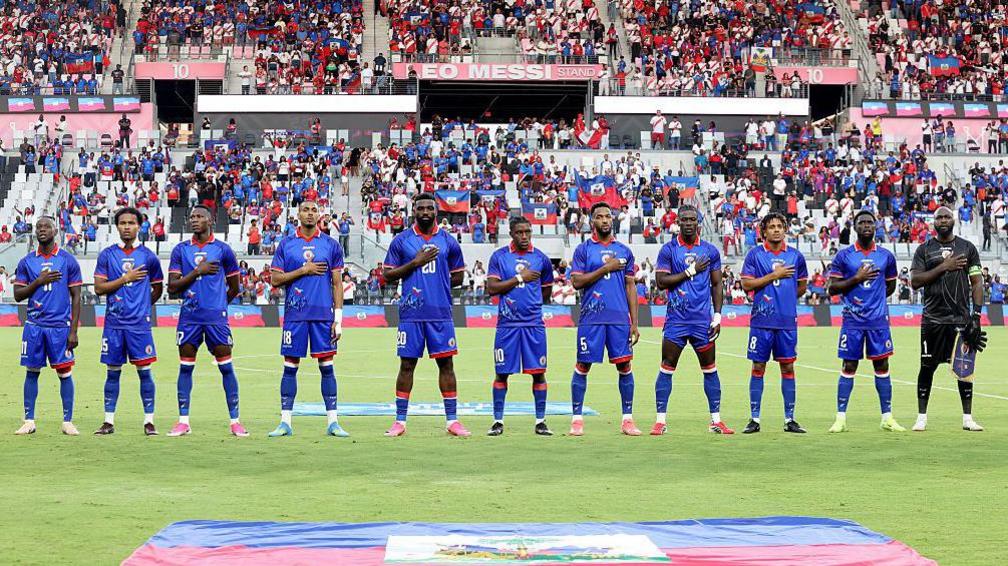
Woodensky Pierre grew up dodging bullets in Cité Soleil, playing football barefoot on rubble-strewn lots where hesitation meant danger — now he’s preparing to face Brazil at the World Cup. For a nation that hasn’t hosted a home match in five years and where gangs control much of Port-au-Prince, Haiti’s qualification is nothing short of miraculous. The team, largely forged abroad, carries the weight of a people long starved for pride. When Brazil last visited in 2004 for a UN-organized friendly, the capital fell silent — gangs observed a rare two-day ceasefire as 30,000 fans flooded the streets, waving flags and climbing trees to catch a glimpse of Ronaldo and Ronaldinho. Haiti lost 6-0, but the result was irrelevant. Peace, however brief, had taken the field. Now, 20 years later, Haitians will finally cheer for their own players on football’s biggest stage.
Group C pits Haiti against Brazil, Scotland, and Morocco — a daunting draw, but one met with defiant joy. Streets in Port-au-Prince have been swept, Haitian flags hung from balconies, and fans are rigging solar-powered screens to overcome chronic electricity shortages. The squad itself is a tapestry of diaspora and determination: 16 of the 26 players were born outside Haiti, representing 25 clubs across 15 countries. Coach Sébastien Migne, the Frenchman who once led Cameroon’s assistants at Qatar 2022, has stitched them together not with tactics alone, but with heart. "He just tells them put your heart in it," says Haitian journalist Pierre Richard Midy, who calls Migne a "magical coach."
Duckens Nazon, Haiti’s all-time top scorer with 44 goals in 80 appearances, was born in France but embodies the nation’s spirit. "When we put the shirt on, it's more than a normal game," he says. "We are the first independent black nation in the world. We have a lot of history. We have to assume this role." His words resonate deeply in a country still rebuilding from the 2010 earthquake that killed over 100,000. Defender Hannes Delcroix, raised in Belgium after being adopted at two, only recently reconnected with his birth mother by phone. "I have never seen them before in real life," he admits, "but through the phone, we call now and then."
Woodensky, the only domestically based player, was scouted through online videos — Migne never saw him play live. "He plays with instinct because he learned early that hesitation costs you everything," Midy says. "He is precious for Haitian people because we think he's the one to say, 'we are not dead, we have talent here.'" As the world watches, Haiti’s team isn’t just chasing victory — they’re carrying a nation’s hope, one pass at a time.