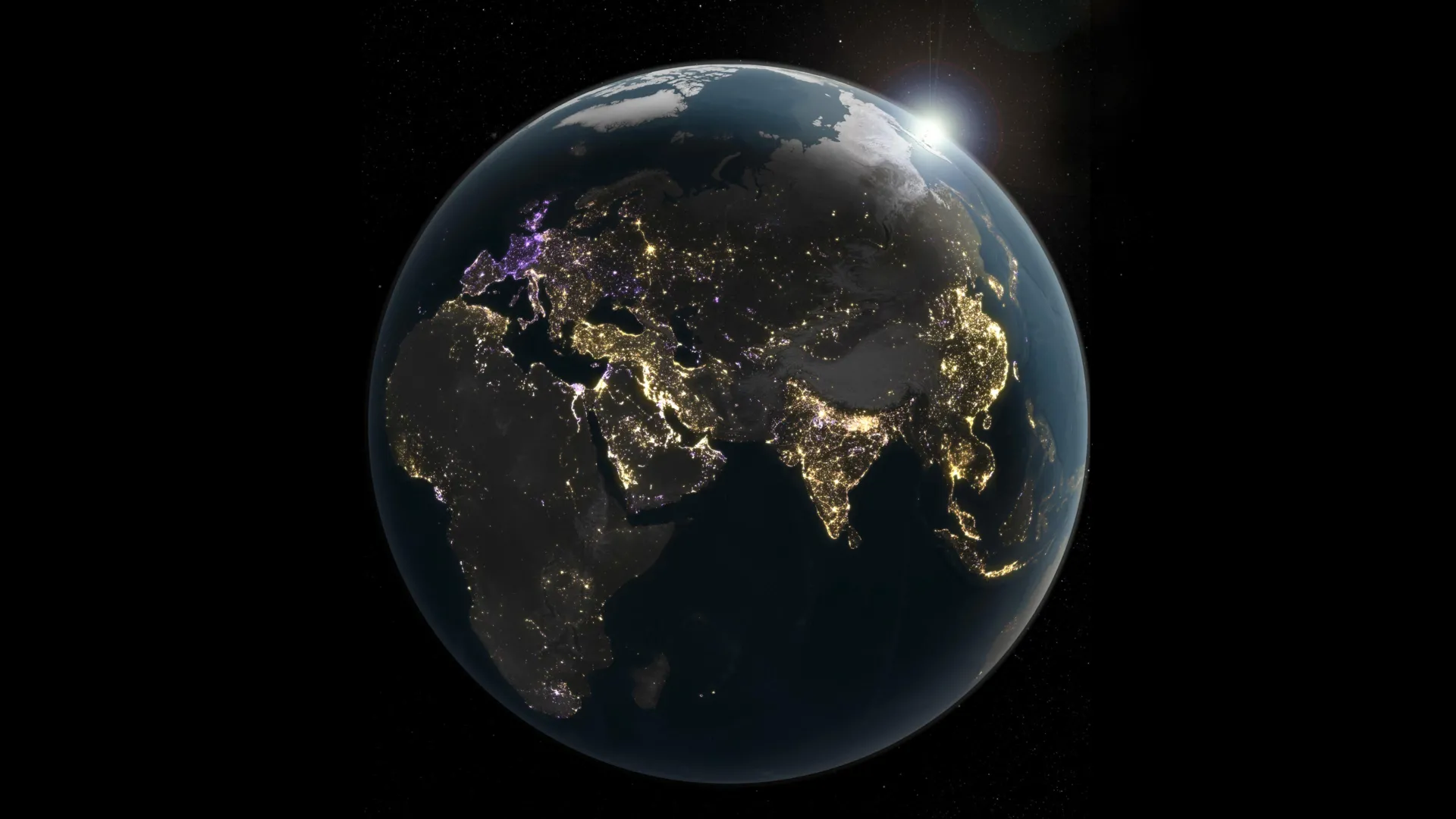
When night falls over France, something remarkable is happening: the lights are going out. Since 2014, nighttime brightness across the country has fallen by 33 percent, as cities from Nice to Nantes dim their streetlamps after midnight to save energy and protect their dark skies. It is a striking reversal — and one that satellite data now reveals is more widespread than scientists ever knew.
A new analysis of nighttime lighting using data from the VIIRS Day/Night Band instrument, spanning 2014 to 2022, shows that while the planet as a whole grew 16 percent brighter at night, the global picture is far from uniform. In regions where lighting increased, emissions climbed by 34 percent — but that rise was offset by an 18 percent decline elsewhere. The planet's nights are changing, and they are changing fast.
"Although there has been a total increase of 16 percent worldwide, that does not mean that lighting is increasing everywhere," said Christopher Kyba, a researcher at the GFZ German Research Centre for Geosciences who led the analysis. His team's work, published using full-resolution nightly satellite data for the first time,捕捉到了 earlier studies missed: short-term shifts, local policy changes, and even the effects of conflict.
Nowhere is that more visible than in Ukraine, where nighttime lighting plummeted sharply following Russia's 2022 invasion — a stark demonstration of how quickly human activity can vanish from the satellites' view. But elsewhere, the patterns tell a more hopeful story. Across Europe as a whole, nighttime light emissions fell by 4 percent, a trend driven largely by LED retrofits, energy conservation policies, and growing awareness of light pollution's toll on ecosystems and human health.
Germany illustrates the complexity of this shift: while some German regions brightened by 8.9 percent, neighboring areas dimmed by 9.2 percent — reflecting a patchwork of local priorities and planning decisions. "In Germany, light emissions remained almost constant overall despite local variations," Kyba noted.
The implications go beyond aesthetics. Artificial lighting now consumes a significant share of the world's electricity at night, and its ecological consequences — disrupting insect navigation, bird migration, and human circadian rhythms — are well documented. Understanding exactly how those emissions are shifting, in which directions, and at what pace, is a prerequisite for doing something about them.
That is why Kyba is pushing for a new kind of satellite. Currently, nighttime observations rely on instruments designed for other purposes, mounted on weather satellites operated by the U.S. and China. No European satellite currently dedicated to monitoring the night sky exists. Kyba is working with the European Space Agency to change that, proposing a next-generation system as part of the ESA's "Earth Explorer 13" mission — one capable of detecting far fainter light sources and offering dramatically higher resolution.
"While the U.S. and China each have multiple satellites that observe nighttime light, there is currently no European satellite designed for this purpose," Kyba said. The stakes, he argues, are worth the investment. With better data, cities like those in France can know precisely how much darkness they are reclaiming — and share that knowledge with the world.