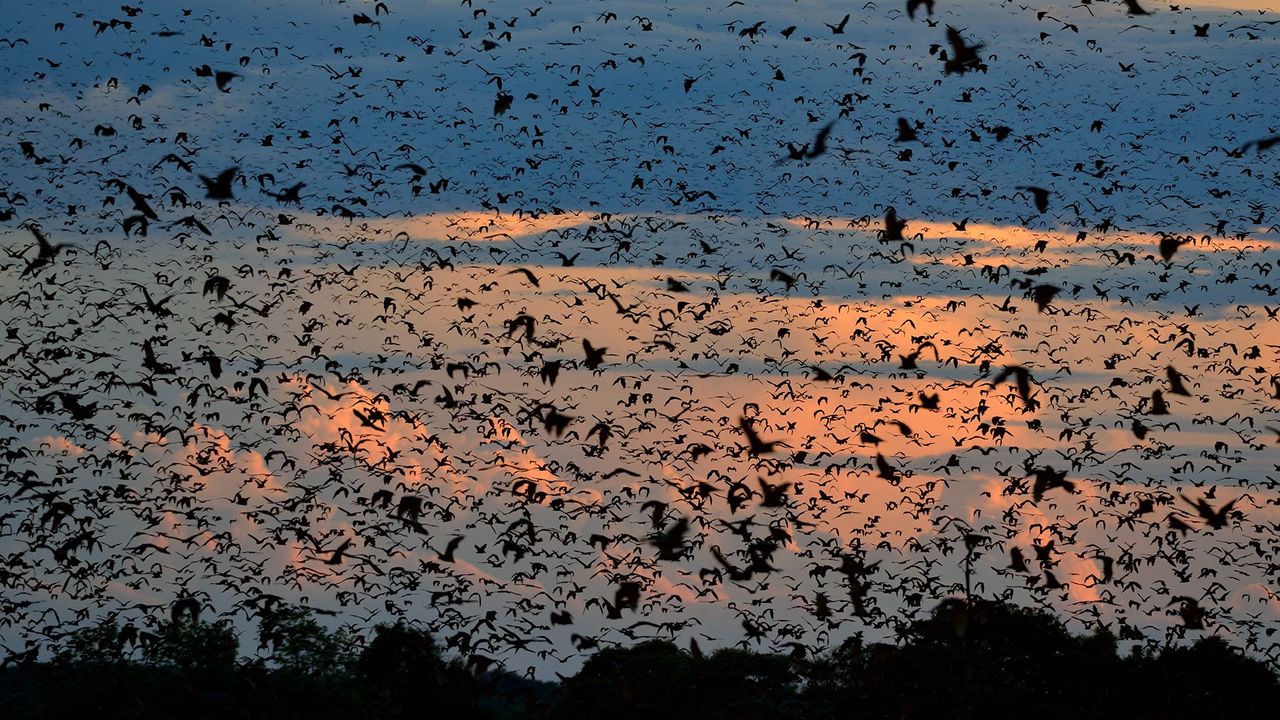
As dusk settles over Kasanka National Park, the forest begins to tremble. Eight million straw-coloured fruit bats stir in the canopy, their wings rustling like wind through dry leaves. From the Musola Hide, 10 meters above the ground, the sky erupts into motion — a swirling, chattering river of bats pouring from the trees like smoke caught in a storm. This is the largest mammal migration on Earth, and few have seen it.
Each year, between late October and December, 8–10 million Eidolon helvum descend on this 390-square-kilometer sanctuary in northern Zambia, drawn by a seasonal feast of wild loquat, milkwood, and waterberries. The spectacle dwarfs the Serengeti’s Great Migration in sheer mammal numbers — eight times over — yet only about 800 visitors witness it annually, compared to over half a million who flock to East Africa’s famed savannahs. Kasanka, tucked near the border with the Democratic Republic of Congo, remains a quiet secret: no safari convoys, no crowds, just papyrus swamps, lagoons, and a forest alive with wings.
These are no ordinary bats. With a wingspan of up to one meter and a nightly appetite equal to their own body weight — about 250 grams per bat — the colony consumes an estimated 230 to 250 tonnes of fruit every single night. Over their months-long stay, that adds up to around 330,000 tonnes of fruit devoured, and just as importantly, seeds dispersed. "Eidolon helvum disperse seeds both locally and over long distances," says Zambian bat ecologist Helen Taylor-Boyd. "They're capable of dispersing seeds further than many vertebrates studied, including elephants." In doing so, they act as invisible architects of the forest, replanting vast stretches of miombo woodland with every flight.
Some bats travel up to 96 kilometers in a single night, but their journeys extend far beyond. In 2005, biologist Heidi Richter tracked four bats fitted with solar-powered transmitters. One, named Hercules, flew more than 2,400 kilometers — a record-breaking journey that hints at a migration network spanning Central Africa. Yet much remains unknown. Where the bats come from, and where they vanish to in January, is still a mystery, with only a handful of tracking studies to guide researchers.
As the last of the bats disappear into the night sky, the forest quiets once more. But for a brief window each year, Kasanka pulses with one of nature’s most astonishing spectacles — a reminder that wonder still thrives in the quietest corners of the world.