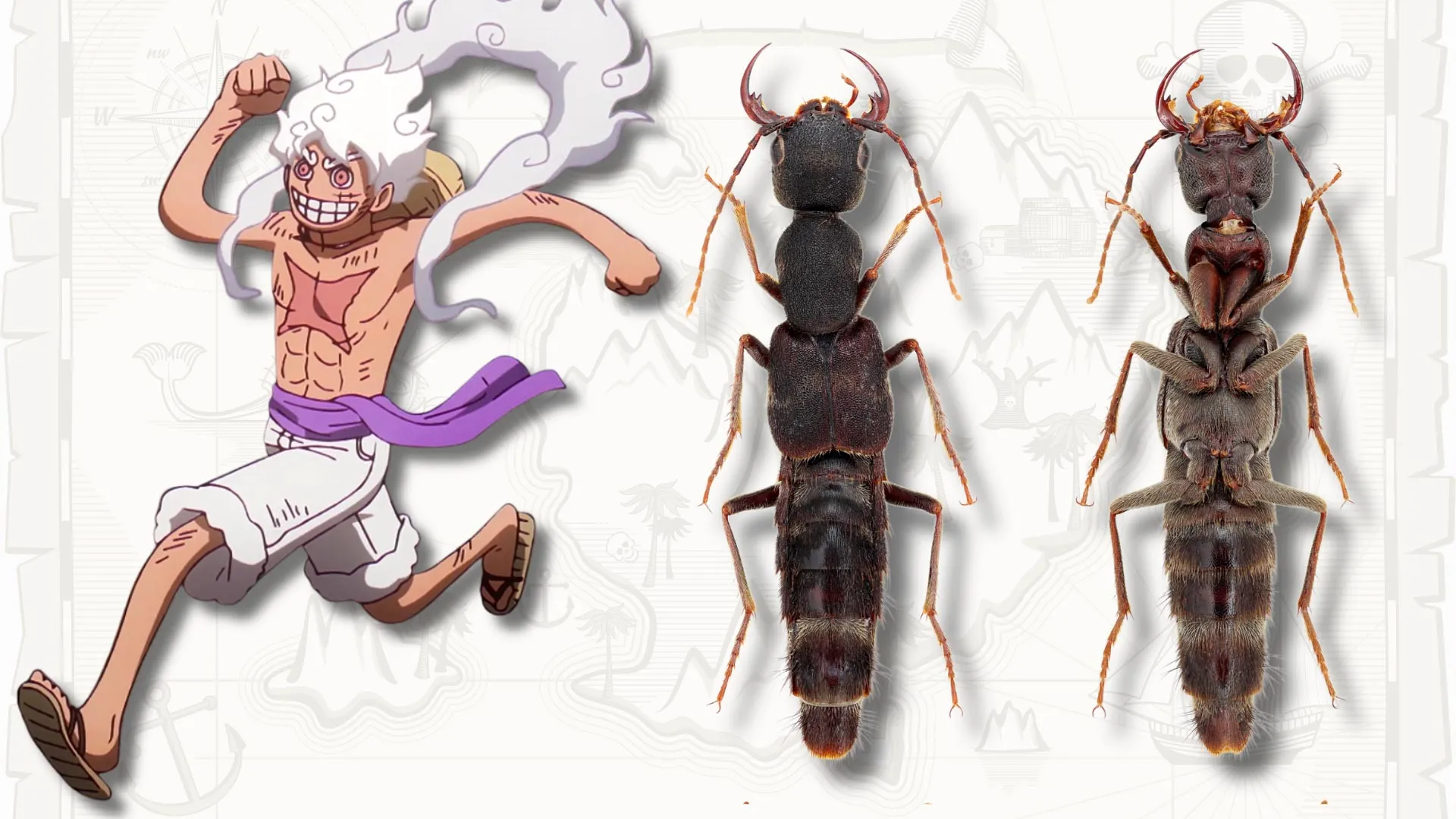
When scientists first spotted these beetles crawling through the forests of Yunnan Province, China, they noticed something unusual: body parts so long and slender they seemed to stretch like rubber. That quirky feature inspired the researchers to give these insects an unforgettable name — Luffy — after Monkey D. Luffy, the stretchy-armed hero of the popular manga and anime series One Piece.
Two new species now belong to this freshly named genus: Luffy schillhammeri and Luffy nika. Fang-Shuo Hu, a PhD student, and Alexey Solodovnikov from the Natural History Museum of Denmark described both in a study published in the journal ZooKeys.
Luffy schillhammeri was found in broadleaf forests in Yunnan and honors Dr. Harald Schillhammer of the Natural History Museum Vienna for his decades of work studying rove beetles. The second species, Luffy nika, was discovered in Louang Namtha, northern Laos. Its name refers to Luffy's legendary Devil Fruit awakening, a power that transforms him into a white, smoke-covered form. The researchers say the beetle's own white bands of hair across its body and wings echo that very image.
Beyond their memorable origins, these beetles solve a real scientific puzzle. Hu and Solodovnikov spent months reviewing every genus in a beetle group called the Ocypus group, studying hundreds of specimens and comparing tiny anatomical details. Their work clarified how several mysterious groups fit into the broader beetle family tree. They found that Luffy shares some key features with a lineage called the Eucibdelus, yet also has traits all its own. This makes Luffy something like a missing link — a genus that bridges two groups and helps explain how they evolved apart.
The researchers hope the story of stretchy beetles named after a rubber-limbed pirate will do more than entertain. By connecting science to something people already love, they want to spark curiosity about biodiversity and taxonomy — the science of naming and classifying living things. "Serious research can also be creative, memorable, and accessible," they note.
For the scientists, naming a beetle after a fictional adventurer was a way of showing that exploring nature can be just as exciting as sailing the Grand Line.