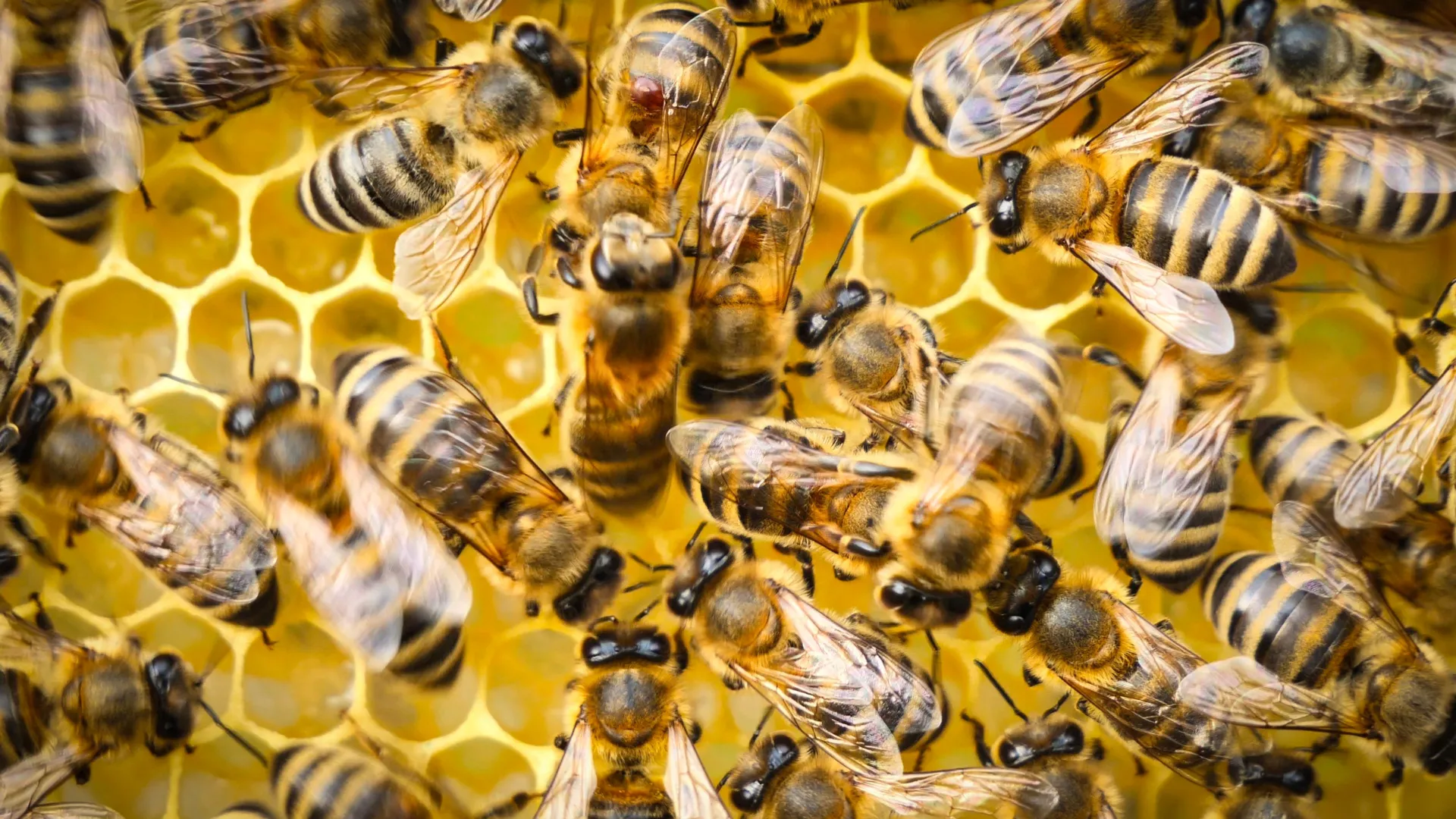
In the hills behind UC Riverside, something remarkable is happening inside the colonies that beekeepers there have been quietly watching for years. These bees aren't dying. And researchers finally want to know why.
Commercial hives across the United States are in crisis, with beekeepers losing as much as 62% of their colonies in 2025 alone. The collapse is tied to a web of pressures: pesticide exposure, climate stress, shrinking wild habitats, and parasites. But among these threats, one stands out for its devastation. The Varroa mite—an invasive parasite that feeds on bees' fat body tissue, crippling their immune systems and spreading lethal viruses—has become the single greatest driver of colony death worldwide.
Yet in Southern California, a naturally hybrid population of bees is proving something many thought impossible: they are keeping mite infestations under control on their own.
A new study published in Scientific Reports by researchers at UC Riverside's Center for Integrative Bee Research tracked 236 honeybee colonies from 2019 through 2022. What they found defied expectations. Colonies headed by locally adapted hybrid queens carried roughly 68% fewer mites on average compared to colonies led by standard commercial queens. Even more striking, these local colonies were more than five times less likely to reach infestation levels that would require chemical treatment.
These bees aren't the product of any formal breeding program. They descend from a wild, self-perpetuating population—many originally from feral colonies nesting in trees—combining genetic traits from at least four lineages: African, Eastern European, Middle Eastern, and Western European bees. No one designed them. They evolved.
To understand what makes these bees different, the research team ran experiments on developing larvae, because Varroa mites must invade brood cells to reproduce. They discovered that mites showed measurably less interest in larvae from the hybrid Californian bees, particularly around day seven of development, when young bees are typically most vulnerable.
"What surprised me most was the differences showed up even at the larval stage," said Genesis Chong-Echavez, a UCR graduate student and lead author of the study. "This suggests the resistance mechanism may go deeper than some kind of behavior and may be genetically built into the bees themselves."
The implications stretch far beyond one region. Honeybees pollinate crops worth billions of dollars annually, and their decline threatens food systems already strained by environmental change. If certain natural traits can suppress mite populations without chemical intervention, those traits could eventually inform breeding programs or reduce reliance on treatments that themselves carry costs.
Boris Baer, a UCR entomology professor and co-author of the study, stressed that the work began not in a laboratory but in conversation with the beekeepers who first noticed the bees surviving with fewer treatments. "They were not just observers; they helped shape the questions behind this research," he said.
Researchers caution that the hybrid bees aren't completely mite-free, and current beekeeping practices shouldn't be abandoned. But the findings point toward something rarer in today's environmental headlines: a problem that may already contain its own solution, waiting only to be understood.