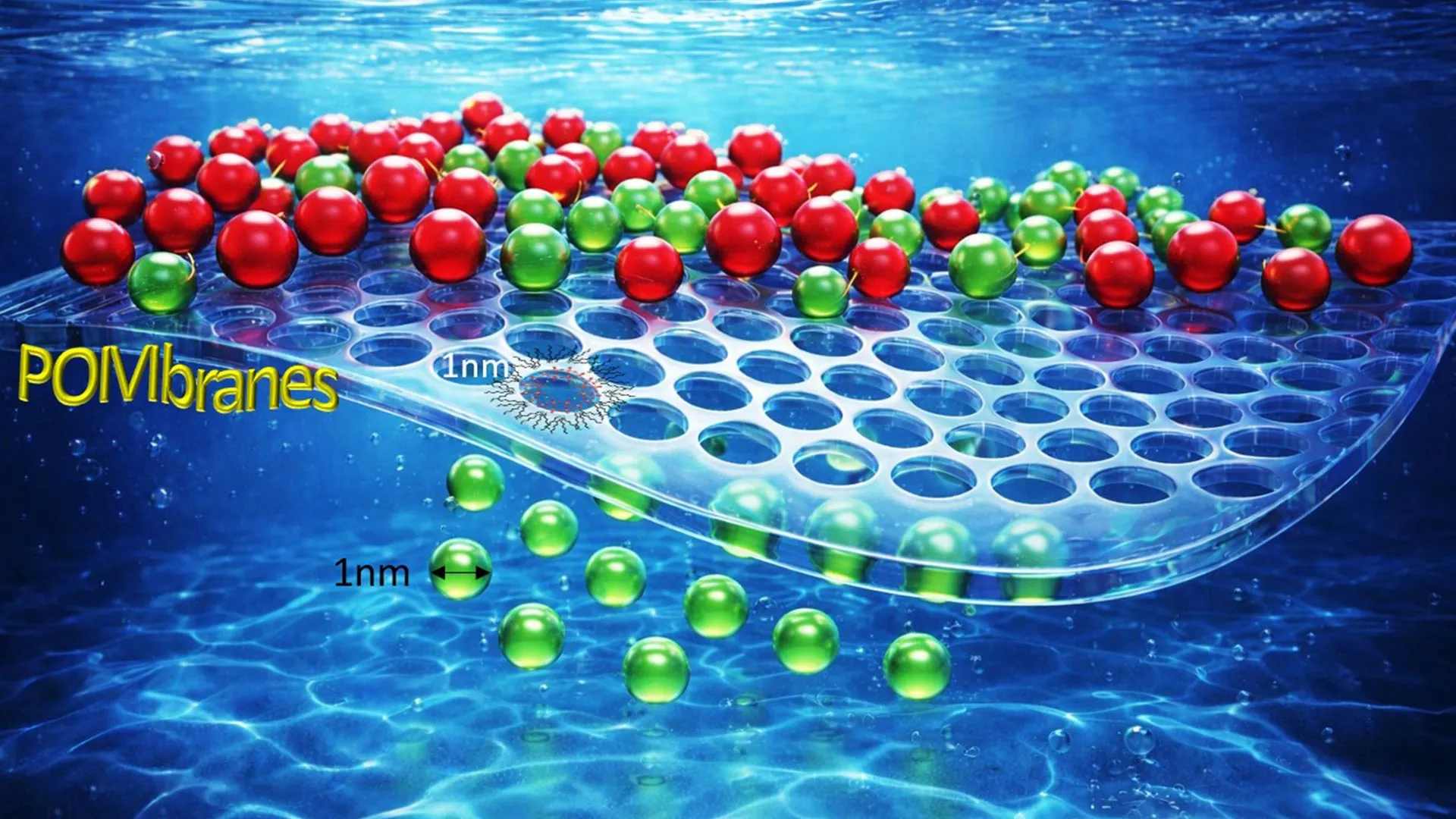
At the nanoscale, an Indian research team has engineered what amounts to a molecular sieve so precise it can distinguish between molecules differing by just 100 to 200 Daltons—a feat that marks a significant leap forward in industrial water treatment. Scientists from the CSIR-Central Salt and Marine Chemicals Research Institute (CSMCRI), the Indian Institute of Technology Gandhinagar (IITGN), Nanyang Technological University in Singapore, and the S N Bose National Centre for Basic Sciences have created membranes called POMbranes, which contain pores exactly one nanometer wide—thousands of times thinner than a human hair.
The breakthrough matters because separation processes like dye treatment, drug purification, and food production currently devour 40 to 50 percent of global industrial energy consumption. Most facilities still rely on distillation and evaporation, energy-hungry methods that drive up carbon emissions. While membrane-based filtration offers a cleaner alternative, conventional polymer membranes have historically suffered from a critical flaw: their pores are uneven in size and degrade over time, limiting their effectiveness in demanding industrial settings. The new POMbranes solve this problem by drawing inspiration directly from nature. They use polyoxometalate (POM) clusters—tiny, crown-shaped metal clusters that each contain a naturally occurring opening exactly one nanometer wide. Crucially, as Ms. Priyanka Dobariya, a CSMCRI research scholar and co-first author, explained, "These POMs are tiny, crown-shaped metal clusters that have a permanent, perfect hole in their centre that does not change or lose shape, which is the biggest hurdle with traditional plastic filters."
The technical innovation lies in how the researchers organized billions of these microscopic structures into a continuous, defect-free membrane. They attached flexible chemical chains to the POM clusters, and when placed on water, the modified clusters naturally spread out and self-assembled into an ultrathin film. By varying the length of the attached chains, the team controlled how tightly the clusters packed together, forcing all molecules to pass through the one-nanometer holes—and only those holes. Dr. Raghavan Ranganathan, Associate Professor at IITGN's Department of Materials Engineering, noted that "this forced molecules to cross the membrane through the only open path, the one-nanometer holes built into each cluster, allowing the membrane to act like a high-tech sieve."
Testing revealed that the POMbranes deliver nearly ten times better separation performance than existing technologies while remaining flexible, stable across different pH ranges, and manufacturable in large sheets. The findings, published in the Journal of the American Chemical Society, could reshape industrial water treatment, particularly in sectors critical to India's economy. India's textile and apparel industry contributes more than 2.3 percent of GDP and 13 percent of industrial production, with a domestic market valued at $160 to $225 billion today but expected to reach $250 to $350 billion by 2030. Textile dyeing and finishing alone generate vast amounts of contaminated wastewater; the new membranes could selectively remove dye molecules while allowing water to be recycled, simultaneously reducing freshwater demand and chemical waste. Similar benefits extend to pharmaceutical manufacturing and beyond. As Dr. Ketan Patel, Principal Scientist at CSMCRI, reflected, "Our membranes show almost ten times better separation performance compared to existing technologies, while remaining flexible, stable, and scalable." For water-scarce regions and energy-intensive industries worldwide, these one-nanometer openings may signal the beginning of a quieter, cleaner manufacturing era.