A planet where the sun never rises or sets might still harbor life. That's the surprising finding from researchers at the University of Pennsylvania who studied worlds that sound more like science fiction than science fact.
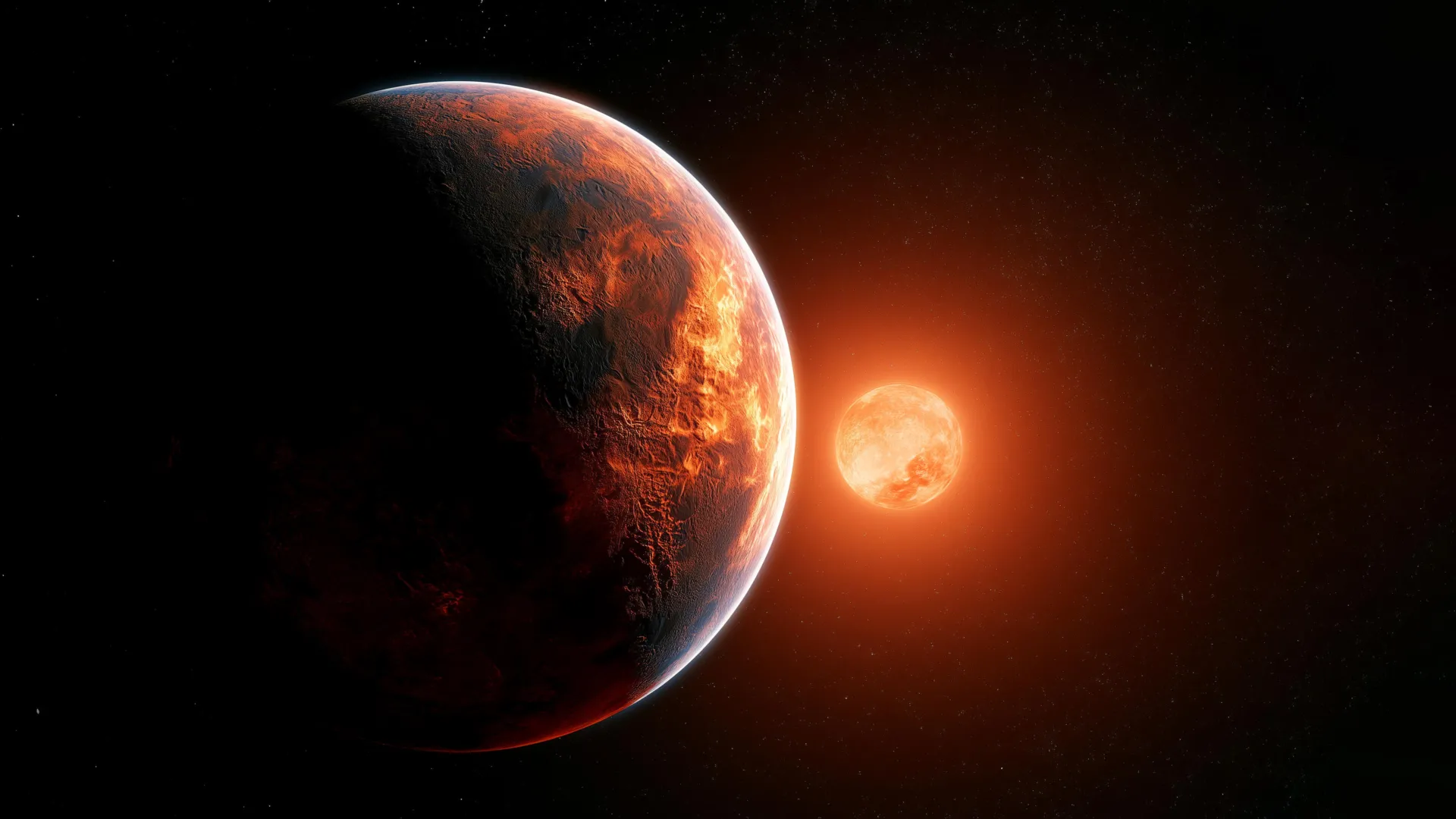
LHS 3844b is an exoplanet — a planet outside our solar system — located 48.5 light years away. It orbits a red dwarf star called LHS 3884, and it is slightly larger than Earth. But unlike our planet, LHS 3844b is what scientists call tidally locked. That means it rotates on its axis exactly once for every orbit it makes around its star, so one side always faces the light and the other stays in darkness forever. There is no sunrise, no sunset, no day-night cycle at all.
On the day side, temperatures can reach roughly 1,000 to 2,000 Kelvin — hot enough to melt rock. On the night side, it is so cold that particle motion effectively stops, approaching absolute zero, the coldest possible temperature in the universe. At first glance, this seems like an impossible place for life.
But Daisuke Noto, a postdoctoral researcher working with Hugo Ulloa at Penn's GEFLOW Lab, thinks otherwise. "Just looking at the extreme temperatures on the day and night sides — like 1,000 to 2,000 Kelvin on the day side and absolute zero on the night side — might lead one to conclude these exoplanets are too harsh for life," he said. "But life might find a way."
In a study published in the journal Nature Communications, Noto and collaborators from the Japan Agency for Marine-Earth Science and Technology and Hokkaido University discovered something unexpected. Tidally locked planets may actually create their own moderate zones where life could survive. The key lies deep beneath the surface, in the planet's mantle — the thick rocky layer between the crust and the core.
To study what happens inside these extreme worlds, the team built a miniature model in the lab. Noto joked, "Building an actual exoplanet in the lab wasn't in the budget." Instead, they used a small rectangular tank filled with a thick, syrupy liquid called glycerol, along with tiny temperature-sensitive crystals that change color as things heat up and cool down. Four thermostats heated and cooled different regions to mimic the drastic difference between a planet's day side and night side.
The experiment revealed a surprisingly stable pattern. Hot material rose beneath the day side, flowed across the upper region, cooled as it reached the night side, then sank and flowed back through the lower layers. It was one continuous circulation loop — steady and predictable.
"It's not chaotic like Earth's mantle," Noto said. "It's slow and steady. Predictable. Kind of boring — but in a good way."
This steady circulation acts like a planetary heat engine, distributing warmth from the hot side toward the cold side. The amount of heat transported was comparable to Earth's own mantle. That means some tidally locked exoplanets could maintain pockets of geothermal heat — localized environments warm enough and stable enough for life to potentially exist, especially in more temperate regions between the extremes.
This finding matters because tidally locked planets are actually very common in the universe. Any world orbiting close to its star tends to become tidally locked over time. If even some of these worlds can support life, the possibilities for habitability across the galaxy expand dramatically.
Noto believes this steady internal circulation might also influence a planet's magnetic field, which helps protect life from harmful radiation. That's something the current experiment couldn't test, but he calls it an exciting direction for future research.
For now, the message is hopeful: even in the most extreme corners of the universe, life might find a way to survive.