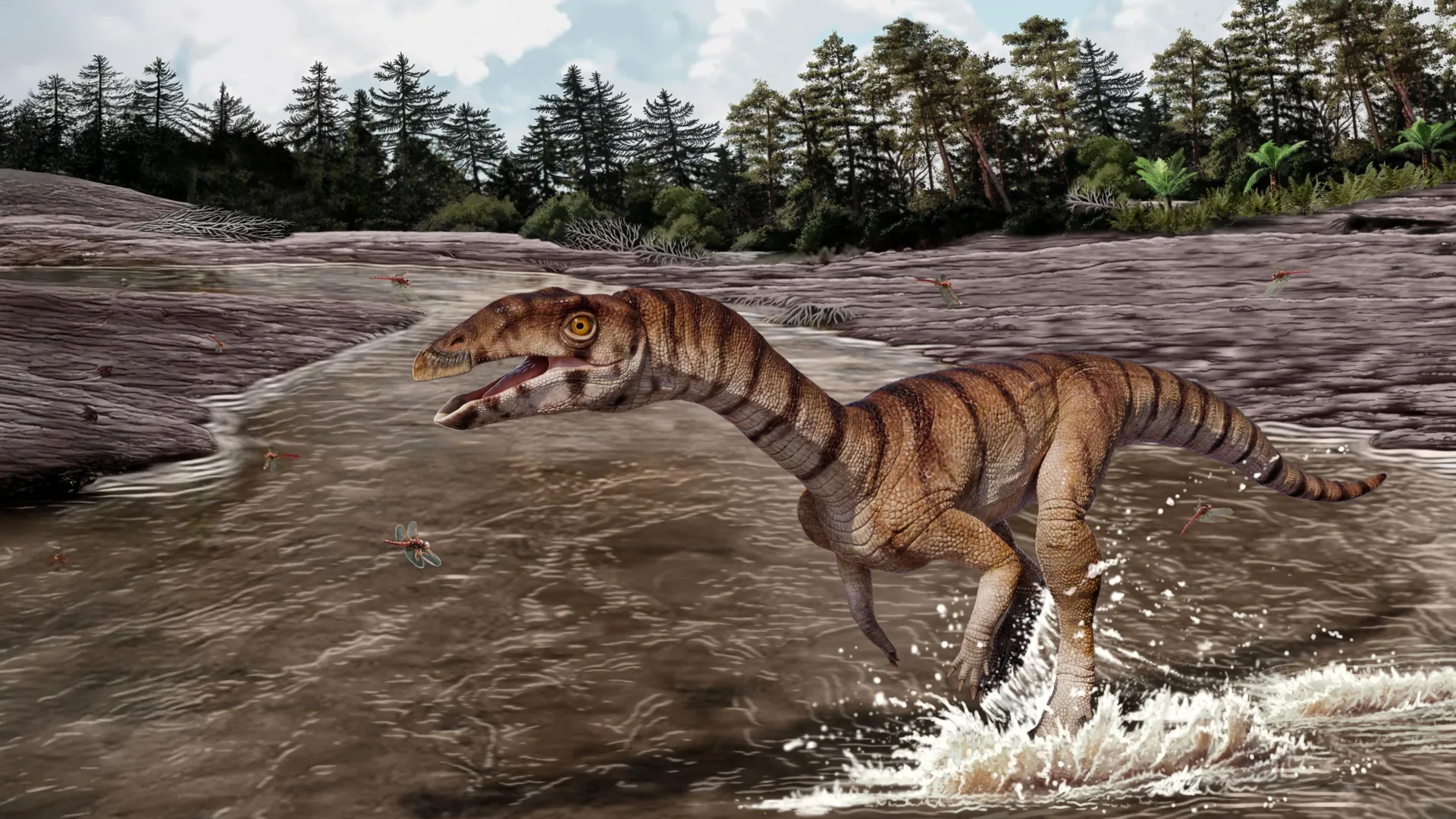
At Ghost Ranch in New Mexico, where local legend once warned of witches to keep cattle rustlers at bay, paleontologists have uncovered a creature that challenges everything we thought we knew about crocodile ancestry. Labrujasuchus expectatus, described this month in the Journal of Vertebrate Paleontology, was a small Triassic reptile that walked upright on two hind legs, possessed a beaked snout instead of teeth, and sported tiny forelimbs—making it look far more like an ostrich dinosaur than any crocodile alive today.
The discovery matters because it reveals how differently life experimented during the Triassic Period, roughly 250 to 200 million years ago, when the major animal groups we recognize now were only beginning to take shape. The world then was filled with unusual creatures testing out body plans that would later appear in dinosaurs, pterosaurs, and modern animals. Labrujasuchus belongs to Shuvosauridae, a small group of ancient crocodile relatives whose evolutionary lineage would eventually lead to the four-legged, tooth-filled reptiles we know today. Yet this newly identified species looked almost nothing like its modern descendants—a striking example of what scientists call convergent evolution, where distantly related animals independently develop similar features.
"We see a lot of the successful strategies for modern animals and non-avian dinosaurs first arise in the Triassic, and shuvosaurs are a great example of that convergent evolution," says Dr. Alan Turner, lead author of the paper. "Bipedalism is certainly a unique path for crocodile relatives to take, but it's a path well-trod by dinosaurs and later birds. It obviously worked for these animals."
Only five shuvosaur species have been identified so far, making Labrujasuchus expectatus especially significant. Paleontologists had previously discovered shuvosaur fossils from older and younger rock layers in the Ghost Ranch region, and they predicted that intermediate species must have existed in between. This new discovery fills exactly that gap. The species name—expectatus—was chosen deliberately to reflect this anticipated finding, acknowledging that scientists had long expected to uncover such a link in the evolutionary chain.
The genus name carries deeper local meaning. Labrujasuchus combines a reference to "Ranchos de los Brujos," an old Spanish name for Ghost Ranch meaning Ranch of the Witches, with the Greek word for crocodile. According to Dr. Nate Smith, co-author and director of the Dinosaur Institute, the land originally earned its name when local rancheros used it to scare people away from the Archuleta brothers' cattle-rustling operations. By honoring that colorful history in the fossil's name, the research team highlighted both the site's historical significance and its ongoing role in revealing Triassic secrets.
Ghost Ranch remains one of the world's most important windows into that distant past. Multiple fossil quarries have been excavated there for decades, consistently yielding exceptionally preserved specimens from the Late Triassic. This summer marks the 20th anniversary of intensive paleontological work at the site, where teams of scientists and volunteers continue to unearth creatures that reshape our understanding of how life experimented with different body plans before the age of dinosaurs truly began. Each discovery like Labrujasuchus expectatus reminds us that evolution's path was far stranger and more creative than we often imagine.