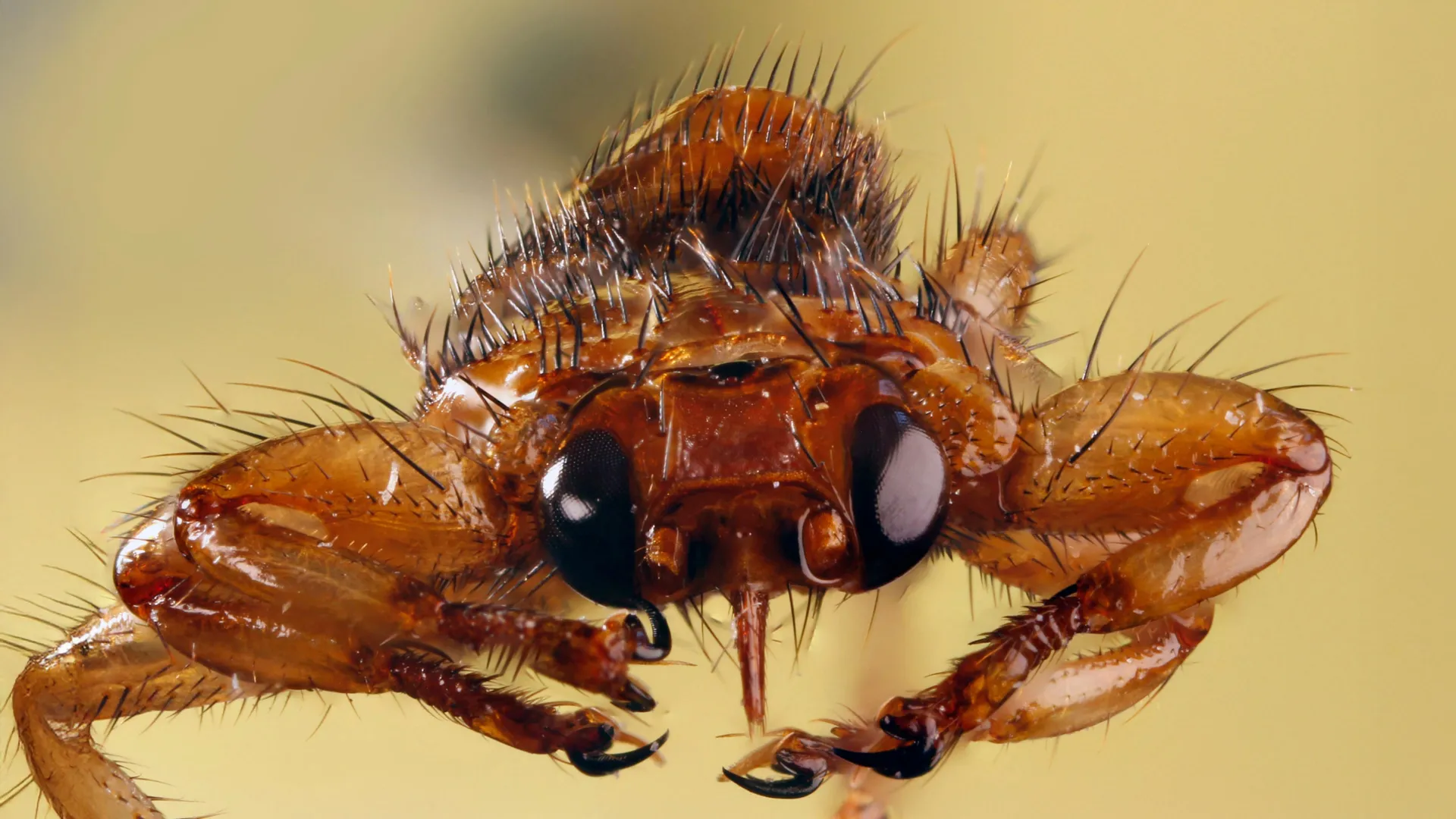
On the moment a deer ked lands on its host, the insect begins a transformation more radical than a caterpillar's metamorphosis—it sheds its wings and downgrades its eyes, trading flight and vision for a permanent life nestled in fur. This peculiar blood-feeding fly, found throughout Europe, Asia, Africa, and the Americas, has evolved a remarkably efficient answer to a simple question: why waste energy seeing when you no longer need to hunt?
Scientists from Aberystwyth University and the University of Florence discovered that this behavioral shift is accompanied by a dramatic rewiring of the fly's sensory system. The finding reveals how evolution tailors an animal's capabilities to match its circumstances—a lesson that hints at how other parasites have adapted to radically different lifestyles.
For much of its life, the deer ked is a hunter. Winged adults use both flight and vision to search through the landscape, seeking out suitable hosts, typically deer but occasionally humans and other mammals. Once airborne and searching, their eyes and visual systems work with the intensity of a tsetse fly's, one of Africa's most formidable mammal hunters. But the moment they land on a host, everything changes.
Dr. Roger Santer from the Department of Life Sciences at Aberystwyth University, who led the study, frames the trade-off plainly: "Vision plays a vital role in animal behavior, but it is also energetically expensive. Evolution favors sensory systems that are efficiently matched to an animal's way of life." For a permanent parasite, clinging to fur and feeding on blood, keen eyesight becomes a luxury the fly cannot afford.
The research team examined winged adults actively searching for hosts and compared them with wingless adults collected from deer after settling into their parasitic existence. They focused on genes associated with visual sensitivity, known as opsins, tracking how their activity changed after the flies shed their wings. The result was striking: opsin gene activity dropped to around half its previous level once the flies became ectoparasites.
Yet the deer ked does not go blind. Instead, it appears to scale back its visual capabilities strategically, dimming rather than extinguishing its sight. "The flies do not lose vision entirely, but their visual sensitivity is reduced," Santer explains. "We think the fly might be sacrificing sight to conserve energy for functions such as digestion and reproduction." In the bloodstream and fur of a host, vision is nearly useless. Energy devoted to eyes is energy not available for converting blood into offspring.
This finding, published in the Journal of Experimental Biology, offers a window into how parasites reshape themselves when their circumstances shift utterly. It is a reminder that animal bodies are not fixed blueprints but rather flexible solutions, constantly retuned by evolution to fit the world as it actually is.
Understanding how deer keds and other biting flies sense their world may eventually contribute to better strategies for monitoring and controlling these insects. For now, the research stands as an elegant example of adaptation: a fly that realized it no longer needed to see, and had the evolutionary wisdom to stop paying the price.