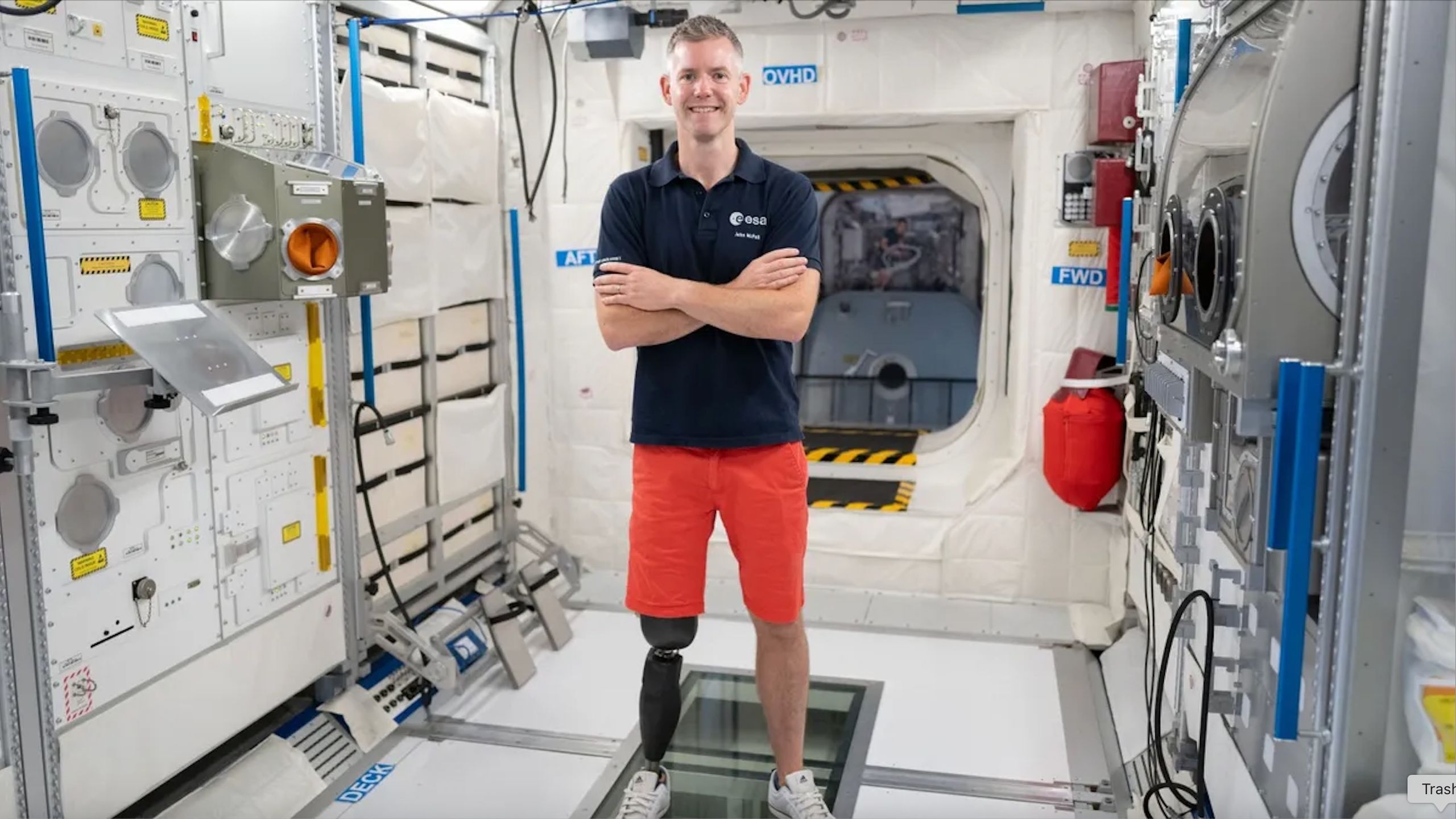
John McFall, a 45-year-old surgeon and bronze medalist from the 2008 Beijing Paralympic Games, could soon become the first person with a physical disability to live and work in orbit. The U.K. government and the private space company Vast have signed a memorandum of understanding that aims to place McFall, a reserve astronaut with the European Space Agency, aboard Vast's Haven-1 space station for a groundbreaking research mission.
McFall lost his right leg in a motorcycle accident at age 19 but went on to build a remarkable career as both an athlete and a physician with the United Kingdom's National Health Service. His journey from that life-altering injury to the threshold of space exemplifies what the agreement itself aims to celebrate: the extraordinary capacity of people with disabilities to excel at the highest levels of human endeavor.
The mission would launch aboard a SpaceX Falcon 9 rocket as soon as next year, carrying McFall to Haven-1, the first in Vast's planned line of Haven outposts in low Earth orbit. While the memorandum doesn't guarantee his flight, it commits the U.K. Space Agency to supporting Vast in securing sponsorships to fund the spaceflight. Once aboard, McFall would conduct research focused on human physiology, prosthetics, and movement in microgravity—work with profound implications for life on Earth.
The research carries dual significance. For disabled populations globally, findings from McFall's work could accelerate the development of lighter, more adaptable prosthetics and deepen understanding of conditions like osteoporosis and muscle wastage. For the broader space industry, the mission represents a deliberate step toward expanding access to the cosmos and strengthening Europe's role in enabling private ventures in low Earth orbit.
McFall himself framed the opportunity in words that reach far beyond the technical dimensions of the research. "If we can make this mission happen, it won't just be a milestone for human spaceflight, it will send a powerful message about what people with disabilities are capable of, and that there should be no limit to what you can achieve—on Earth or in space," he said in announcing the agreement. That message resonates precisely because it comes from someone whose life already embodies the principle: a surgeon, an Olympic athlete, and soon—potentially—a space researcher.
The U.K. Space Minister Liz Lloyd underscored the government's commitment to this vision. "The UK is committed to being at the forefront of inclusive human spaceflight," she said, noting that the agreement builds on the groundbreaking work McFall has already accomplished across sports, medicine, and science. The memorandum reflects a growing recognition that expanding who gets access to space isn't merely a matter of equity—it's scientifically fertile ground. The data McFall gathers in microgravity, observed through the lens of disability and adaptation, could unlock insights that benefit millions.
The timing arrives as commercial spaceflight itself is maturing. Vast, which has already signed a two-mission deal with France to fly one astronaut to the International Space Station and another to Haven-1, is one of several companies pushing toward a future where Earth orbit becomes genuinely accessible. McFall's potential flight would transform abstract promises about inclusion into lived reality, conducted at an altitude of roughly 250 miles above Earth.