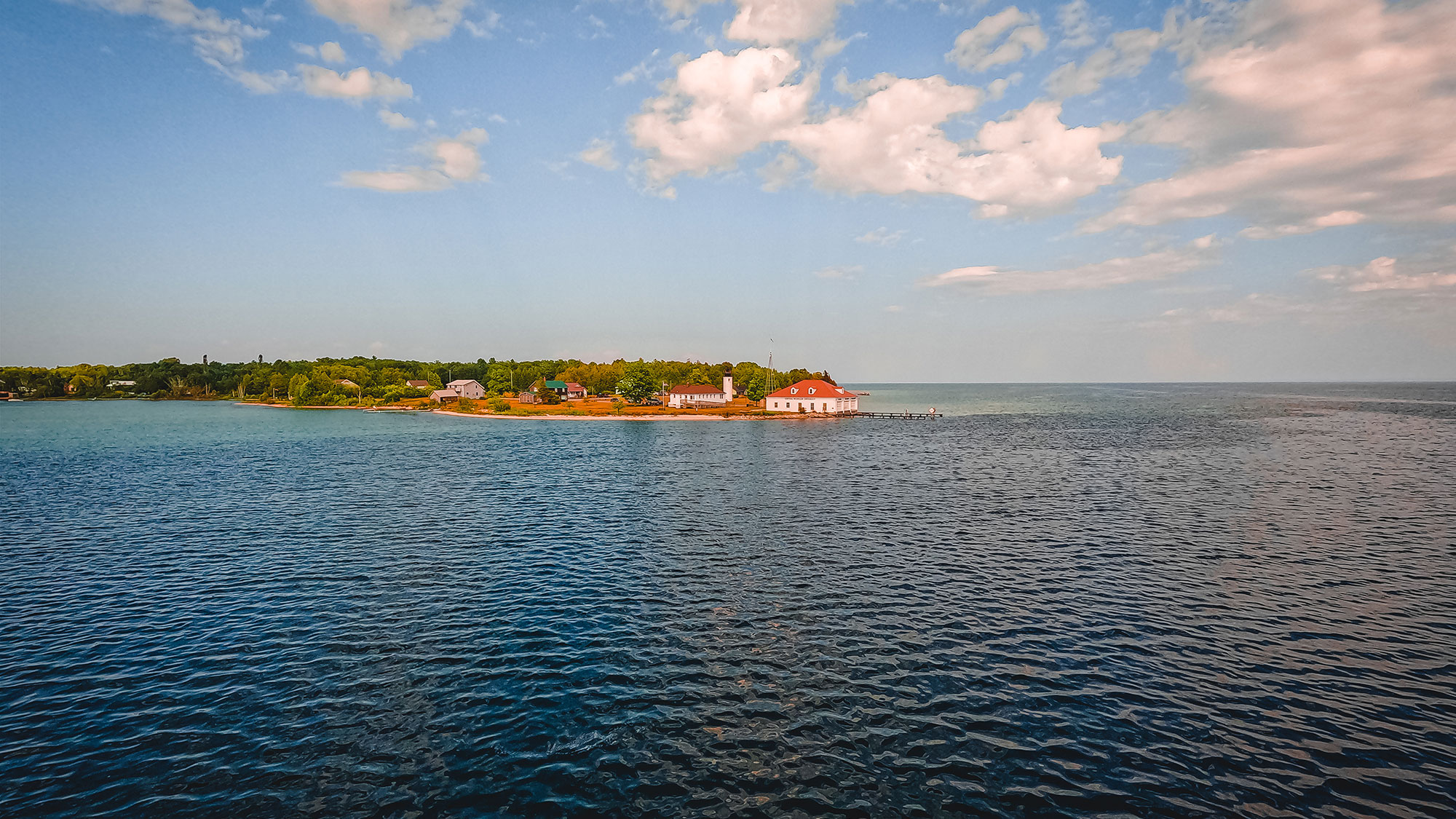
Lei Zuo’s prototype, no larger than a yoga ball, bobbed gently in the chop of Lake Michigan, its PVC frame creaking as waves rocked it back and forth—yet inside, a small light blinked steadily on. On the shores of Beaver Island, a 55-square-mile speck of forest and stone 30 miles from the Michigan mainland, this modest device represents a bold hope: energy independence. For 600 year-round residents and thousands of summer visitors, power has long been a fragile lifeline, delivered via undersea cables that fail during ice storms and gales. When a brutal storm knocked out electricity for weeks last year, the island’s vulnerability became impossible to ignore.
That’s why Zuo, a mechanical engineering professor at the University of Michigan, and his team have spent two years collaborating with locals to design a solution rooted in Beaver Island’s most constant force—its waves. The two prototype devices recently deployed can generate enough electricity to power a light bulb and charge a phone, small feats in isolation but symbolic of a larger shift. Unlike solar or wind, wave energy is consistent, predictable, and surrounds the island on all sides. "We need to work with the community together to identify the need and design together with them," Zuo said, underscoring a philosophy that’s central to the project’s credibility.
Residents like Seamus Norgaard, who spends summers on the island, see wave energy as part of a broader vision: reducing costs, cutting dependence on the mainland, and protecting the environment. Some already use solar or geothermal systems, and past federal grants have helped expand renewable access. But with federal support for clean energy in flux under the Trump administration, long-term funding remains uncertain. Still, marine energy has flown under the political radar—hydropower, including hydrokinetic technologies like wave converters, was included in plans for regulatory fast-tracking, and Congress has allocated $220 million to the Department of Energy’s Hydropower and Hydrokinetic Office to advance research.
The Beaver Island project is part of a quiet but growing national movement. Similar wave energy tests are underway at PacWave in Oregon, CalWave’s deployments off California, and a decade-old test site in Hawai‘i. The University of Michigan team is also developing a parallel project in North Carolina’s Outer Banks. While wave power likely won’t replace entire grids, experts like Dan Hellin, PacWave’s director, argue that regional solutions are key: "finding something that works within the region is critical." For remote communities from Galena, Alaska, to Adjuntas, Puerto Rico, the future of resilience lies not in one silver bullet, but in a mix of locally adapted renewables.
As the prototypes continue their rhythmic dance in Lake Michigan, they carry more than energy—they carry possibility. Beaver Island may be small, but its waves could help chart a course for others seeking power that’s as steady as the water itself.