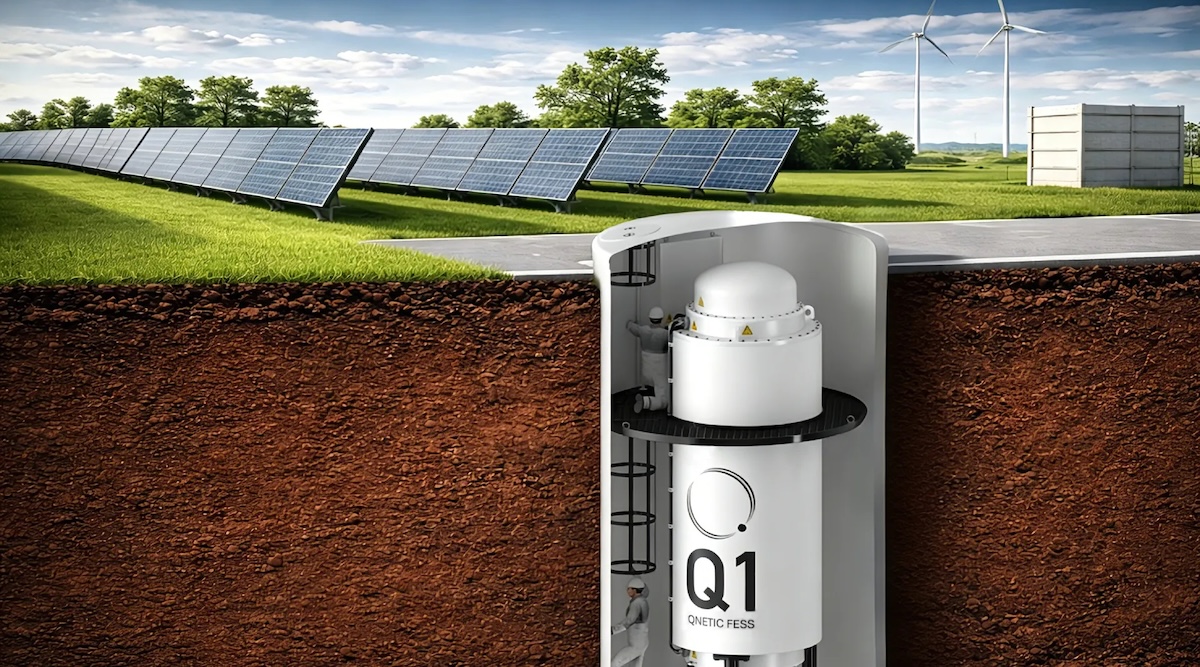
Deep beneath Shanghai, engineers are building a testing facility that could help solve one of the biggest puzzles in clean energy: how to store power from the wind and sun until it's needed, even hours or days later. The facility belongs to a startup called Qnetic, and it is being called the world's largest dedicated flywheel test cell — a million-dollar-plus investment in the race to make renewable energy reliable around the clock.
Flywheels are not new. People used simple versions of them more than 8,000 years ago to help shape clay on potter's wheels. But Qnetic has given this ancient technology a futuristic makeover. Their system, called Pulsar, uses a 15-foot-tall rotor made of lightweight carbon fiber. The rotor spins at extremely high speeds inside a vacuum-sealed chamber, storing energy not in chemicals but in motion — the same principle that keeps a spinning top upright for a while.
"Unlike batteries, which store energy chemically, flywheels store energy kinetically by spinning a rotor at extremely high speed inside a vacuum enclosure," Qnetic explains. Because there is no chemical reaction involved, the system can last for decades without degrading, and it can release stored energy almost instantly when the grid needs it.
Qnetic's Pulsar aims to store energy for up to 12 hours — longer than most battery systems on the market today. That is a big deal because solar panels only generate electricity during the day, and wind turbines work best when the wind is blowing. Utilities need a way to hold that clean energy until evening peak hours or calm mornings. Currently, about 95 percent of long-duration energy storage in the United States comes from pumped hydropower, which requires specific geography, lots of water, and steep hills. Flywheels like Pulsar could work almost anywhere.
The company is building a 200-kilowatt-hour prototype in Shanghai right now, with plans to eventually manufacture the full system in the United States. The technology has already caught the attention of EPRI, a respected independent research organization based in California that validates energy technologies for utilities worldwide. Qnetic estimates that a single Pulsar project could generate twice the revenue of an equivalent lithium-ion system, every single day, while also reducing fire risks and eliminating dependence on scarce materials.
If the Shanghai tests go well, this centuries-old idea could help wind and solar power finally deliver on their promise — storing sunshine and breeze for the moments when nature is not cooperating, and helping the clean energy future arrive a little faster.