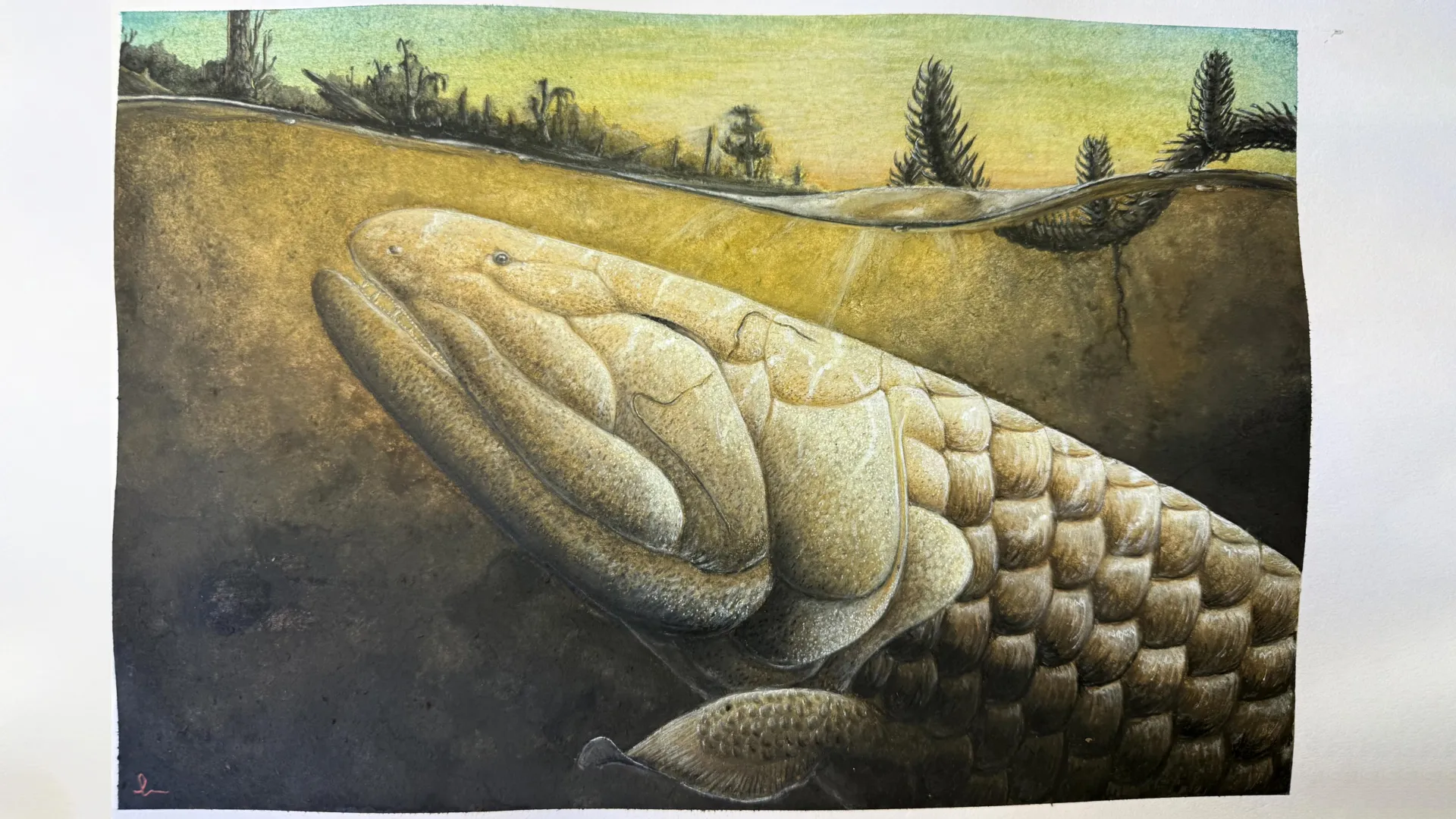
In the Lashly Mountains of Antarctica, a single fossil is rewriting the story of how animals first learned to walk on Earth. Using advanced neutron imaging technology, researchers at Flinders University have peered inside the 380-million-year-old skull of Koharalepis jarviki—a one-meter-long predatory fish so rare that this specimen is the only known example of its kind. What they found inside that ancient braincase offers fresh insight into how vertebrates made the most transformative leap in evolutionary history: leaving water behind to conquer land.
The Devonian Period, roughly 380 million years ago, was the Age of Fishes—a time when oceans and freshwater systems teemed with predatory lobe-finned fish. But among those aquatic hunters were species walking a strange evolutionary boundary, developing traits that would eventually enable their descendants to survive on land. Koharalepis belonged to the Canowindrid family, a group once widespread across East Gondwana, with fossils now found in both Antarctica and Australia. Scientists recognize these fish as close relatives of the earliest four-limbed vertebrates—the tetrapods—making them keys to understanding a pivotal moment in vertebrate evolution.
What makes this Antarctic fossil precious is something only modern technology could unlock. As lead researcher Corinne Mensforth, a PhD candidate from the Flinders Palaeontology Lab, explains, Koharalepis is the only member of its entire family whose fossil preserves the internal bones of the skull. Using non-destructive neutron and synchrotron scanning methods, researchers were able to examine the braincase and neuroanatomy hidden within the rock for hundreds of millions of years without damaging the specimen. The scans revealed something striking: Koharalepis's brain shared surprising similarities with species that straddled the water-to-land transition—ancestors of the animals that would eventually leave the oceans behind.
The adaptations told a story of life in transition. The fish possessed openings in the top of its skull for additional air intake, a feature that would have been advantageous in shallow water where oxygen near the surface was crucial. It also carried within its brain an organ that detects light and maintains circadian rhythms—the internal clock that helps animals navigate the shift between aquatic and terrestrial environments. These weren't just minor tweaks; they were practical innovations for survival in the boundary zones where water meets air.
Beyond its anatomy, Koharalepis itself offers clues to behavior. Growing to around one meter, this ancient predator likely hunted in freshwater systems, using an ambush strategy to capture smaller prey. Despite having relatively small eyes, it thrived—evidence that it relied heavily on senses beyond vision to navigate and hunt in its murky freshwater world. This combination of physical features and behavioral adaptability hints at the flexible body plans and sensory systems that would eventually make the water-to-land transition possible.
John Long, an Emeritus Professor at Flinders University who first described Koharalepis back in 1992, emphasizes the power of modern imaging. "This has enabled us to understand some of the behavior, adaptations and relationships of Koharalepis to its environment and to the other tetrapod-like fishes—and how fish first left the water to live on land approximately 385 million years ago," he says. Each fossil, examined with the precision that technology now allows, adds another piece to a narrative written in bone and stone: how the descendants of Koharalepis and its cousins eventually traded fins for limbs and water for land, launching the evolutionary journey that would ultimately lead to every four-legged animal alive today.