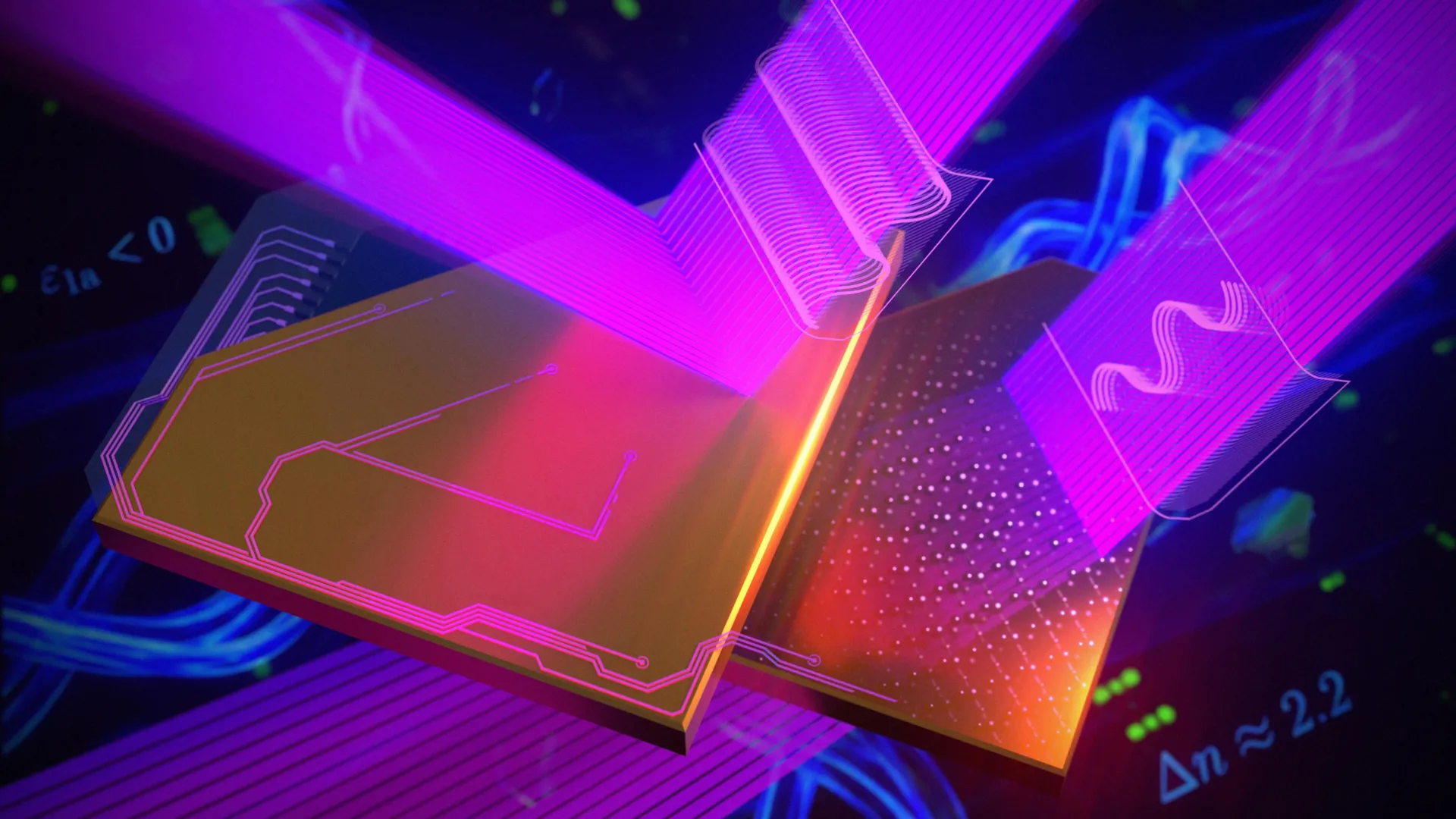
Deep in a laboratory in Singapore, scientists have discovered a crystal that refuses to choose: molybdenum oxychloride (MoOCl2) bends light like metal when approached from one direction, then becomes transparent like glass when rotated 90 degrees. This optical chameleon could transform how we build the invisible technologies we'll wear in the future—from smart contact lenses to augmented reality glasses so thin they vanish against the skin.
The race to miniaturize optical devices has long frustrated researchers. Conventional lenses and hardware are bulky, making truly wearable AR technology impractical. But if scientists could find materials that manipulate light at the atomic scale, they could shrink these components down dramatically. That's where MoOCl2 comes in. A team from XPANCEO, working with scientists at the National University of Singapore and the University of Chemistry and Technology in Prague, has now mapped the crystal's optical properties with unprecedented precision, and the results are remarkable.
The researchers discovered that MoOCl2 exhibits the strongest light-bending effect ever measured in a natural material. Its in-plane birefringence value reaches approximately 2.2—meaning it can split and bend light with exceptional efficiency. This extreme optical anisotropy stems from the crystal's unusual electronic structure: it contains one-dimensional chains of molybdenum atoms that allow electrons to move more easily in one direction than another, creating a material that behaves like both a conductor and an insulator depending on which way you look at it.
But there's more. The researchers identified a rare epsilon-near-zero point at 512 nanometers—right in the visible green light spectrum. At this precise wavelength, part of the material's optical response drops almost to zero, causing light to effectively slow down while the electric field inside the crystal intensifies dramatically. This phenomenon is significant because most materials only reach epsilon-near-zero behavior in the ultraviolet or infrared ranges, which limits practical applications. By achieving it in visible light, where lasers, microscopes, cameras, and sensors already operate, MoOCl2 opens new doors for existing technology.
"Observing a phenomenon is the first step, but engineering requires precise numbers," said Dr. Valentyn Volkov, founder and chief technology officer of XPANCEO. "By rigorously measuring the complete dielectric tensor of MoOCl2, our work provides the experimental foundation needed to understand why this material behaves the way it does and to design around it with greater confidence." The study, published in Nano Letters, provides exactly those missing measurements that have long eluded the field. Previous research had glimpsed the crystal's optical tricks—watching light waves travel through it in unexpected ways—but without precise quantification, engineers couldn't confidently design devices around it.
The potential applications extend across compact polarization optics, nonlinear devices, and eventually, miniaturized integrated systems. For AR displays, XPANCEO suggests, this could enable sophisticated light control using materials thousands of times thinner than a human hair. For photonic chips powering data centers, stronger light-matter interactions might mean faster processing with dramatically lower power consumption. In the longer term, this humble crystal could be the missing piece that finally makes smart contact lenses practical—and invisible.