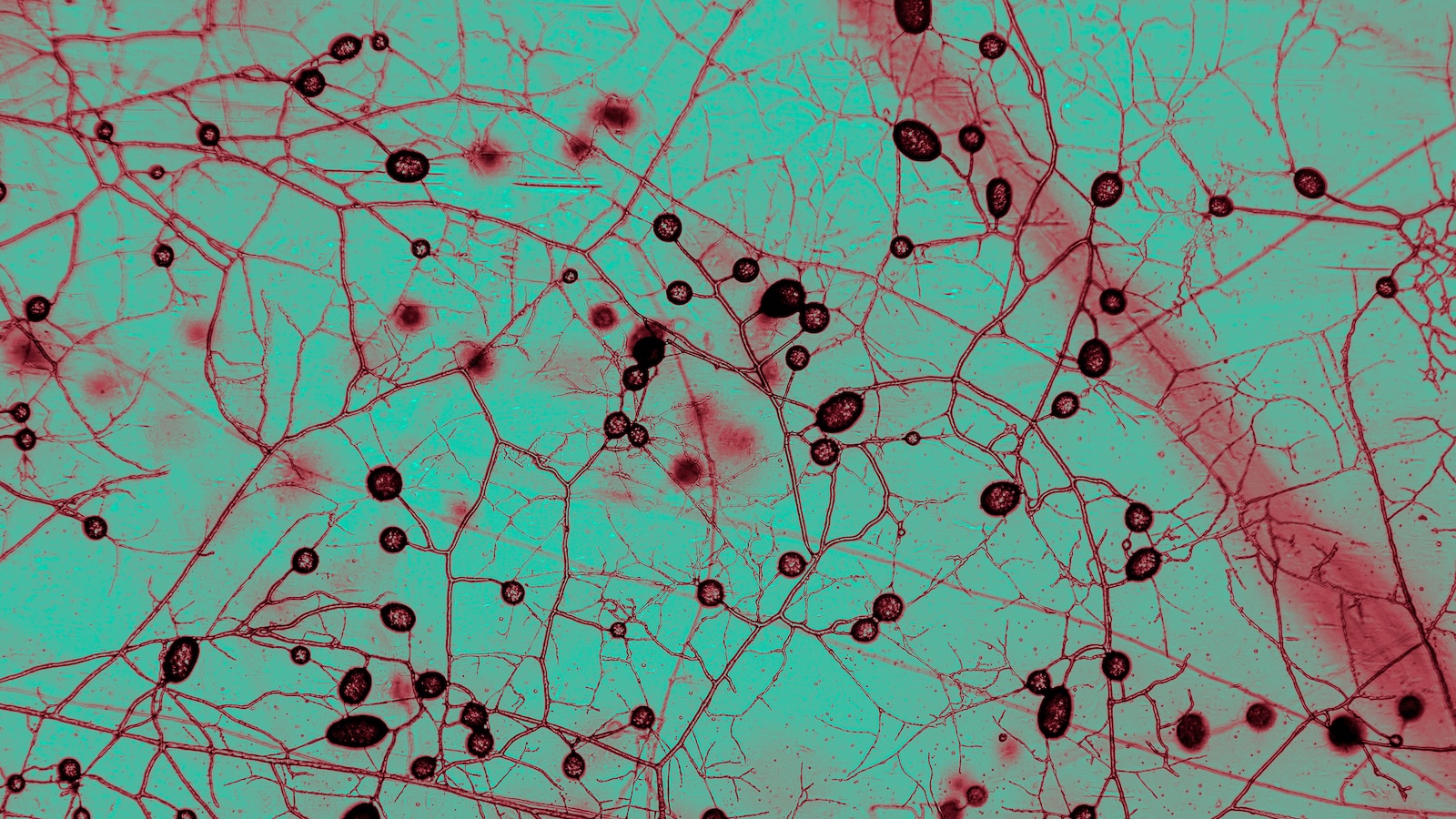
Beneath every footstep you take, an invisible empire stretches through the soil—a network of fungal threads so vast that if you gathered all 110 quadrillion kilometers of them, it would extend nearly a billion times the distance from Earth to the sun. These underground filaments, called hyphae, belong to arbuscular mycorrhizal fungi, organisms so crucial to life on land that they partner with 75 percent of all plant species on the planet. Yet because they live underground, hidden from view, scientists have struggled for decades to measure their true extent and understand their global significance.
Now, using machine learning trained on thousands of soil samples collected worldwide, researchers have mapped these networks with unprecedented clarity—and the results are humbling. Every single year, these fungi move 4 billion metric tons of carbon through the soil, an amount equal to 11 percent of humanity's total CO2 emissions. This means that the fungi working silently beneath our feet are already doing some of the planet's most important climate work, sequestering carbon that would otherwise heat the atmosphere.
The relationship between fungi and plants is one of biology's great partnerships. The fungi extend their hair-like threads into plant roots, becoming an extension of the roots themselves and helping plants absorb far more water and nutrients than they could alone. In exchange, the plants feed the fungi with carbon they've drawn from the atmosphere through photosynthesis. "Just as a circulatory system moves resources through a body, these sort of microscopic fungal pipes are connected to plants," said Toby Kiers, executive director of the Society for the Protection of Underground Networks and coauthor of the study published in the journal Science. This mutual aid network underpins the greenness and fertility of Earth itself.
The distribution of these fungi tells an unexpected story. While tropical rainforests might seem like the obvious stronghold for fungal diversity, grasslands actually account for 40 percent of the planet's arbuscular mycorrhizal biomass. This makes sense: grasses allocate more of their carbon to their fungal partners than trees do, and even when grasslands burn on the surface, the carbon stored underground and in vast root systems remains protected, allowing ecosystems to recover more readily than forests can.
Yet the maps reveal a troubling reality. Only 5 percent of the world's arbuscular mycorrhizal fungal biodiversity hotspots currently lie within protected areas—meaning humanity has largely failed to deliberately safeguard these critical organisms. Meanwhile, industrial agriculture has devastated fungal networks where it has spread. In large-scale farming systems, fungal network densities average 50 percent lower than in natural ecosystems, likely because synthetic fertilizers reduce plants' dependence on fungal partners and because tilling tears networks apart each season.
The implications are clear: protecting these hidden networks offers a pathway to support plant life, sequester more carbon, and rebuild soil health all at once. With detailed maps now in hand, scientists and policymakers have a tool to identify where fungi thrive and where protection matters most. "This map is for mycorrhizal fungi what the first detailed maps were for ocean currents or river systems," Kiers said, signaling that understanding these underground systems may prove as transformative to ecology as charting the planet's visible waters once was to oceanography.