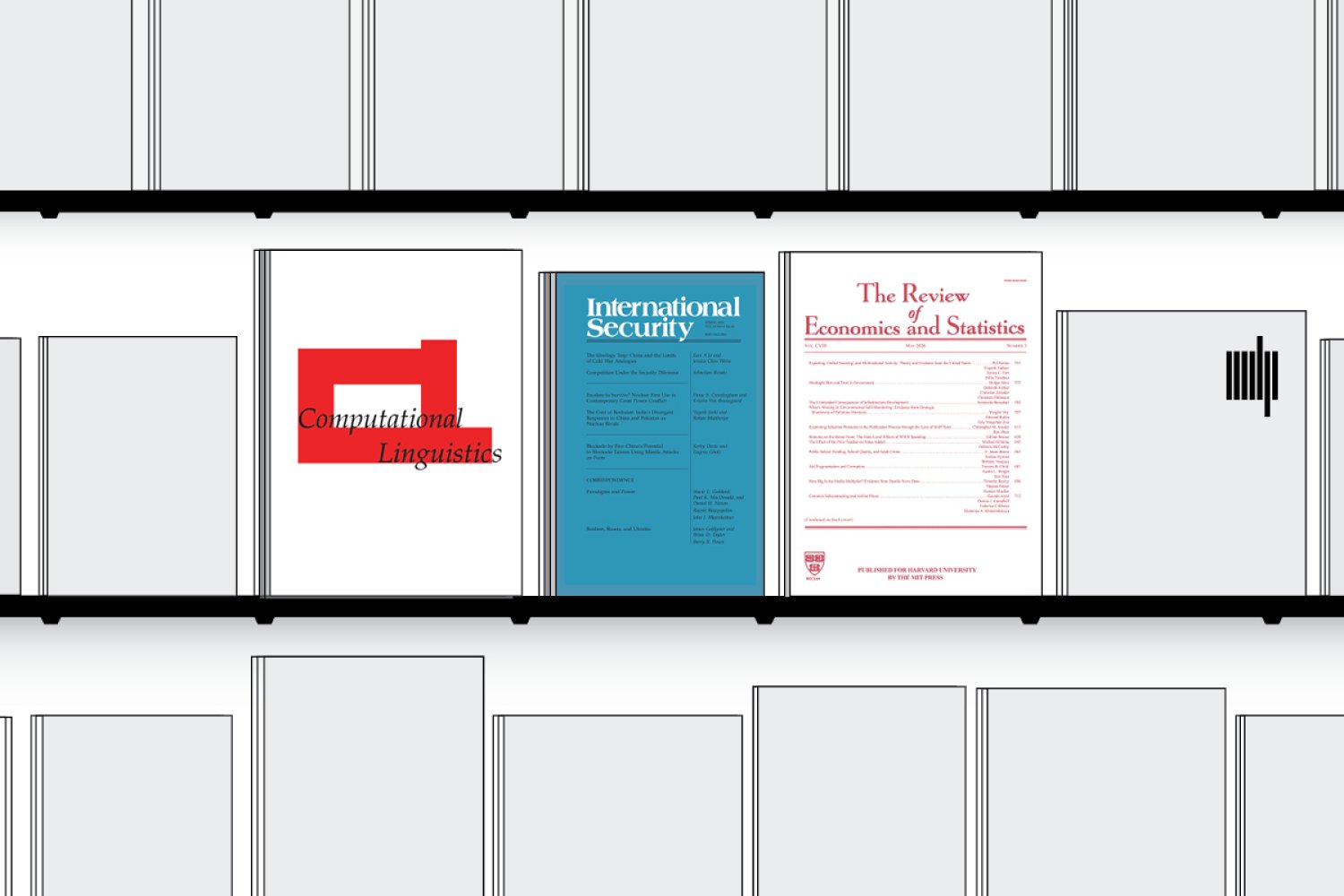
A tiny team at MIT Press in Cambridge just pulled off something remarkable: three of their journals now rank number one in their fields, according to Clarivate's 2026 journal impact factor report.
Computational Linguistics tops the Linguistics category. International Security leads International Relations. And The Review of Economics and Statistics is the highest-ranked in Social Sciences with Mathematical Models. That's three gold medals from a presses that employs fewer than 10 people across its entire journals division.
Impact factors measure how often other scholars cite a journal's articles. It tells us which publications shape how experts think and debate. For MIT Press, these rankings prove that a small, university-based publisher can compete head-to-head with massive commercial operations many times its size.
International Security's influence stretches well beyond academic circles. The journal's research has shown up in Foreign Policy, Foreign Affairs, The Conversation, CBC, and Brookings — mainstream outlets where regular people read about world events. One widely discussed article by MIT political scientist Caitlin Talmadge predicted how a limited military strike on Iran could spiral into chaos in the Strait of Hormuz, disrupting shipping and sparking a wider crisis. That kind of real-world impact is exactly what these journals aim for.
"I am proud and humbled that International Security has had the number one impact factor in International Relations for two years running," said Jacqueline Hazelton, the journal's editor. She credited the reviewers, authors, and editorial team — the people who handle the unglamorous work of copy editing and production day after day.
Wei Lu, editor of Computational Linguistics, echoed that pride. "In a field that moves remarkably fast, our aspiration is for it to remain a home for work that lasts — scholarship the community can keep building on for years to come," he said.
The numbers tell the story of a small team doing heavy lifting. Those under 10 staff members collaborate with editorial teams at 50 different journals to publish roughly 2,500 articles every year. Yet quality hasn't suffered. Thirteen MIT Press journals landed in the top quartile of their fields this year. Transactions of the Association for Computational Linguistics came in second among 312 linguistics journals. Global Environmental Politics placed second among 173 international relations publications. Harvard Data Science Review ranked seventh in Statistics and Probability.
Nick Lindsay, who directs journals and institutional partnerships at MIT Press, acknowledged the pressures the team has weathered over the past decade — everything from shifting business models to rapid technological change. "Through it all, the journals group has adapted and evolved and remains a home for experimentation and fair and equitable publishing," he said.
That reputation has attracted prestigious partners including Harvard University, the American Academy of Arts and Sciences, and the University of California at Berkeley. The MIT Press continues launching new journals in emerging fields while holding to the standards that earned them three top spots. For a small team in Cambridge, that's no small feat.