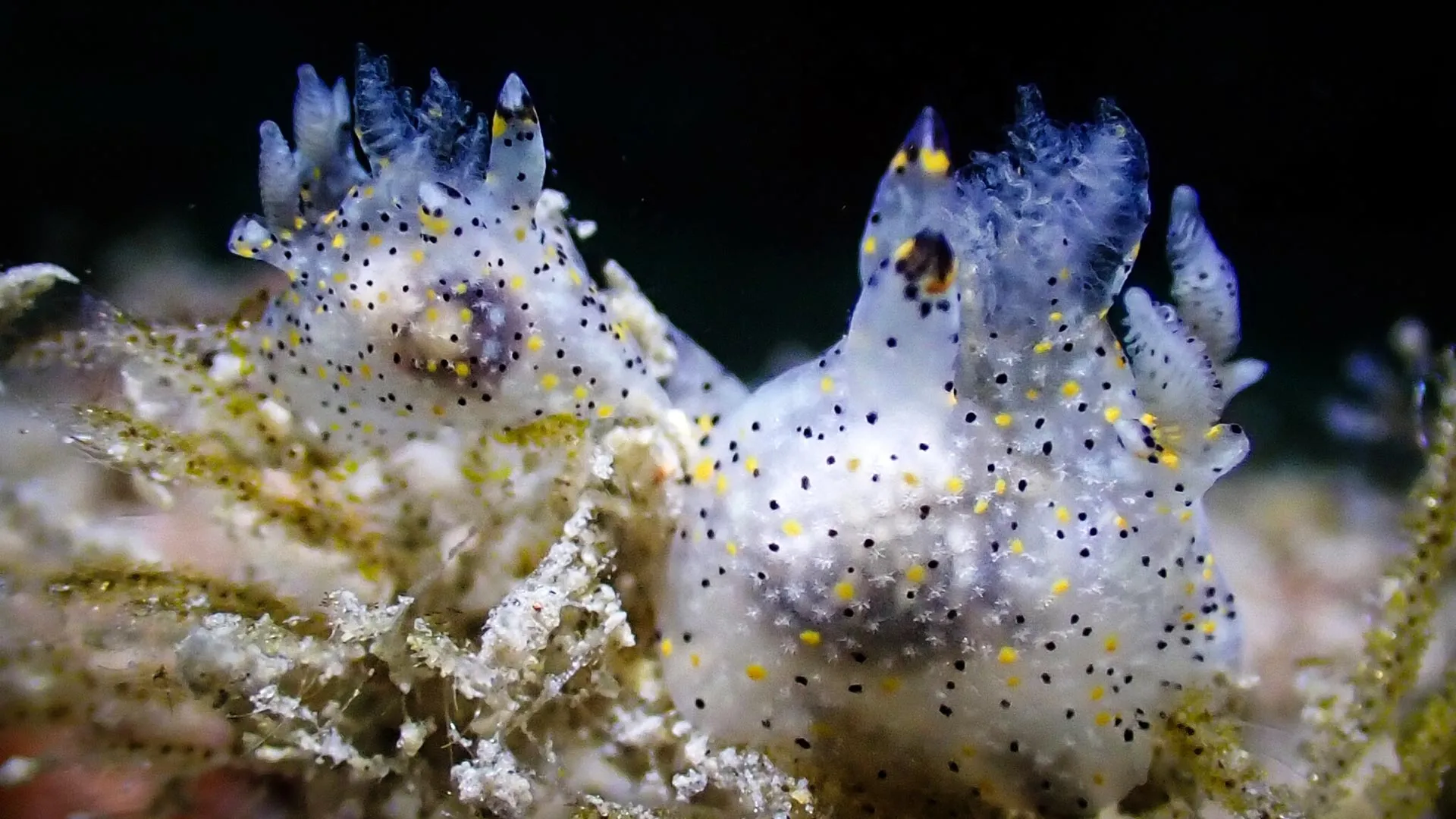
In the summer of 2019, Ho-Yeung Chan was on a recreational dive off Keelung's coast in northern Taiwan when he spotted something that would change what we know about the ocean. It was a creature so small—less than three millimeters long—that most people would miss it entirely: a translucent sea slug adorned with distinctive black and yellow markings, small enough to fit on a sesame seed.
Chan didn't know he had discovered a species unknown to science. It wasn't until months later, when he reached out to sea slug expert Hsini Lin on Facebook, that the magnitude of his find became clear. What Chan had found was Thecacera sesama, a nudibranch now officially named and described by researchers from National Taiwan Ocean University, the National Museum of Natural Science, and National Taipei University of Education. The name itself reflects the creature's appearance: Taiwanese divers had nicknamed it "sesame" in Chinese, and the comparison stuck. The slug is not just small like a sesame seed—it resembles one.
What makes this discovery remarkable is how it happened by chance, and how it reveals the hidden worlds still waiting beneath the waves. Chan's find emerged during the narrow window when such research is even possible. Taiwan's northern coastline experiences some of the planet's harshest diving conditions. Summer typhoons and winter monsoon waves, combined with water temperatures that can plummet below 16 degrees Celsius, mean researchers can conduct underwater surveys for only about four months each year. Within that compressed timeline, spotting a creature measuring less than three millimeters requires equal parts expertise and luck.
The nudibranch's world is as simple as it is specialized. Thecacera sesama lives on bryozoans—tiny aquatic invertebrates commonly called "moss animals"—where it spends its life feeding, searching for mates, mating, and laying eggs. Researchers suspect the bryozoan species hosting these sea slugs may itself be previously unknown to science, suggesting layers of discovery yet to unfold.
For all their diminutive size, nudibranchs are vital to marine ecosystems. "Nudibranchs are one of the key players in the marine food web," the research team noted. These creatures are famously colorful and striking on coral reefs, yet many remain invisible to divers and scientists alike. Their size—often just millimeters—makes them extraordinarily difficult to spot with the naked eye underwater.
The formal description of Thecacera sesama was published in the open-access journal ZooKeys on May 11, 2026, marking the moment when a chance discovery during a summer dive became scientific fact. Yet researchers emphasize that this single species represents only a glimpse into Taiwan's marine biodiversity. The ocean harbors countless tiny organisms that are routinely overlooked simply because they are small and elusive. Every chance encounter—like Chan's dive off Keelung—hints at a much vaster, largely uncharted world beneath the surface, waiting for curious eyes to find it.