In June 1984, a watch rolled off a factory floor in Hosur, Tamil Nadu that would transform how Indians saw themselves. It wasn't Swiss. It wasn't Japanese. It was theirs. For decades, the watch business belonged to the West—precision instruments and prestige symbols imported from Europe and Japan into a country still learning to call itself a consumer economy. Then JRD Tata asked a question that seemed almost naive for its time: Could India build a modern watch company that matched international standards?
The answer arrived through an unlikely partnership. Titan began as a joint venture between Tata Industries and the Tamil Nadu Industrial Development Corporation, but its soul came from two men whose temperaments differed sharply yet whose ambitions converged completely. JRD Tata carried a vision for India—the belief that the country could make products good enough to compete with the world. Xerxes Desai, Titan's first CEO, understood something manufacturers often missed: a watch wasn't just a device measuring hours and minutes. It was a companion through examinations and job interviews, weddings and promotions. It carried memory. If Titan was to succeed, it would have to sell not just precision but aspiration.
By 1986, the first prototypes emerged from conversations between Desai, Anil Gore, and Anil Manchanda—watches that looked strikingly different from what Indian consumers had grown accustomed to. They were slimmer, lighter, guided by a design philosophy influenced by global trends. While mechanical watches still dominated display counters across the country, Titan was quietly preparing to introduce quartz technology, a different understanding of what a modern wristwatch could be. In 1987, Ogilvy and Mather launched Titan's first major advertising campaign, displaying rows of watches with a sophistication rarely seen in Indian consumer marketing. Something unusual happened almost immediately: customers began arriving in stores carrying newspaper cuttings of those advertisements, asking specifically for the models they had seen. The watches had acquired an identity even before reaching many wrists.
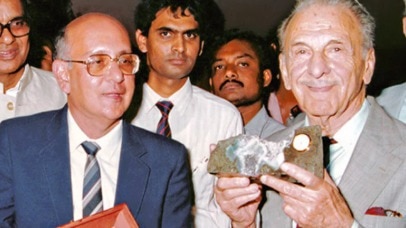
Meanwhile, in Hosur near the Tamil Nadu-Karnataka border, the physical foundation of this ambition was rising from the ground. The inauguration of Titan's manufacturing facility by JRD Tata, Xerxes Desai, and Jacques Perrett of France Ebauches represented far more than the opening of a factory. Within those walls, engineers, designers and technicians worked toward a goal that appeared ambitious for its time: producing watches in India that could stand comparison with those made in Europe and Japan.
By the early 1990s, Titan had already transformed the domestic market—but remaining an Indian success story was never the final objective. The company's leadership believed that if a watch was truly world-class, geography should not define its audience. In 1993, Titan entered the European market, a move carrying both commercial and symbolic significance. For decades, Europe had exported watches to the world. Now an Indian watchmaker was attempting the reverse journey. Expansion into the Middle East and Asia-Pacific followed, and what had begun as an experiment in Indian consumer manufacturing slowly evolved into something larger: proof that pride in Indian-made products was not mere sentiment, but sound business.