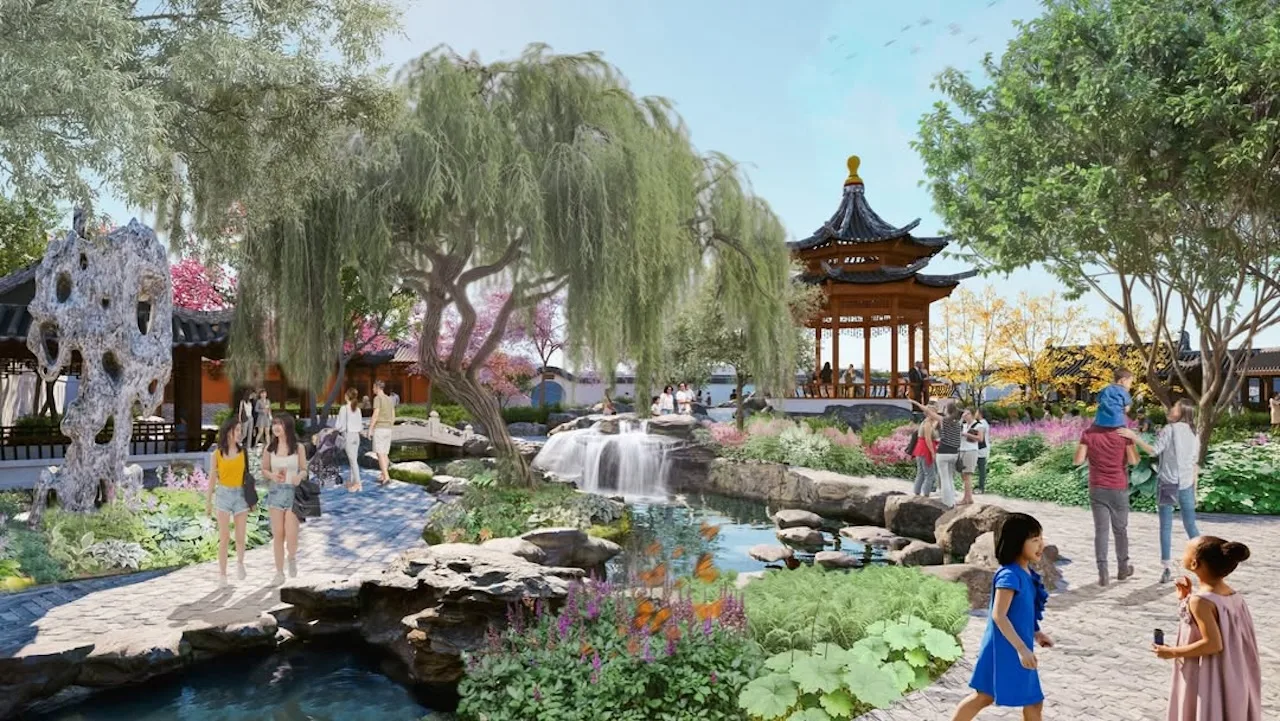
On a spring day at the Sheppard Avenue East campus of Toronto's Chinese Cultural Centre, more than 200 people gathered to break ground on a vision that has been three decades in the making—Ontario's largest Asian garden. The 1.5-acre space, which will feature traditional Chinese landscaping, water features, rock formations, and pavilions, represents far more than a horticultural project. It is a living testament to Chinese heritage in Canada's largest city, and a place where art, nature, and philosophy will converge for generations to come.
The project feels urgent precisely because it has waited so long. First proposed in 1994 as part of the Chinese Cultural Centre of Greater Toronto's broader development plans, the garden has been imagined, refined, and championed through decades of organizational dreaming. Now, with groundbreaking underway, completion is expected by the end of 2028. "The Garden will serve as a living representation of Chinese heritage, showcasing traditional Chinese landscaping, architecture and horticulture," explains founding chairman Dr. Ming-Tat Cheung, whose words capture the dual purpose: this is both a public green space and an educational sanctuary dedicated to Chinese horticultural traditions, architecture, and philosophy.
The gathering itself underscored the project's cultural weight. Attendees included Toronto Mayor Olivia Chow, as well as city councillors, provincial representatives, federal officials, and international dignitaries—a lineup that speaks to how deeply this initiative resonates across political boundaries. Senator Yuen Pau Woo was among the speakers, highlighting the garden's significance at the national level.
Funding has come from multiple sources, reflecting shared commitment. In 2021, the federal and provincial governments jointly committed $5.2 million through the Community, Culture and Recreation Infrastructure Stream of the Investing in Canada plan. To date, the Chinese Cultural Centre has raised almost $3 million more through private donations and community support, demonstrating the strength of grassroots backing for this vision. Bringing the project to full fruition will require continued fundraising, but momentum appears strong.
The garden's design philosophy is rooted in centuries-old Chinese landscaping traditions. Traditional garden elements—water features that reflect philosophy and natural harmony, rock formations that evoke mountains and permanence, pavilions that serve as spaces for contemplation and gathering—will be integrated with native plant species. Together, these elements create a space that functions as both refuge and classroom, a place where Toronto residents and visitors can experience the aesthetic and philosophical dimensions of Chinese horticultural heritage.
The Chinese Cultural Centre itself, founded in 1988 as a non-profit organization, has spent more than three decades building cultural programming, performances, language classes, and community events that anchor Toronto's multicultural identity. This garden represents its most ambitious physical manifestation to date—a permanent landmark that will outlive its founders and continue speaking to new audiences about the beauty and depth of Chinese culture.
As construction moves forward and 2028 approaches, the garden promises to become a quiet sanctuary in the heart of the city. It will be a place where children learn about horticulture, where residents find solace among water and stone, and where Toronto's Chinese heritage becomes tangible, rooted, and growing.