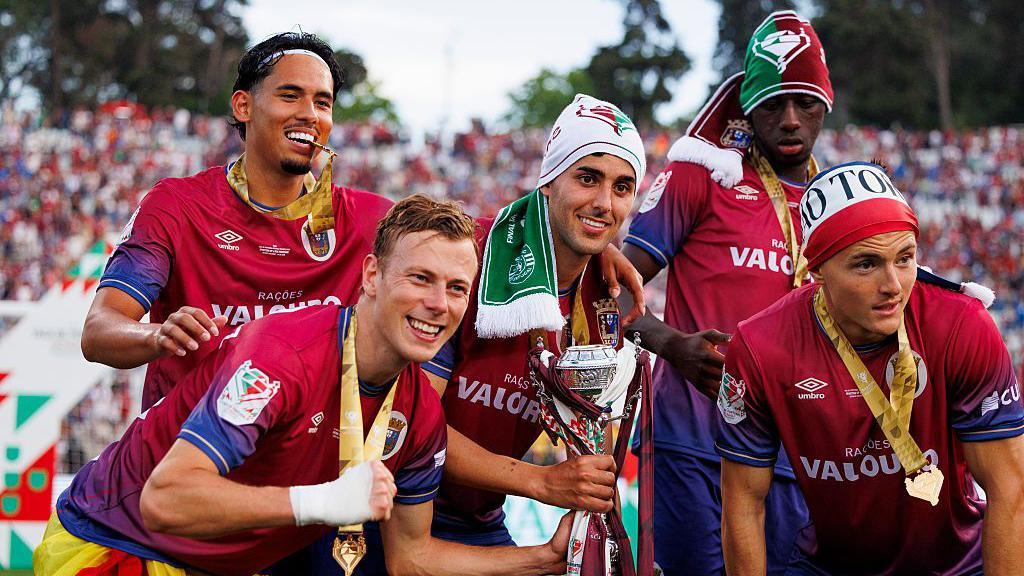
From a stadium that holds barely 2,500 spectators in Torres Vedras, 25 miles north of Lisbon, Torreense has just claimed something that seemed impossible: a ticket to European football while playing in Portugal's second division.
The club's path to this unlikely dream began on Sunday when they pulled off a stunning 2-1 victory against Sporting CP in the Portuguese Cup final—their first major trophy in 109 years of existence. That triumph should have been the prelude to promotion. Torreense had finished third in the second division and earned the chance to fight for top-flight status through the promotion play-offs. But on Thursday, they lost 2-0 away to Casa Pia, the side that had finished 16th in the top flight, ending their hopes of league promotion in the process.
Yet what appeared to be a heartbreaking double blow became something extraordinary: the Portuguese Cup victory alone secured them a place in the league phase of the 2026-27 Europa League. Torreense will become one of a rare breed—a second division club competing in major European competition. The catch is practical: their home ground doesn't meet UEFA's stadium requirements, so they'll play their European matches 193 miles away at the Estadio Algarve in Faro, a facility with far greater capacity than their intimate home stadium.
They won't be alone in this peculiar predicament. Vestri, an Icelandic club based in a village of fewer than 3,000 people, won their nation's cup final this year and will also enter the Europa League as a second-tier side. FC Vaduz of Liechtenstein has become almost a specialist in this arrangement, having spent much of the 21st century in the Swiss second division while regularly qualifying for Europa League qualifying rounds through 21 cup victories in 22 years—though they've finally achieved promotion to the top flight after this season.
The annals of football history offer plenty of precedent, though usually with less happy outcomes. Millwall reached the 1904 FA Cup final while in the second division but were dispatched early from the UEFA Cup. When Wigan Athletic won the FA Cup in 2013, they celebrated their first European adventure—only to be relegated from the Premier League days later, finishing bottom of their Europa League group. Birmingham City followed a similar trajectory in 2011, reaching the playoff round after winning the League Cup before their own relegation followed months later.
These cautionary tales make Torreense's achievement all the more remarkable. They've dodged the trap that has caught other ambitious second-tier sides: they won't arrive in Europe diminished by league struggles or sudden promotion pressure. Instead, they'll bring the momentum of a historic cup triumph and the scrappy determination of a club that has weathered a century of relative obscurity to find itself competing alongside Bournemouth, Sunderland, Crystal Palace, Juventus, AC Milan and Bayer Leverkusen in the Europa League proper. For a town of modest means and a stadium of intimate proportions, that's a victory worth savoring—regardless of where they play their matches.