Three seconds after charging a metal sample with deuterium, researchers rinsed away the electrolyte and plunged the tiny test tips into liquid nitrogen. That fast freeze helped preserve the hydrogen isotope inside the metal long enough for atom probe imaging to reveal where it had gone.
Finding hydrogen inside a metal is not just a matter of spotting a signal. Hydrogen can sit between metal atoms as a dissolved, or interstitial, solute; form a solid hydride with certain elements; or gather at defects such as vacancies and grain boundaries. Each state can affect how a metal behaves. Hydrogen can make strong alloys brittle, while the way it moves through a metal helps determine whether that metal can store hydrogen and release it again. In nuclear materials, hydrogen-related changes can also threaten reactor parts.
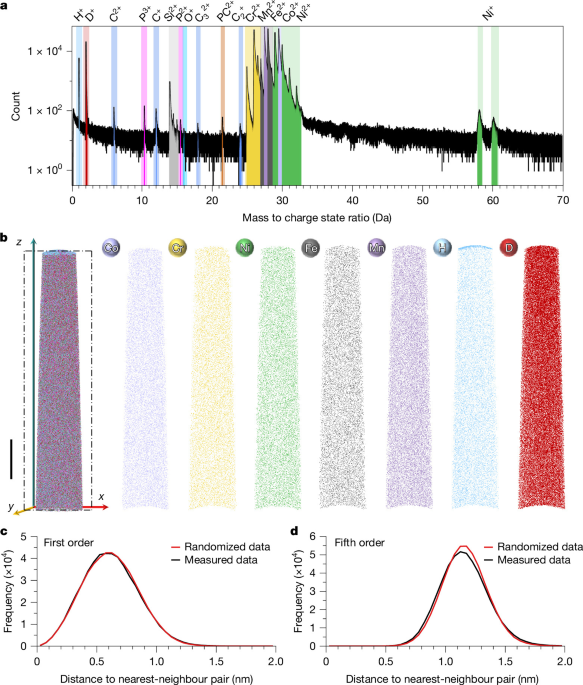
A team studying face-centred cubic, or FCC, metal alloys reports experimental evidence of hydrogen in solid solution between the atoms of the metal lattice. The researchers used atom probe tomography, a method that identifies atoms by measuring their mass and maps them at very small scales. They used deuterium, a heavier form of hydrogen, because the instrument itself contains background hydrogen that can confuse measurements. Voltage pulses, rather than laser pulses, helped distinguish the deuterium signal from that background.
The first alloy described in the study was an equiatomic mix of cobalt, chromium, nickel, iron and manganese, known as CoCrNiFeMn. “Equiatomic” means that the five elements are present in equal amounts. The alloy, first developed by Cantor and colleagues, has a locally distorted crystal structure. That distortion can slow hydrogen movement, making it less likely to escape before the sample is measured.
After electrolytic deuterium charging, the team removed the liquid in about three seconds, cooled the tips in liquid nitrogen, and transferred them into the atom probe using a cryogenic procedure. The mass spectrum showed a clear deuterium peak at a mass-to-charge ratio of 2 Daltons, separate from the instrument’s ambient hydrogen signal. The study used FCC alloys because they can hold more hydrogen and allow it to move more slowly than body-centred cubic metals, improving the chance of detecting it.
That distinction matters because earlier atom-probe studies have more often examined hydrogen in hydrides or at visible defects. Hydrogen dissolved between atoms is harder to measure: it may be present at low levels, and it moves quickly enough to escape from a sample. Sample preparation can also create tiny defects that trap hydrogen, making it difficult to tell whether a measured signal reflects the metal’s original state or an artifact of testing.
The results offer a way to study hydrogen in metals while paying close attention to those risks. Better maps of where hydrogen resides could help scientists understand both hydrogen storage and the damage that can weaken metal components. The researchers’ approach does not remove every source of uncertainty, but it gives future studies a clearer starting point: preserve the mobile atoms, separate their signal from background noise, and check carefully for defects made during preparation.