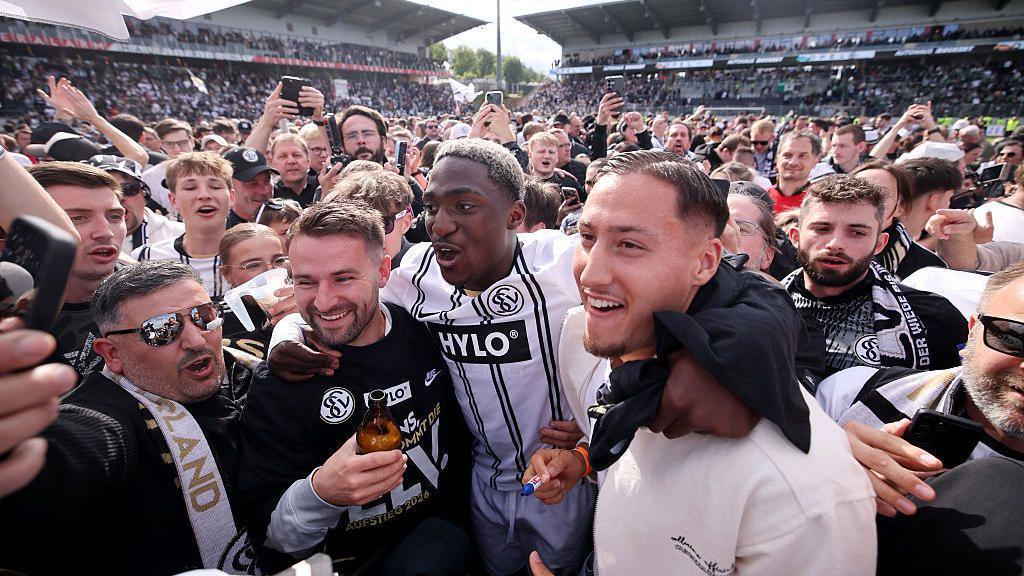
When Bambase Conte scored within the first fifteen minutes of Elversberg's promotion match against Preussen Munster, few in the 10,000-seat Waldstadion an der Kaiserlinde could have imagined what they were witnessing: the beginning of a transformation that would send a town of 13,000 people into Germany's most prestigious football division. David Mokwa added two more goals—one to help secure control and another midway through the second half—to seal a 3-0 victory that delivered not just promotion, but a piece of sporting history.
Spiesen-Elversberg will become one of the smallest towns ever to be represented in the Bundesliga, a remarkable achievement for a club that was playing in the regionalised fourth tier just three seasons earlier. The scale of this rise cannot be overstated. In 2021-22, Elversberg was competing at the fourth-tier level; until last season, they had never even played in Germany's second division. Now, they will take their place among Germany's elite clubs—a journey that speaks to the power of ambition and sustained success in even the most unlikely places.
The club's supporters understood the magnitude of the moment. When the final whistle sounded, they streamed onto the pitch in celebration, their joy uncontainable. This was Elversberg's third promotion in five years, a feat of consistent excellence that had quietly captured attention in German football circles. But last season had brought heartbreak: the club fell just short in the promotion-relegation play-off, losing 4-3 on aggregate to Heidenheim. The setback only seemed to sharpen their focus.
Even Deutsche Bahn, the rail operator serving the region, had appeared skeptical about Elversberg's promotion prospects before that play-off. The company posted an image of a train with only one carriage, a darkly humorous suggestion that a small-town club wouldn't need much capacity to transport supporters to big matches. This year, the message has changed entirely. Elversberg's second-place finish speaks for itself.
The club itself carries deep roots. Founded in 1907, Elversberg is embedded in the fabric of Saarland, the small state in south-west Germany that has punched far above its weight in recent football seasons. Now the town faces a new challenge: their stadium is undergoing renovation to meet Bundesliga requirements, with capacity expected to expand to 15,000 by spring 2027. Infrastructure must match ambition.
Elversberg will not be alone in their Bundesliga debut. Schalke, a storied name in German football, earned promotion by winning the 2. Bundesliga title after three years away from the top flight. Together, these clubs represent different paths to redemption: one a giant returning home, the other a giant-slayer arriving for the first time. Meanwhile, Wolfsburg and Paderborn will contest the promotion-relegation play-off, battling for the final spot in a division that is about to grow more diverse, more interesting, and more reflective of the true scope of German football talent.
For Spiesen-Elversberg, next season represents not an ending, but a beginning—a chance to prove that a town of 13,000 belongs on Europe's biggest stages.